
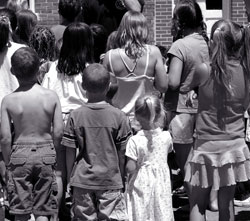

 How many kids have to die before we do something about kids and gun safety? Whether in
The most recent figures available, from the Centers for Disease Control and dated 2004, show that 55 percent of all murders of those under age 18 in the
According to the Children’s Defense Fund, in 2003, 2,827 children and teens died as a result of gun violence — more than the number of American fighting men and women killed in hostile action in
Want a bigger number? From 1979 to 2001, a total of 90,000 children and teens died from gunfire in this country. Ninety-thousand.
Seven years ago I was the
Several hundred of us marched in Louisville that day to ask for some fairly simple things: cooling off periods for gun purchases, background checks, safety locks for all handguns, the licensing and registering of all handguns, limiting purchases to one handgun per month, and the no-nonsense enforcement of existing gun laws. At that time, President Clinton was on board and he spoke out for new laws to protect our children. Funds poured in to the campaign and we were pushing our legislators to make changes.
Then George W. Bush was elected president for his first term and nearly everything we had worked toward came to a screeching halt. We called them “Common Sense Gun Control Laws” then, but few of them made it into law — common or otherwise. I came to the conclusion by the /files/storyimages/of 2001 that my time and efforts were of little consequence. I turned my information over to another local woman, who has since dropped out of the Million Mom March too. There is no longer a
I wasn’t a zealot, but a lot of the women I was involved with were totally committed to the cause. They put jobs, families and other things on hold to work for the organization. Did I do enough? Did I make a difference? I ask myself that sometimes.  Emergency personnel t/files/storyimages/to one of the Edwardsville, Ind., shooting victims on June 18
I still hope that 20 years from now we will have sensible gun-control laws because the shootings keep coming: Feb. 29, 2000, Mount Township,
Then there was Virginia Tech on April 16, 2007: 32 students and teachers dead, the worst school shooting in this country’s history. The shooter at Virginia Tech was considered a young adult, so maybe he and the other slain students belong in another accounting. But if you ask their families I think that they would strongly disagree with that point of view.
And closer to home, in mid-June, a 15-year-old Edwardsville, Ind., boy shot and killed a police officer and critically wounded his partner when they arrived at his home after the boy’s mother called them to help settle her dispute with her child.
Why is this happening? Here’s the simple answer: It’s much too easy for our kids to get their hands on guns. It seems to me that we accept and tolerate this dangerous situation. Why did that 15-year-old Edwardsville boy have access to a high-powered rifle? What in the hell was he doing with an M1 World War II military weapon in his hands, all alone in his house, while his mother, who called police, stood outside with the officers? That’s the hard question that no longer gets asked.
We focus on the grief, as we should. The impact is enormous. The child’s and the officers’ families are shattered. Media reports have also focused on releasing information to police about juvenile criminal records. But what about the root of the problem? Easy access to guns is the biggest contributor to the death of that officer and that boy.
Gun violence involving kids is an epidemic — as is gun violence involving adults — and it doesn’t matter who you are or where you live; it will affect you. Here’s another alarming statistic: In 2006, 25 percent of the shooting victims at downtown
Here are more facts about kids and guns: In the United States today, nearly eight young people aged 19 and under are killed and 45 are non-fatally wounded every day. In 2004, 1,804 children were murdered in gun homicides, 846 committed suicide with guns, and 143 died in unintentional shootings. A total of 2,793 young people were killed in the
As the mother of a 12-year-old, I worry about gun violence every day. I still keep up with the issue — who is saying what and which legislators are pushing for sensible guns laws. I give money to candidates who support these laws. I write letters to my legislators. I wish I could do more.
It frustrates me when I consider how much power and money the gun lobby has over our lives and how it has turned the issue in its favor. Thinking back, maybe we should have used the words “gun responsibility” instead of “gun control.” I think that would resonant with more people because it doesn’t have the point-blank finality of “control.” Control denotes power, and power and money are of great importance to so many people in the gun debate. The “gun control” phrase also opened the door to a fear by gun owners, unfounded I think, that any restrictions would be a first step toward taking away their rights to own any firearms.
The Brady Campaign is working nonstop to get the message out that there are solutions to gun violence. Sarah Brady, wife of former Ronald Reagan aide and gun victim James Brady, for whom the campaign is named, has said, “We can ban military-style assault weapons and high-capacity ammunition clips that make it so easy to kill quickly. . . . We can require Brady background checks for all gun sales, including at gun shows. . . . We can stop large-volume gun sales that supply illegal gun traffickers. These are just some of the steps we can take to make it harder for the wrong people to get guns.”
Unfortunately,
If states and the federal government are not doing much to enact common-sense guns laws to help keep our kids safe, what can we as individuals do in the face of such overwhelming odds? I believe we must first understand that gun violence happens at all socio-economic levels. Virginia Tech and Columbine are examples, as are Paducah, Ky., and Edwardsville, Ind. — all involved people and situations in middle-class, mainstream America. All it took was an available gun and a curious or angry kid or two.
Here are some things that I have done to protect my child: If my son is going to another kid’s house and I don’t know the family, I ask the parents if they have any unlocked guns in the house. If they think I’m weird, so be it. It could save my child’s life. I talk to my son about guns and how dangerous they are and tell him repeatedly to never touch a firearm. I’ve made him promise more than once that if any of his friends comes forth with a gun that he will get as far away from them as possible. Call home, run home, go to a safe place. Basically, just get out alive.
I’ve never wanted to take all guns away from all people. Among other reasons, one lies very close to home: My husband of 13 years actually owns a 9-millimeter handgun, which I have never laid eyes on. He follows the safe ownership guns laws; unload it, lock it up; lock and store ammunition separately; and hide the keys where children can’t find them. Our son has never seen or handled this weapon.
I believe that gun violence and kids is a solvable problem. We have the numbers and the political power to get it done. We can make it harder for children to get their hands on guns through strong gun laws. That is what we marched for in 2000, and it’s what we should march for in 2007 — a million moms, a million dads and everyone else who wishes to protect our youth from these deadly weapons.
Freelance writer and public relations consultant Pam Gersh may be reached at editorial@loumag.com.