

I pity the person who shops for drapes without a basic knowledge of sewing. The lingo required to understand the, dare I say, “seamy” side of the business, could flummox a lifetime, word-a-day addict. There are pelmets and cornices; swags and jabots; valances and relaxed Roman shades; tab tops and rod pockets; panels and poufs. And don’t get me started on pleats.
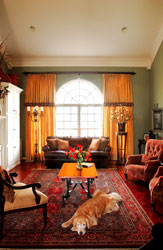
Panel drapes in a linen-look Marigold fabric by Braemore, with bouillon-and-tassel trim and 12-foot decorative traversing rod.
That’s why I recomm/files/storyimages/stopping by Calico Corners to pick up a free copy of the store’s new “Window Treatments” booklet. Like a crib sheet for a Curtains 101 exam, it offers neatly labeled, detailed sketches of today’s most-requested styles. And style, of course, is a major part of what window dressings are all about. As Cindy Alberding Druin of The French Pleat on East Market Street maintains, when it comes to home decor, “draperies are the icing on the cake.”
Style
Gene Coffey, head of The Flooring Gallery’s Plantside Drive workroom, has seen a many styles come and go in his 38 years in the business. “Ten or 15 years ago, people wanted their entire window covered. Now they’re requesting simple window treatments,” he says. “Some of it is fashion, but I also think people want to be able to enjoy their views.”
Architectural trends are also behind today’s straightforward styles. Windows and ceilings are getter taller, and builders are decking them out with gorgeous wood trim. “People who have nice moldings want them to show,” says Alberding Druin.
So what are Louisville’s best-dressed windows wearing this year?
Topping the list are panel drapes, says Suzanne Terry, store manager for Calico Corners on Shelbyville Road. “We’re seeing a lot more panels with decorative rings and rods that showcase the crown moldings.”
“Panels are huge right now because they work well in two-story great rooms and larger windows,” adds Lisa Bizelle, interior designer at Tassels in Middletown. “Many of them are stationary (unpullable) and serve primarily to frame the view.”
Though panels seem plain compared to the fussier styles favored in years past, there are several ways to make them interesting. Bizelle suggests applying bands of contrasting fabric to the leading (interior) or bottom edge. Other options include header treatments such as oversized grommets or tabs in lieu of pleats, and elaborate trims, such as fringes, glass beads and multi-textured tassels. Trims, in fact, are so fashionable that Terry calls them a “key to adding personality to windows,” and Alberding Druin believes it’s almost impossible to use too many. “Enough is never enough,” she says.
Spare or ornate: a Grand Band panel drapery (left) that slides via grommets; and elaborately swagged Thai silk treatments with long jabots by Jim Thompson.
When selecting trim, the most important factor is color, says Tyler Payne of Spindletop Draperies on Bardstown Road. “Placement can vary,” he explains. “For panel drapes, you usually want it on the leading edge, where it catches the light and stands out. If sewn right on the edge, however, it will show from the outside and fade faster. Moving it in on the drapery several inches gives a taste of the fabric and prevents fading.”

Pleats are another way to add pizzazz to plain panels, and serve a useful purpose as well. “If you want to hang your curtains with decorative rings,” Payne says, “it’s better if you pleat them. It prevents the rings from being sewn on.”
And that brings up another item on 2007’s best-dressed window list: decorative hardware, or “jewelry for drapes,” as Alberding Druin calls it. Once hidden behind yards of material, drapery rods are replacing valances and now serve as major design elements in many window treatments. Made of woods and metals in many different finishes, the rods sport decorative finials on both ends and may even include ornaments — shields, crests or geometric shapes — in the center. Most of the time, the rods are paired with matching rings.
Such high-styled hardware isn’t cheap and can easily account for a fourth to a third of the total cost of a window treatment, says Bizelle. “Spending $300 to $500 on the hardware for a single window isn’t surprising, and many people sp/files/storyimages/$1,500 or more.”
When selecting hardware, Alberding Druin suggests playing off other elements in the room. “In a dining room, for example, you might want to match the finish on the chandelier,” she says. Bizelle also offers this advice on ring sizes for operable drapes: “Make sure they’re large enough in proportion to the rod to allow them to slide easily,” she warns. “Some rod styles require larger rings.”
Two more trends worthy of note: tailored valances featuring clean lines and kick pleats, along with cornice boards made of padded particle board upholstered with decorative material. Both add verve to windows without spoiling the view.
Cornice boards in particular are making a comeback, says Terry, ticking off their advantages. “They’re a great choice for casement and other windows that lack architectural detail because you can make them in so many shapes. Because they have a smooth surface, they show off the fabric’s design. And they’re cost-effective because they don’t require much material,” she says.
Bizelle says cornices are especially popular in children’s rooms. “We’re doing them with large monograms or nonograms (script-style designs) in the center. We can also shape the board to accentuate the fabric’s pattern. It’s a great way to make an inexpensive fabric look grander,” she says.
Letting in Light
When light control is the issue, blinds are one of the most cost-effective options available, says decorating consultant Marybeth Crouch of Gotcha Covered. “Two-inch wood and faux-wood blinds have replaced the mini-blinds of the 1970s and 1980s,” she notes.
At the high /files/storyimages/of the pricing spectrum are plantation shutters, which Coffey says customers like because “they can have the bottom part closed for privacy and leave the top part open for light.” Shutters are also available for problem windows, such as arched-top Palladians and those without moldings. However, says Coffey, “two-inch wood blinds will give you a similar look for a lot less money.”
Choosing faux, rather than real wood shutters and blinds, will save you about 30 percent. Plus, they’re easier to clean, Crouch says. “You can wash them with mild soap and water, while real wood has to be cleaned with a feather duster or Swiffer cloths.”
Also gaining a following are silhouettes and luminettes — sheer shades with interior fabric vanes that work like blinds. “We’re seeing them used most often in bedrooms and dining rooms,” says Crouch. “They block 65 percent of UV light when they’re open and 99 percent when they’re closed.”
Other fashionable alternatives include woven wood and Roman shades. Tyler Payne notes that today’s wood shades are vastly improved and much less prone to sun rot. “With blackout linings they can even be used in bedrooms,” he says.
Roman shades put a lot of fabric on display, says Terry. “They have the appeal of a valance, but they also offer privacy. The hardware is improving, too. We’re using continuous cord systems, so they operate like a roller shade.”
For hard-to-reach windows, such as those over tubs or in two-story great rooms, remote-controlled shades or blinds offer a great solution, says Coffey. “They’re much less expensive than they used to be and incredibly easy to operate.”
Protecting Your Investment
Spindletop Draperies president Patrick Payne likes to say that “sun rot and dry rot are my two best salesmen.” With the average cost of a fabric window treatment hovering around $1,000, it makes sense to protect your investment. Here are some tips from the pros:
• Shake out and vacuum fabrics once a month.
• Get a professional dry cleaning every three to five years.
• Fragile fabrics such as silk must be lined and interlined to protect them. Faux-silks are not only more durable, but can also cost significantly less.
• For windows with bright afternoon sun, have the glass tinted or invest in shades that block UV light.
• Dust silhouettes, luminettes and honeycomb shades with a can of compressed air.
• Test fabric deodorizers on a back hem before spraying. They may water-spot or change the color of the fabric.
RESOURCE LIST
CALICO CORNERS - 7619 Shelbyville Road, 327-0944
THE FLOORING GALLERY - 2298 Plantside Drive, 966-4245
THE FRENCH PLEAT - 552 E. Market St., Ste. 203, 569-7547
GOTCHA COVERED- 297-8884
SPINDLETOP DRAPERIES - 1064 Bardstown Road, 583-5556
TASSELS - 12004 Shelbyville Road, 245-7887