

TV talk-show host Oprah Winfrey purportedly once said, "It’s much easier for me to make major life, multi-million-dollar decisions than it is to decide on a carpet for my front porch."
Winfrey isn’t alone. Purchasing a high-visibility area rug today is comparable to shopping for a super-special-occasion dress. It tests the depth of your commitments to fashion and personal style.
Floor coverings have been around since civilization began. The oldest surviving area rug, the Pazyryk carpet, dates to the fifth century B.C. and was found frozen in Siberia by a Russian archeologist in 1949. For centuries, such handcrafted carpets were the only game in town, and because of their expense, were considered lifetime investments, affordable only to the elite. Technology, however, has profoundly impacted what’s underfoot in the 21st century. Mass production and synthetic fibers such as nylon and polypropylene (also called Olefin) have brought area rugs out of dimly lit galleries and into the aisles of Target and Wal-Mart.
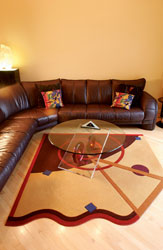
This Landis Lakes home’s seven-color broadloom area rug was custom-made by CSM Custom Rugs.
Donna Mudd, area rug manager for Sam Kinnaird’s Flooring, compares the cost of a wool, eight-by-11-foot machine versus hand-made rug. "Machine-mades range in price from $399 to $859, while hand-knotteds run $3,360 or more," she says. In the middle are hand-tufted rugs, made by manually punching yarn through a backing to create a tuft and then gluing the tuft into place. She pegs those at $560 to $1,500. 
Mass production also takes the credit for the rug industry’s fashion explosion over the past decade or so. While many Oriental and Persian patterns have remained unchanged for hundreds of years, machine-made rugs offer a constantly evolving panorama of patterns, colors, textures, shapes and themes. There are now rugs to celebrate the holidays and collections devoted exclusively to kids. The result, says Mudd, is that many style-conscious but impulsive consumers are treating area rugs not as investments but as "throwaways" to be replaced every time they decide to repaint. "Younger people aren’t buying and keeping their rugs for 25 years. They want to change them fairly frequently," Mudd asserts.
Ida Lee, known as "the rug lady" at Burdorf’s St. Matthews store, adds that "rugs have become fun. They’re no longer just collectors’ items. You can use them to liven up a room and they can be gone in five years."
One place to find top-quality Middle Eastern carpets is Frances Lee Jasper Oriental Rugs. 
Choosing the Right Type of Rug
Before she ever begins talking pattern and color, Lee asks her rug customers three questions: Do you have children? Do you have pets? Where do you int/files/storyimages/to use it? "You need to buy the right product to begin with, or your rug will be ruined," she explains.
Wool — the most expensive option — remains the gold standard by which other fibers are judged. All wool, however, is not created equal, as Fran Jasper, owner of Frances Lee Jasper Oriental Rugs, points out. "High-quality wools have a natural sheen and a silky hand because they contain more lanolin," she says. "Low-quality wools look dry and the colors look very flat. They break down faster and absorb liquids, making them more likely to stain."
Stains, in fact, motivate many a rug purchase, Lee observes. "Most rugs aren’t replaced because they’re worn out. People replace them because they’re stained."
For Jasper, who also cleans and repairs rugs at her Bardstown Road gallery, wool’s biggest enemies are red wine and urine. For that reason, Lee recommends synthetic fibers for homes with young children or pets and for under the kitchen table.
Another enemy of wool, and also nylon, is sunlight, which causes fading. For bright, sunny spots, polypropylene is preferable. Outdoor rugs, in fact, are made of polypropylene because it resists fading, mildew, water damage and staining. The only negative of high-quality polypropylene, Mudd says, is "it doesn’t have good memory and won’t bounce back like wool when you rearrange the furniture."
Lee often recommends nylon for bedrooms because, she says, "it’s soft, comes in great colors, wears well and can be treated to repel stains."
What about silk? Though Jasper says silk can be used to add highlights to wool rugs, all-silk rugs are best destined to become wall hangings. "They don’t clean well and take on a mottled appearance," she contends.
Another material finding its way into casual rugs in recent years is plant-fiber-based sisal — one instance, Mudd says, in which imitations are better than the real thing. "We recomm/files/storyimages/Olefins or wools designed to look like sisal, because sisal itself is not user-friendly. A water spot will never go away," she asserts.
Pile and weave are additional factors to consider when selecting a rug. When pets are in the picture, Lee always recommends cut pile over looped. "Cats t/files/storyimages/to pick at loops and big dogs will snag them," Lee warns. "Pet owners should avoid hooked and needlepoint rugs."
For family rooms and high-traffic areas, Jasper suggests flat weaves, such as Aubussons, Kelims, Dhurries and Soumaks, because "they wear like iron and are more affordable," she says.
Of course, if it’s art for your "fifth wall" that you’re after, a hand-knotted wool Persian may be just the ticket. Named for the tribes that make them — a la Bakhtiari, Gabbeh, Heriz — or the cities where they’re crafted —Bidjar, Kerman, Qum, Tabriz — each type carries distinctive designs, colors and knots. A rug aficionado can tell simply by flipping a rug over where a Persian was made, says Anabel Musselman, proprietress of Anabel’s Oriental Rugs in the Vogue Center on Lexington Road. And while Persians can cost many thousands of dollars, Musselman notes that quality look-alikes can be had for as little as $2,000. "The price depends on the wool, how it was dyed (vegetable dyes cost more than chemical), the tightness of the weave and the rug’s origin," she explains.
Focused on rewarding weavers themselves over middlemen, Just Creations, a non-profit on Frankfort Avenue, will hold its annual rug event, featuring hand-knotted rugs from Pakistan, March 28-31. "Sixty-two percent of the retail price goes to the artisan," notes Joan Frisz, executive director and store manager
Custom-Made Rugs
Having trouble finding just the right rug for the great room? CSM Custom Rugs on Shepherdsville Road, Burdorf’s and Sam Kinnaird’s are doing a brisk business fashioning rugs from wall-to-wall carpet. Cathy and Steve Miller, who own CSM, say the only limit on their custom creations is your imagination. "It’s common for clients to bring in a sketch and fabric samples. Then we take it from there," says Steve Miller, who ticks off the advantages his handiwork has to offer — limitless choice, the ability to mix carpets and bindings from different manufacturers, odd sizes and shapes, and unique features such as inlays and carved bas relief designs.
The most intricate rug CSM ever fabricated: a scene of Hurstbourne Country Club. That project, Miller says, took months, but many rugs can be made in under a week. Cost depends on design and materials and can range from "a couple of hundred to several thousand dollars,"
he says.
Both Anabel’s and Frances Lee Jasper offer custom-made hand-knotted rugs in special sizes, colors and patterns, though patience is definitely required. The process can take many months depending on the rug’s size.
RESOURCE LIST
Anabel’s Oriental Rugs
3740 Frankfort Ave., 895-9595
CSM Custom Rugs
4002 Shepherdsville Road,
452-2038
Burdorf’s Furnishings and Flooring
3939 Shelbyville Road, 719-9738
Frances Lee Jasper Oriental Rugs
1330 Bardstown Road, 459-1044
Just Creations
2722 Frankfort Ave., 897-7319
Sam Kinnaird’s Flooring
4343 Poplar Level Road, 451-2600
4238 Shelbyville Road, 894-8100
12621 Shelbyville Road, 244-8606