

Photos Courtesy of Actors theatre Louisville |
Any theatrical event as enduring and artistically venturesome as the Humana Festival of New American Plays, now in its 31st season, prompts questions about its continuing relevance and about its role in the diffuse and changing world of American theater. Two of the bigger queries are: Is the festival as successful as it once was? And does it still attract international attention on the scale of former years?
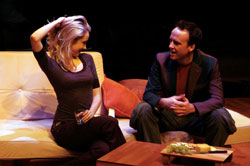
Anna Camp and David Wilson Barnes in 2006’s The Scene.
Actors Theatre of Louisville’s producing director, Marc Masterson, inherited the annual March extravaganza from its founder and his predecessor, Jon Jory. Artistic directors can be less than grateful for, and sometimes feel constrained by, any huge commitments they inherit, so is the Humana Festival the jewel in Masterson’s crown or an inherited albatross around his neck?
It might seem to the casual viewer that in its early years the festival produced more Broadway hits. Certainly the string of The Gin Game (1977), Crimes of the Heart (1979) and Agnes of God (1980) represents a staggering early track record and one surely impossible to maintain. But that was then; now, Broadway no longer may be the measure of all things. In fact, few plays of any sort nowadays make it to Broadway, which seems to exist on a diet of imported musicals, revivals of classic American musicals and the odd title by the more brainy Brits like Tom Stoppard, Alan Bennett and David Hare.
Will Hussung and Georgia Heaslip in 1977’s The Gin Game.
A few of the international journalists who formerly attended no longer come. Whether this means the Festival is losing its importance internationally as a showcase of the best new writing in American theater is a subject for debate. We can find answers, perhaps, in how each year’s new plays are selected, what sort of balance is sought among them and, ultimately, in identifying the real audience Actors is trying to please.
Some facts appear to be at variance with the sometimes-expressed perception that Actors Theatre and the Humana Festival have lost their primacy or sense of direction. Since the festival’s founding in 1976, approximately 50 plays premiered during the multi-play event have received a New York production: Theresa Rebeck’s The Scene from 2006 is currently running at Second Stage in New York, for example. Kathleen Tolan’s Memory House from 2005 has been produced in New York, Chicago and at the Seattle Repertory Theatre.
What has changed, perhaps, is not the impact of the Humana Festival, but rather the way success is gauged.
Marc Masterson is the first to state that the measures of success for ATL’s annual offspring have altered over the decades, with Broadway no longer the yardstick for success. “For me the measures of success include whether a play goes on to receive further productions in one of the many strata of theatrical activity which make up the vitality of the American theatrical scene,” Masterson says.
He cites Pure Confidence, a hit two seasons ago, which went on to productions in Alabama, Denver and Cincinnati. He might also have mentioned Omnium-Gatherum, a big hit of the 2003 Festival, which was a Pulitzer Prize finalist and has had a half-dozen productions or more in venues as wide-ranging as off-Broadway, Toronto and Olney, Md. Masterson instantly rejects the albatross-around-his-neck metaphor and replaces it with one of his own. “The Humana Festival is a huge mountain we gladly climb each year,” he says, something in which he takes immense pride.
The play-selection process is a mountain in itself, and its foothills are inhabited by Adrien-Alice Hansel, director of new-play development, and Julie Felise Dubiner, resident dramaturge. In the old days, up to 1,250 scripts, solicited and not, would pile up in the literary offices of ATL. More recently, the policy changed to one of only reading scripts from agents or other recommending sources, so the pile has shrunk to about 800 plays each year. Some are immediately farmed out to professional readers; many more are given a first read in-house. “I will reckon on reading about 500 myself and Julie Felise about 100 more,” says Hansel. “And, yes, we read the entire play!”
Approximately 60 plays make it into the finals, when as many as seven of ATL’s principal artistic staff will read all 60. Narrowing this down to the six that will receive full-stage productions involves myriad thematic and technical decisions. Hansel explains: “If there are three excellent family dramas among the finalists, then clearly two have to go.” If three are ideally suited in scale to the Victor Jory, then two must be jettisoned, as only one play can be scheduled in that small space in any festival. The final say resides, always, with Masterson, whose skill at balancing the technical, thematic and marketing considerations is acknowledged by all.
Some of the plays are commissions. “From time to time Marc will feel there’s a need for a play that will address a certain issue,” says Dubiner. Pure Confidence, for example, was this type of Actors-encouraged work.
In the earliest days of the festival only premieres were given. At some point Jory relaxed this rule. “We will occasionally produce a play which has already had a premiere in, let’s say, Cleveland and has not hit the national radar screens,” Masterson explains. “By presenting it in the Humana Festival we can do just that — bring it to national attention.” Conversely, if a play has had its premiere in a major center and been reviewed in New York or nationally, “we will probably decide not to produce it.”
Another vital theatrical function ATL does not do is “work-shopping,” where a play is rehearsed and rewritten over a period of weeks. The ATL philosophy is to develop plays by giving them full-scale productions. Actors’ staff members, according to Hansel, “visit a variety of workshops around the country, but with six plays to produce and only three weeks of rehearsal, there is time only for minor changes of mind and not for the sort of intricate reworking implied by the workshop process.”
Top: Mia Dillon, Adale O’Brien and Anne Pitoniak in 1980’s Agnes of God; Taylor Miller and Cassandra Bissell in 2005’s Memory House.

Humana’s sponsorship of the festival recently gained a lofty perch when Texaco discontinued its 60-year-plus underwriting of Saturday-afternoon radio broadcasts from the Metropolitan Opera. Now the Louisville-based health-care company holds the longest-running artistic sponsorship in American theater: 29 years. In some ways, the festival now attracts more international attention than in its legendary early days. In the beginning British journalists were more prominent, but in those days only British and American critics came. This year’s festival will receive visits from journalists representing French network TV as well as writers from Germany, Austria, Finland, Africa and China.
Michael Billington of London’s Guardian newspaper, formerly a hardy annual attender, no longer comes to Louisville for the end-of-the-festival performances geared toward critics. But he sees that mainly as a reflection of the state of journalism in the U.K. and U.S., where the pursuit of novelty is more important than continuity. The fact that he came seven years in a row is seen by his editors as a reason to give it a rest. “Which is a pity,” he says. “I miss my crash course in American theater and American life.” He also, one suspects, misses the conviviality of an event which, like all good festivals, is as famed for its parties as for its product.
“I am more and more convinced,” says Billington, “that the true vitality of American theater is to be found outside New York, and specifically in Chicago, Oregon and Louisville.” He always looked in on New York theater en route to Louisville, but says he felt more at home at the Humana Festival.
Lee Anne Fahey, Kathy Bates and Susan Kingsley in 1979’s Crimes of the Heart.
The 2007 edition that runs through April 7 represents the start of a fourth decade for ATL’s new-play doings, but Dominic Papatola, critic of the St. Paul Pioneer Press, still considers his annual pilgrimage to Louisville a highlight of the American theatrical year. “The Twin Cities, where I live, have a vital theatrical life, but the Humana Festival keeps me current on who’s writing and what are the trends in American theater,” he says. He likens the chance to see eight or nine plays, full-length and short, in one three-day period to “hearing the canary sing in the coal mine — by that I mean an early-warning system telling me of trends that will later impact theater in my hometown and nationally.”
Billington annoyed Jory once by saying he thought that most American plays seem to be set in the kitchen. The English critic is intrigued by the realism on the American stage at a time when most British and European theater has a minimalist look, with directors striving to distance themselves from “the bourgeois sensibility.” He points out the value of providing a “seed-bed for new writing talent” and thinks that if a Humana play goes on to be a commercial success it is a bonus but not the main point of the festival.
What does Masterson say to the oft-leveled charge that the festival exists only for its out-of-town guests and has little relevance to Louisville? “The truth is,” he responds, “the bulk of the tickets are sold to Louisvillians, and that number is now increasing as we have added new ways for city residents to attend.” One initiative making major waves is a week/files/storyimages/geared toward attracting college students, whose attendance is on the rise.
Papatola believes that the Humana Festival has already established two important legacies. First, he says, “It has created the ethos that a regional American theater does not have to produce Neil Simon to be successful, that there is much more great American writing out there.” And second, “It is possible now for a playwright to have a fine and legitimate career without ever having a play produced on Broadway.”
Indeed, Papatola and others now seem to agree that the true pulse of American theater no longer beats in New York City; it courses, instead, through such centers as Seattle, Pittsburgh, Chicago and, of course, Louisville.
And the Humana Festival remains at the heart of this vitality.