Stepping Out
“Strange harmony of contrasts,” as the chap in Tosca remarked just before they shot him. Louisville’s arts scene this month offers some striking examples of contrast, especially in dance and the visual arts. The pulse quickens somewhat at the prospect of a visit by Pilobolus to the Brown Theatre on Broadway on Saturday, Nov. 10, at 8 p.m. This funky and innovative group has evolved over its

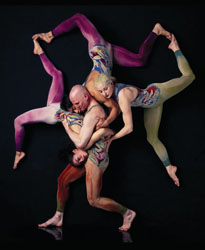
Pretzel logic: Pilobolus defies gravity Nov. 10 at the Brown Theatre.
|
35-year history into a major force in American dance, and if you have no idea of their work, think Cirque du Soleil (sort of) and you will get a sense of their creativity. Pilobolus’ “weight-sharing” approach to partnering has evolved into a unique style in which design, pretzel-like contortions and brilliant costumes (or none, as they warn us) create a unique vision. I am intrigued that in the perilous world of arts management they have become a self-sufficient organization for which their own members choreograph, perform, manage and publicize the programs. Call 584-777 and — if you’d like my opinion — ask for seats in the balcony, which, in the Brown, has the better sightlines for ballet.
Pilobolus is nowadays almost mainstream. In contrast, we note what the Louisville Ballet has on offer Nov. 2 and 3 at the Whitney: a world premiere by Helen Pickett, a young choreographer trained at the San FranciscoBalletSchoolwho has been making waves in contemporary dance and as a performance artist in the rarified field of installation video. What interests me is that artistic director Bruce Simpson has had a hand in shaping the still-untitled piece, inspired by Beethoven piano sonatas. Simpson asked that the classic music and modern dance be used as the basis of a dialogue to explore the spatial relationships between dancers, and between performers and the performance space. Neat idea..
Charitable With Hart
Contrast was never more vividly in evidence than in two exhibitions running this month on and around the University of Louisville campus. George Fischer is a Louisville civic leader and a philanthropist in a quiet way, but on a generous scale. He is also impassioned about the sculpture of Frederick Hart, best known for his moving Vietnam War monument on the National Mall in Washington and for the tympana over the doors of the National Cathedral, also in our nation’s capital, in case you didn’t know. These deal on a huge scale with the Genesis creation myth and are collectively entitled Ex nihilo. Mr. Fischer and his wife Mary Lee are major collectors of Hart’s distinctive and realistic works, in bronze and, more often, acrylic — works that are uncompromisingly realistic in the classical traditions of Michelangelo, Bernini and Rodin. This, of course, gets them no respect from the art establishment. The Fischers are partnering with U of L in the exhibition, which comprises more than 100 pieces of Hart’s work and is located in six sites on campus and downtown at the Cressman Gallery on Mainthrough Nov. 17.
Inside the “Box”
Meanwhile, back at the Speed Museum, another contrast: Curator of modern art Julien Robson is unfolding an extraordinary series of exhibitions, of which the imminent one (opening Nov. 13 and running through Feb. 17) is particularly interesting and, yes, important. Robson states that the two most influential artists of the 20th century were Picasso and Marcel Duchamp, the latter “because he redefined art as concept rather than product.” I think I even know what that means — that art is more than an object to be stared at impassively. It has idea behind it. The Speed will display two versions of one of Duchamp’s most famous works, Boite-en-valise (French for “box in a suitcase”). In both versions, Duchamp reproduced, in miniature, paintings and objects he admired, with the many parts sliding, unfolding and lifting out to create a miniature traveling museum. These boites are rare and valuable artifacts, both of which come from private collections in Cincinnati. The exhibition, entitled “Marcel, Marcel,” will feature the two copies — one dating from 1941, the second from 1966 — in one room, offering a rich opportunity to view and contrast work by this very important artist.
Final Thought
Kentucky Opera will present Poulenc’s opera The Dialogues of the Carmelites on Nov. 30 and Dec. 2 at the Whitney Hall in English translation — and quite right too. Opera, like all theater, should be about communication, and the anachronism of Anglophone singers singing in foreign languages to uncomprehending audiences (supertitles are convenient but distracting) should be abolished. Verdi, Wagner and I all agree on this. In a good year, all the best opera performances one hears are in small theaters in English (Opera Theatre of St Louis, for instance) and the worst ones generally with underpowered singers in massive auditoriums. Poulenc’s intriguing tale of a bunch of nuns getting the chop during the French Revolution has an excellent text that needs to be communicated in the language of the listener. Music plus words in one’s own language are a potent synergy, which explains why the Brits love Gilbert and Sullivan and Americans rightly revere Gershwin, Cole Porter, Sondheim and West Side Story, to mention only the most obvious.