
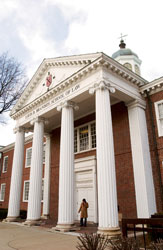

Photos by John Nation From a distance, the Brandeis School of Law does little to impress. One mid-sized brick building tucked among many near the center of the University of Louisville campus, the Brandeis School is not imposing. It’s smaller than the nearby library, larger than a few surrounding campus buildings, and has only a few Greek Revival-style touches to set it apart.
Get close to the building, however, and a sense of something significant becomes evident. It starts on the front stairs. What other law school has a Supreme Court justice buried under its walkways? This one does — in the form of the grave of Justice Louis Brandeis, littered with coins that students have dropped for luck, as if attempting to bribe the man’s spirit for good test grades.
“This law school has a very strong connection to Justice Brandeis,” says Laura Rothstein, a professor, distinguished scholar and former dean of the Brandeis School. “Justice Brandeis was born in Louisville in 1856. . . . He gave money to the school for scholarship purposes. He kept the lights on in 1930s, when the school had a real economic downturn. So his influence has been with us for a very long period of time.”
Just inside the main door is another noteworthy item: A full-sized courtroom. The room’s traditional use is for practical training for students, be it in classrooms or the school’s Mock Court program. But on occasion, the room — built to standard courtroom specifications — has been home to actual court proceedings, including those of the Kentucky Supreme Court.
That’s all part of the legacy of the Brandeis School, which currently boasts about a third of the Louisville Bar as its graduates. Those alums include Kentucky Supreme Court Chief Justice Joseph Lambert, Justice William McAnulty, Louisville Bar president Robert Ewald and even Democratic presidential candidate Sen. Christopher Dodd of Connecticut, who received his degree in 1972. U of L’s law school is in its 161st year and its 10th since being rechristened as the Brandeis School in 1997.
“It was actually a bigger school in the 1970s than it is today,” says Linda Ewald, an alum and a 31-year professor of law at Brandeis. “We’ve become a more selective school in terms of our students.” The difference is apparent in the school’s admissions numbers. The University of Louisville’s law school swelled to a 1974 enrollment of 748 students; today, with about the same number of faculty, the Brandeis School is home to 425 students, for a ratio of 14-to-1. That’s nearly the same student-to-faculty ratio as the University of Kentucky’s law school, but higher than the proportion at Justice Brandeis’ alma mater, Harvard Law School, which has only 11 students per faculty member.
Statues of the signing of the U.S. Constitution hold court in a law school lounge.
The increased selectiveness over the past quarter-century, according to school officials, has allowed students at the Brandeis School to participate in smaller classes and have closer interaction with their professors — developments the school’s name-lender would approve. “It’s allowed for some specialized kinds of courses,” adds Rothstein, who was dean from 2000-’05 (James Chen assumed that role in January). “We have courses in the area of intellectual property, courses in immigration law, courses in the health law area, employment and labor law. We’re not able to offer all of those every year, but by having smaller classes, we have more flexibility in what we can offer.”
In addition to broadening its course options, the law school maintains its public-service commitment, another legacy of Justice Brandeis. It was among the nation’s forerunners when it launched the Samuel L. Greenblatt Public Service Program in 1990, requiring every student to perform 30 hours of pro bono public service before graduating.
Since its launch, this effort has been noticed by members of the local legal community, many of whom feel that it prepares students for an important — if not well-known — part of a real legal career. “Thirty hours is a lot of hours for a student to fork over,” says Jack Ballantine, a 1957 graduate of Harvard Law and member of the Stoll Keenon Ogden firm. “But to me, that’s a wonderful requirement — to indoctrinate soon-to-be lawyers that pro bono work is a crucial part of our responsibility. I think it’s a real tribute to the school that they require that.
“I also think it’s a real benefit to the public that they get the work from law students who will soon be lawyers, and that those students have built into their fiber the beauty and value and necessity of pro bono work.”
The work students do must be unpaid, not for school credit, and legal-related, says Mary Jo Gleason, the program’s director. “Examples would be the obvious things like working for the Legal Aid Society, working for the Public Defender, working for the Department of Public Advocacy, or doing work for not-for-profit organizations,” Gleason says. “Any type of organization that provides services for underrepresented populations.”
New dean James Chen has been charged with upgrading U of L’s ranking among the nation’s law schools. The former associate dean from the University of Minnesota’s law school will be working to bring the Brandeis School into the top 100.
Like many other schools, Brandeis has put a recent focus on expanding classes beyond the technical and theoretical aspects of law. Many of these more “practical” courses are taught by the school’s adjunct faculty — local professionals who teach on the side, like attorney Stewart Conner. “We don’t teach core courses,” says Conner, a Brandeis graduate and attorney with Wyatt, Tarrant & Combs. “So as a result, we teach these very practical courses — everything from trial practice to seminars on real estate or on law office management. We teach the kind of courses that are, ‘Now that you’re going to get out of law school, you ought to know where the courthouse is located.’”
Even in what might be considered traditional classes, Rothstein says, students are getting a more practical education, be it through writing actual legal memos or through the Gordon Davidson Fellowship Program, which brings practitioners from the community into the classroom to give feedback or assignments that practice skills students would actually do in a legal practice, Rothstein says.
“I think there has been an even greater discussion of that sort of thing recently,” Rothstein adds. “We’re even looking at implementing a law school clinic experience — we’re one of the few schools that doesn’t have that.” A clinic would assign students real-world clients under supervision from faculty and practicing lawyers; some experiences would be in local courtrooms and some with businesses or other organizations.
Until recently, Brandeis also was a school that didn’t have much technological savvy, but upgrades have been a focus since 2000. “We have the Smart Podiums, the teaching tools, so the faculty has the ability to use PowerPoint, the Internet, get C-SPAN in the room immediately,” says Rothstein. “We currently have all but three rooms with wireless Internet, and the other three will be wireless by the /files/storyimages/of the summer.”
By kicking up both education and technology a notch, the University of Louisville’s law school has become something of a feeder for the local law community. Its students take a lot of internships at local firms and some of the faculty’s research has been of use to the city’s attorneys. “It’s a major feeder for our community and certainly for the state’s bar,” says J. Michael Brown, a 1980 Brandeis graduate who practices with Stites & Harbison and is the first African-American president of the Louisville Bar Association.
Kennedy Helm III, the chairman at Stites & Harbison, says his firm recruits “pretty actively” at the Brandeis School, and he notes that those students “stack up favorably with the top students at any of the other schools where we recruit.”
One of the U of L law school’s goals, however, is to make the statistics back up those claims. While the Brandeis School is heavily respected in the Kentucky area, it hasn’t drawn as much praise nationally, where the U.S. News & World Report rankings — “the only ones that hold much weight,” Conner says — place the University of Louisville school outside the top 100. According to these rankings, which earmark Yale University as the top law school, the Brandeis School is ranked a tier below in a group not assigned numbers. The state’s only other major law school, at the University of Kentucky, comes in at number 65.
“Alums, faculty and everyone would like to see the law school get back into the first tier, where we think it deserves to be,” Conner says.
And that’s where the school is at a turning point. In the last 20 years, the Brandeis School has seen tremendous changes and improvements. It has become more ingrained in the fabric of the Louisville law community. It has increased diversity among its faculty, broadened its curriculum and put a new focus on community service. Now, alumni and the rest of the Louisville legal community are looking for the school — and, particularly, its brand new dean — to take things “to the next plateau,” in the words of Kennedy Helm III.
And they believe the man to do it is James Chen. “Dean Chen has terrific credentials,” says Conner, who also served on the dean search committee. “He went to Harvard Law, he was a Supreme Court law clerk and, most recently, he was associate dean of the University of Minnesota’s law school.”
In choosing him for the job, the university has charged Chen with a simply defined objective: Bring Brandeis into that top tier of law schools. And Conner says he believes Chen will do that — though he expects him to take more than the few weeks he’s been on the job to lay out his plans.
Chen, only in his third day on the job when he was interviewed for this story, is saying the right things. “It’s a true honor to be called to be the dean of this law school,” he says. “I think it’s a wonderful school, and I’m delighted to have the opportunity to make my own contribution to the school, to the city of Louisville, and to the commonwealth of Kentucky.”
The verdict on that contribution — as the legal community, university administrators and even Brandeis students know — will be read after his case gets its hearing.