
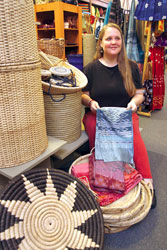

 Although Sandra Chrismon, 39, doesn’t look through microscopes and cannot read an X-ray, she is working on a cure — for people who are black, white and yellow living in poverty from Bangladesh to Peru. Her aim is to feed workers and their families in Third World countries by educating one Louisvillian at a time.
Chrismon stumbled upon her mission while walking past the fair-trade importer Just Creations, 2722 Frankfort Ave., where a window sign declared a need for an education coordinator. After years of studying cultures and their economic situations, she figured this job and her expertise might be a good fit.
Chrismon received her Ph.D. in anthropology from the University of Georgia in 2005, then moved back to Louisville and began the hunt for a job. “People ask me what am I doing here when I have a Ph.D.,” she says. “With anthropology, you have to create your own career. Not many ads appear in the paper that say ‘looking for anthropologist.’” Now she is applying her learning to real-world issues.
According to the website behindthelabel.org, more than two million people in 150 countries around the world work in apparel-making sweatshops that supply American retailers. Four of five work in conditions that violate local and international labor laws. The average wage of apparel workers fell 16 percent between 1968 and 1999, the site says, while the prices of the goods they make continue to increase.
The Fair Trade Federation book The Conscious Consumer describes a factory in Haiti where the workers receive $2.15 a day but their daily expenses are above $6.
Chrismon discusses the issue of fair trade with diverse groups throughout Louisville. Invited by schools, churches, women’s groups and Girl Scout troops, her goals include exposing the conditions the world’s people work under and inspiring local residents to begin their own quests for international economic justice. She finds that personal stories about individual Third World craftspeople are effective resources in communicating their needs. Kenyan Alice Mumbua, for example, is one of many visually and otherwise physically disabled adults in Kenya who find hope through a fair-trade workplace named Bombolulu Workshops. Creating whimsical jewelry from recycled materials such as soda cans and telephone wire, their work gives these craftspeople the opportunity to become self-sufficient. “My community no longer sees me as a burden due to my disability,” says Mumbua in an email, “but accepts me as an intelligent, hardworking woman.” By taking up the art of painting used tea bags for Western purchasers, Nomsa, a South African woman, recently moved from a flimsy shack to a sound home. By sharing these stories, Chrismon informs others about how their buying decisions affect others.
Always searching for new ways to expand knowledge of fair-trade issues throughout the community, she is currently composing explanatory cards to accompany every Just Creations purchase. The cards will include information on what materials the item is made of, how it is made, and the story of who made it.