

As you drive along
Jamey Aebersold — saxophonist, jazz camp organizer and teacher-from-afar of students all over the globe — is a master of improvisation, and the organized chaos in his maze-like subterranean workspace reflects success at ad-libbing. Photos — many of jazz artists and others of friends and public figures, some of them up for ridicule — are stuck to the ceilings, door frames and walls in seemingly random fashion. A Steinway gleams in the midst of the clutter; it’s a focal point for Aebersold’s melodic meanderings or for a pianist called in during recording sessions that produce the CDs accompanying play-along books purchased by jazz learners worldwide. During those sessions, Aebersold sits at his paper-drowned desk near the piano, saxophone at the ready, while a bassist and drummer are sequestered, headphones on, in rooms that warehouse the thousands of jazz instructional books mailed out of the basement business every week. These players are sound-sealed behind doors so that each instrument can be separated and mixed by an engineer. It’s a recording studio, a mail-order house and a den of creativity — all at one time.
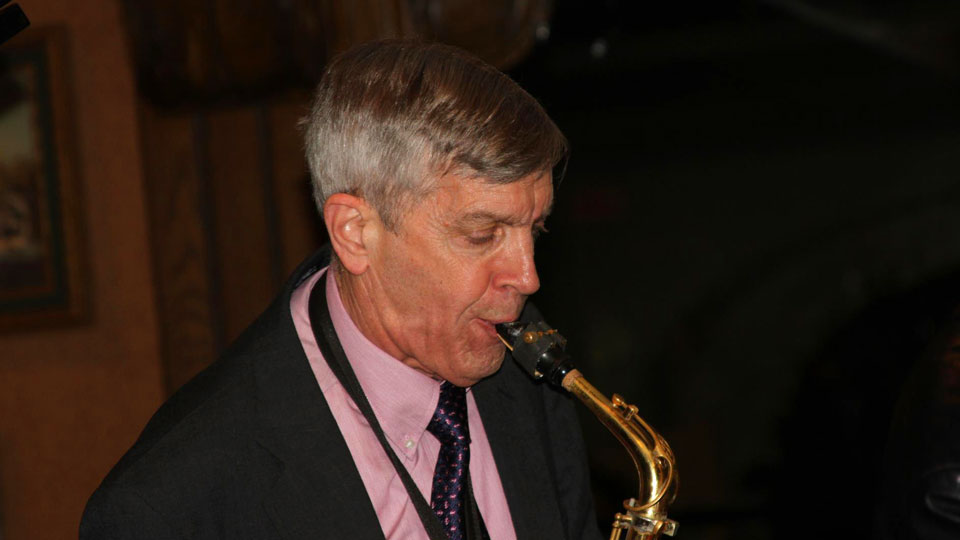
Many of Aebersold’s passions — including his complete immersion in music, his gifts as a leader and teacher, and his anti-tobacco advocacy — find their highest expression, naturally enough, in performance. This shone through at recent concert at the renovated Jeffersonville Township Public Library as he played with his quartet: Crews on piano, Tyrone Wheeler on bass, Jonathan Higgins on drums and, of course, Aebersold on sax. He led but never dominated during an hour of creative and intense playing. The all-ages audience of approximately 40 seemed intent on following an often-complicated improvisational path as the musicians took a well-known tune (on one occasion Gershwin’s ‘Summertime’) and developed, varied and explored its melodic and harmonic material in a way that is the very fabric of music making.Fellow musician Steve Crews says the unique quality about Aebersold is that, while many play jazz and do other things, “Jamey is 24-7.” His dedication to the music — and especially to teaching its joys — is total. “I have never known an artist,” Crews adds, “in any discipline, who is so totally committed heart and soul to his craft.” Enough orders come in by phone and the internet to Aebersold Drive each workday to keep seven people busy; they mail out 150 to 200 packages on a typical day, most containing multiple books and CDs priced in the $16-to-$20 range, making Jamey Aebersold Jazz the world’s leader in educational sales for its musical genre.
Aebersold leads in a co-operative way: “What shall we play next? ‘Summertime’? What key?” he asks. Someone suggests G minor, so G minor it is. As the ravishing melody and its variations unfold and quicken, one audience member closes his eyes, totally absorbed, as body and head sway to the music. A child in the front row fidgets in perfect rhythm while she mimes each instrument, raising an imaginary sax in the air during Aebersold’s solos, then knocks the stuffing out the armrests when the drummer takes over. At one point during a number with Latin rhythms, Aebersold hands a tiny shaker-like instrument to a small boy in the front row who joins in and, just perhaps, becomes a convert for life.
The saxophonist is a formidable player. His extraordinary finger technique allows him to play dazzling runs, make virtuosic leaps and, in one case, /files/storyimages/a number with a deep, low, slow trill in one long breath that seems to last an eternity. “I couldn’t have managed a breath that long if I were a smoker,” he tells his audience. The program is salted throughout with good humor. At one juncture, when he finds himself unable to recall the name of a blues tune, Aebersold simply renames it for the occasion: “The Dedication of Jeffersonville Township Library Blues.”
Aebersold says in an interview that “jazz is hopping,” meaning for him, perhaps, that sales of his revolutionary play-along books and CDs have never been better. In another breath, he deplores the fact that daytime jazz is no longer heard during the week on local public radio, a decision made some years ago by then-managers at the Public Radio Partnership and one still resented by
There was a time when all musicians practiced improvisation as an essential element of their craft. Manuscripts of Renaissance music show that composers of the day merely sketched a melodic outline and indicated a few chords, knowing that the court musicians would develop this into full-scale harmony and a melodic forward drive. Some of Mozart’s concertos for soloist and orchestra contained sections where the orchestra stopped playing and the soloist extemporized. But when Mozart and other great composers, including Beethoven and Chopin, took to writing out cadenzas for soloists, improvisation ceased to be a part of classical music practice.
Not so in jazz, where on-the-spot creativity is quintessential. One of Aebersold’s most remarkable contributions has been his ability to recognize and preach that “improv” is more than the channeling of a musician’s inner ear — that it, like chords and progressions, can be taught.
The Louisville Jazz Society’s Patty Bailey says, “Jamey Aebersold has simply revolutionized the teaching of jazz. Fifty years ago almost no one taught jazz, let alone the art of improvisation.” Early jazz musicians seemed fearful of verbalizing, expecting the music to say it all and for the listener to learn by listening. For a young Aebersold during the 1960s this was too slow and imprecise as a method of mastering the art form, and he has devoted his life to rectifying the deficiency.
He was born 68 years ago this month, in July 1939, into a musical family in
When he was an early teen he read in a magazine that “jazz is the coming thing.” That single, if possibly misleading, phrase was enough to set his life on the course it has followed since — as a jazz player of extraordinary range and talent and also as a teacher of innovative genius. His first “teachers” were gramophone records, radio and the great masters of jazz. At 14, he bought his first stack of 78-rpm recordings of Duke Ellington’s big band, Kid Ory and Louis Armstrong (Satchmo’s trumpeting on “Bugle Call Rag” was an early and much-played favorite).
At age 20, as an
In 1961, while still at IU, where he one year later earned a master’s degree in music, Aebersold began his own teaching out of storefront space in
This was the time when, for him, the clouds parted over Southern Indiana and a big finger — like in Monty Python — pointed out from the sky and signaled Aebersold’s eureka moment: “Everyone can hear and everyone can improvise!”
One of the handbooks distills his teaching philosophy into a single paragraph: “I see and hear the promise of solos being played for money and for pleasure, for fun and as work, by pros and beginners, at home or in the concert hall; by young and by old; with or without a rhythm section; for a huge crowd or for no one but the pictures on the walls; lots of notes and not so many notes; by the educated and by the uneducated; with or without government funding; on expensive instruments and on instruments falling apart. MUSIC DOESN’T CARE WHO PLAYS IT. People have a need to be creative and jazz offers us a natural outlet. Creativity is where the fun is.”
Aebersold took his idea to summer camp. In 1965, while teaching for the first time in such a setting, he had another insight: Playing in a big band at music camps was fun enough, but “campers” didn’t get to solo or improvise — and missed out on much of the joy of jazz. The next step, it turned out, was to create combos of the better students, who met outside of the big-band sessions each night to rehearse and att/files/storyimages/a listening class. This has developed into today’s weeklong combo workshops with up to 800 attendees and as many as 65 teachers that desc/files/storyimages/each summer on the
The application form for this month’s 2007 Jamey Aebersold Summer Jazz Workshops, held July 1-6 and 8-13, lists a dizzying roster of two-day and weeklong seminars with titles such as “Anyone Can Improvise,” “Bass Drums or Guitar” (with the Aebersold faculty) and “Week-long Combo Session.” And to show that jazz education Aebersold-fashion is not for the faint of heart, here’s a sample daily schedule: breakfast at 7 a.m.; sessions on jazz theory, jazz musicianship, master classes, combo rehearsals during the day; and an evening at faculty concerts and a 10:30 student jam session.
It had always been assumed that improvisation was some sort of mystic gift: Close your eyes, lean back on the piano bench and inspiration will desc/files/storyimages/from the heavens. Aebersold’s greatest contribution to jazz education, at the philosophical level, was to show that improvisation could be taught. On the practical level, the big breakthrough was the play-along concept. A few jazz teaching recordings were available in the mid-’60s, but they required pupils to play with or trade off on solos with an established national artist, not create their own passages. Aebersold’s innovation was to provide only background instrumentation, leaving students to practice and improvise their own phrasings.
In 1966, he published his first Play-A-Long LP record and book set and sold copies out of the trunk of his car. He was in no rush to capitalize on the modest sales of Volume One, but then an odd thing happened. When a second set followed in 1970 and he took out a small ad in DownBeat magazine publicizing it and Volume One, sales of Volume One took off. Also, the longer the ads became as new volumes were added, the more he sold of the earlier volumes. There is an engaging touch of naivete as he notes, “Not being a businessman, this was all very interesting to me.”
The Aebersold catalog now lists 120 Play-A-Long volumes grouped under categories such as Standards, Bebop, Latin/Bossa, Fusion, Improvisation and Vocal Play-A-Longs With Lyrics. Some employ tracks from great jazz musicians, as is the case with pianist Dave Brubeck, who plays with his drummer and bassist on an instructional CD. Others — featuring the songs of greats such as John Coltrane, Wes Montgomery, Cannonball Adderley and many more — are recorded minus the star, with rhythm sections, including some combos Aebersold brings in to his downstairs studio. Having just released “Feelin’ Good” with organ, guitar and drums, Aebersold next plans to record songs for four volumes featuring, in succession, saxophonists Phil Woods, Jimmy Heath, Bobby Watson and Eddie Harris.
If you can lay hands on a copy of his free Jazz Handbook, you’ll find a newspaper-print manual that contains a concise encyclopedia of technical information interspersed with musical and lifestyle hints that are revelatory without being preachy. “I have the notion that people learn instruments as an exercise in patience — to get to know themselves,” he writes. Other pearls include: “Start to improvise early in your musical education,” and “Sing a 12-bar blues (it’s not all that hard); just think and sing while driving or waiting for the bus.”
Another maxim stands out and segues (as musicians say) into another of his life’s passions. He counsels, “Ignorance kills. So does smoking.” Aebersold’s passion for jazz dates from his teens and so does his dislike of smoking. Decades of playing in the smoke-filled cellars of the jazz world and observing many of his colleagues succumb to the effects of a lifetime of smoking or secondhand smoke led Aebersold to take practical steps. Five years ago he formed an ensemble that tours schools in Southern Indiana and
Crews is one of the quartet who deliver the anti-smoking message to schools — with 50 or more concerts a year. “It’s not just tobacco,” he says. “All of us in this business have seen people die of alcohol and drugs as well as first- and secondhand smoke. Seems a shame to practice all your young life and die at 40.”
Terry Griffey is a detective with the New Albany Police Department and a devoted Aebersold play-along alumnus. Griffey recalls that he took up the saxophone in high school, but like so many of us allowed his musical skills to rust. In the mid-’90s, he was keen to start back up and bought a Play-A-Long. He explains the approach of the basic instruction: The CD comprises a rhythm section of bass, drums and keyboard, and the workbook exercises can be as simple as variations on a C-major scale, encouraging the player to play along and improvise on the scale. From scales, Griffey progressed to the point of actually soloing over a jazz progression and “playing blues alongside the greats.” Griffey currently owns six or more of Aebersold’s Play-A-Longs.
Aebersold’s sales and impact are truly international, in part because the language he speaks — that of music — is a true Esperanto. He says that he has never tried to track sales figures for his instructional materials. “Some sell well, some don’t,” he says. And he evades direct answers to the question of whether the business has made him a rich man. “Wise investments with Merrill Lynch,” he jokes, while hinting that he’s a man of comfortable means. He lives with Sara, his wife of 45 years. The couple has a son, Jamey Dwayne, 41, and a six-year-old grandson.
Like many great musicians, Aebersold radiates a kind of inner calm. If you want to penetrate that, a cue word is “basketball.” He’ll show you around his basement office, with its massive collection of his own stock and his 15,000-plus collection of jazz recordings, but his voice rises a major third (or, as the handbook teaches, M3 = 4 half-tones) when he pulls down basketballs inscribed to him by college coaching greats Bobby Knight and Dean Smith and, for comedic effect, by fellow saxophonist John Moody. Aebersold once dropped 50 free throws in a row, and he’s a crack three-point shooter. He’s known to hit the court at a nearby elementary school for a game of pick-up.
Aebersold keeps up a schedule of concerts, runs a tight business, speaks, teaches and plays ball — all with undimmed energy and enthusiasm. Perhaps the key to it all lies in the concept of improvisation. As it happens, this musical imperative, which he so brilliantly teaches, pervades his multi-faceted existence. Here, it seems, his life imitates his art, and it’s always open to the possibility of new discoveries.
Cover Photo: Jamey Abersold Jazz // Facebook