

Photos by John Nation
|
|---|
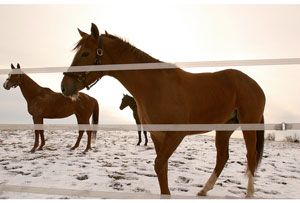
Out to pasture: Three of the 80-plus Thoroughbred Retirement Foundation - supported horses at Claybank Farms. |

The game of fortune that is Thoroughbred racing has its upsides and downsides. Leave Seattle, an 18-year-old son of Triple Crown winner Seattle Slew, was about to become an example of the sport’s biggest downer. He was slated to be peddled for a pittance at a horseflesh sale in Massachusetts, with the likely outcome that his purchaser there would in turn ship Leave Seattle to the slaughterhouse.
This ignominy came to the horse because, despite being a $200,000 purchase at a 1990 two-year-old training sale, Leave Seattle never hit the board in any of his three starts at Southern California racetracks. His lifetime earnings stood at zero.
But when Michael Blowen, founder and president of Old Friends, a Thoroughbred retirement facility in Midway, Ky., discovered that the horse might be headed for the slaughterhouse, he turned to a Connecticut prison guard for help. “He’ll use his own money to buy Thoroughbreds from sales and donate them to the Thoroughbred Retirement Foundation or another group,” Blowen said of the unidentified samaritan. “He happened to have the day off so he could . . . talk to the owners.”
That gesture bought Leave Seattle precious time. His appearance at the livestock auction was delayed and, as this issue went to press, the horse was still being stabled in Massachusetts. The Old Friends founder said he would take him in should his status change. “His life is already better,” said Blowen. “Anytime you draw attention to any of these horses it’s a good thing.”
A slaughterhouse fate recently may have befallen a son of top sire Storm Cat as well. Storm Uprising, out of champion mare Hidden Lake, bombed at the track, and as a four-year-old gelding was not even competitive in low-level claiming races. His future was uncertain until Carol Farmer, one of the co-breeders of the unsuccessful runner, quietly purchased him, retired him and turned the flopped Thoroughbred, who was once trained by D. Wayne Lukas, over to the Thoroughbred Retirement Foundation. Storm Uprising is now being stabled at the Blackburn Correction Complex in Lexington, which is one of six prison facilities in the U.S. that takes in retired racehorses on behalf of the TRF and trains inmates in their care.
For Rep. John Sweeney, a New York Republican whose district includes Saratoga Springs — home of the historic Saratoga Race Course — leaving the fate of unwanted horses to the whims of the marketplace is unacceptable. An estimated 65,000 horses, representing all breeds, are killed each year at foreign-owned meatpacking plants located in Texas and Illinois. As many as 10 percent of those horses are estimated to be Thoroughbreds, and Sweeney believes their slaughter needs to end.
|
|---|
Showing the love: Claybank’s Julia Householder |

“Slaughter is not humane euthanasia,” Sweeney wrote in an e-mail to Louisville Magazine. “Horses suffer horribly on the way and during slaughter.”
As a member of the House Appro- priations Committee, Sweeney introduced an amendment to the 2005 Agriculture Appropriations Bill that overwhelmingly passed the U.S. House and Senate. It effectively removed federal funding for live-horse inspections prior to slaughter for the 2006 fiscal year. Last November, President Bush signed the measure into law, barring the Agriculture Department from using taxpayer money for such inspections. Because federal law requires pre-slaughter inspection of livestock, congressional sponsors of the legislation thought they had successfully stopped horse slaughter in the U.S.
They were wrong.
A month prior to the March 10 deadline for the removal of federal funding for inspections, the USDA cited a loophole in the law and said it would pay for inspectors by charging the slaughter plants for the service. An outraged Sweeney lashed out at the Department of Agriculture.
“My colleagues in Congress and I were shocked and deeply upset to learn that USDA has apparently decided it need not carry out Congress’ clearly expressed intent to /files/storyimages/horse slaughter for human consumption . . . but, rather, intends to engage in a complex regulatory maneuver to willfully circumvent legislation,” his e-mail to Louisville Magazine said.
(In 2002, Sweeney introduced a stand-alone measure that called for the outright ban of horse slaughter. The American Horse Slaughter Prevention Act languished in the House Agricultural Committee until 2005, when it was assigned to another committee. Sweeney now hopes that backlash over the Department of Agriculture’s recent inspection decision will encourage members of Congress to pass this act.)
Had the anti-slaughter law been implemented, it might have lowered the level of desperation associated with some Thoroughbred rescues. But even its passage would have left unchanged the day-to-day struggles faced by groups charged with caring for hundreds of Thoroughbreds deemed no longer useful by the racing and breeding industries.
“Do the math,” said Blowen, who operates Old Friends on 10 acres of leased land at Hurstland Farm. “See how many foals are born. They have to go someplace.”
At first glance, the numbers are overwhelming.
An estimated 37,000 registered Thorou- ghbred foals were born in 2005 in North America. No single agency tracks the fate of retired or non-raced horses, so it’s difficult to know how many are at risk to become homeless or bound for the slaughterhouse. Here’s what we do know: Several groups, often with meager resources, are making heroic efforts to save these animals.
Despite limited space, 15 retirees reside at Old Friends. The farm, whose main mission is to ensure the safe return of pensioned stallions to the U. S. once their overseas stud services are no longer economically viable, also supports two elderly mares and a stallion at two other retirement facilities. It helps from a public-relations point of view that high-profile horses such as 1984 Bluegrass Stakes winner Taylor’s Special and 1988 Eclipse Award-winning turf champion Sunshine Forever live on the grounds. But also in the mix are a few low-level claiming horses from Suffolk Downs near Boston.
Blowen shares the horses’ stories with tourists. Free tours are given daily, and last summer Old Friends averaged 750 visitors a month. Some are die-hard racing fans looking to see some of the sport’s aging stars, while others simply want an opportunity to visit a Kentucky Thoroughbred farm. Moved by what they see and hear, many visitors hand Blowen cash following a tour. And while Old Friends doesn’t solicit contributions from owners looking to donate a horse to the facility, some have funded those animals or paid for the repatriation of stallions from abroad.
Twenty-one-year-old Ruhlmann is a good example. As a racehorse, the nearly all-black eight-time stakes winner gallantly ran down both Easy Goer and 1989 Kentucky Derby winner Sunday Silence during separate winning efforts. He came to Old Friends with an endowment provided by owners Jerry and Ann Moss days after their colt Giacomo won the 2005 Kentucky Derby. While Blowen wouldn’t disclose the size of Ruhlmann’s trust fund, he said that Madeleine Paulsen Pickens picked up the $65,000 tab to bring both 1992 Breeders’ Cup winner Fraise and multiple Grade I winner Ogygian back from Japan. This was done to ensure that they would not share the fate of 1986 Kentucky Derby winner Ferdinand, whose death in Japan after he failed to sire winning progeny was widely believed to have come at a slaughterhouse. (Slaughtered horses are often used for pet or zoo food, but diners in some European and Asian societies, including the Japanese, consume horseflesh.)
Blowen believes the Old Friends concept can be duplicated in other places. “There’s no reason why you couldn’t do this in New York or Florida,” he said. “Or you can do other things, like have a place where land isn’t as expensive as it is here in central Kentucky. Get the horses. Get the old trainers and get them to tell stories. People like hearing stories associated with these horses.”
ReRun takes a different approach. Based in New Jersey, some 30 miles from Monmouth Park, this organization takes retired racehorses and rehabilitates them for adoption. The group’s president, Laurie Condurso-Lane, says right now ReRun is paying the bills for 22 ex-racehorses housed at satellite farms around the U.S. “How many open slots I have hinges on how much money we raise,” said Condurso-Lane. “Or, if I get 10 adopted out, then I have 10 slots. I always have a waiting list.”
In 2004, ReRun found homes for 69 Thoroughbreds. The number of adoptions dropped in 2005 to 39. “This year, we’ve started off strong,” she said. “We’ve already adopted six horses in two months.”
Owners and trainers often inform ReRun about at-risk horses. So do volunteers who att/files/storyimages/live auction sales in search of Thoroughbreds. Condurso-Lane recalls what happened the night she took a call from a frantic volunteer who had just watched a Thoroughbred being purchased for what she suspected was an upcoming trip to the slaughterhouse. With the noise of the sale in the background, Condurso-Lane listened as the woman urged her to act quickly.
Condurso-Lane instructed the volunteer to ask the buyer how much he wanted for the animal. The answer was $275. Despite her own limited funds, Condurso-Lane agreed to the price and bought the ex-racer, who happened to be a son of 1997 Horse of the Year Favorite Trick. “He came from Philadelphia Park and still had his racing plates on,” she said. “. . . It was the best Christmas gift I could have bought myself. But I did think about all the ones we didn’t buy that day.”
Something Condurso-Lane is very clear about is the fact that it might be impossible for ReRun, or any other organization, to save every unwanted racehorse from meeting an untimely and unsavory demise. Still, she is undaunted. “You’ve got to go to bed at night knowing you’ve made a little difference,” she said. “Our mission is horses on the racetrack and we stick to that.”
ReRun has devised innovative ways to raise money. One of the most successful to date is through “Moneighs,” paintings produced exclusively for ReRun by famous racehorses such as Kentucky Derby winners Funny Cide and Smarty Jones (the brushwork is done by their heads and tails). Sales of this horse art have added a much-needed $20,000 boost to ReRun’s coffers. Another fund-raiser, “Running for ReRun,” encourages owners to donate a portion of their horses’ winnings to the organization.
Condurso-Lane endorses euthanasia, if no better option exists. “My dad’s fri/files/storyimages/calls me the Grim Reaper,” she said. “But euthanasia is not a horrible death. It is a dignified death.”
New York turf writer Bill Heller refuses to accept the idea that not all ex-racehorses can be safely kept outside the slaughterhouse doors. While researching and writing After the Finish Line: The Race to End Horse Slaughter in America (BowTie Press), Heller said, he counted no less than 250 horse-rescue Web sites on the Internet.
“If they can’t all be saved, then veterinarians should donate euthanasia,” said Heller. “The way these horses are slaughtered is disgusting and disgraceful.”
Anger over the practice prompted Heller to come up with the impetus for the “Ferdinand Fee” — a voluntary donation program initiated in late 2005 by the New York Thoroughbred Breeders Inc. and the New York Thoroughbred Horsemen’s Association. Revenue from the program is divided between Thoroughbred Charities of America and Blue Horse Charities, which distribute money to rescue and retirement operations around the country.
The Shrewsbury, N.J.-based Thoroughbred Retirement Foundation has seen the number of horses living at sites it works with swell to 1,600.
“They closed the backstretch at Suffolk Downs and so there were probably 50 or 60 horses with just no other place to go,” explained TRF executive director Diana Pikulski. The organization moved in and found shelter for the dispossessed Thoroughbreds. Pikulski said she expects TRF to recoup some of that cost this spring when the Massachusetts Horsemen’s Benevolent and Protective Association is expected to give the TRF a $50,000 donation for its intervention.
At nearly the same time, the TRF stepped up its presence at livestock auctions and searched “kill pens” for Thoroughbreds it might save. Last fall, the group called upon breeders to do more and, as part of that effort, TRF operations director Fred Winters asked members of the Kentucky Thoroughbred Farm Manager’s Club to voluntarily take in a retiree or two.
In general, the TRF asks owners seeking to relocate a horse for a $2,500 donation. But, Pikulski said, no horse will be turned away if an owner lacks the means to pay. “Flexibility is not the right word, but we rise to the occasion depending on what the circumstances are for every horse and every person who needs to retire a horse,” she said.
And the organization relies heavily on owners with deep pockets — like John and Susan Moore, who reside in New Jersey and race under the name M&M Stable. Because they don’t own a farm, the Moore’s retire their horses through the TRF at the rate of two to three a year. Pikulski said the Moore’s generally donate anywhere from $50,000 to $100,000 a year to the TRF to help offset the cost of caring for the horses.
The TRF has become creative in fund-raising and developing relationships with foster caregivers. Julia Householder, a Thoroughbred breeder, maintains 81 TRF horses on her 300-acre farm north of Lexington. Situated in an area that is considered prime central Kentucky horse farm country, Claybank is also home to Householder’s active broodmares, pensioned broodmares and a handful of pasture boarders.
“We get a minimal monthly fee,” said Householder, who began sheltering TRF horses in 1999. “Most of the horses we have are not eligible for adoption. Their (racing) injuries are so significant they’ll never have a use other than as ‘lawn ornament,’ which is a term I hate.”
As a satellite farm, Householder receives $3 a day per horse from the TRF. She cultivates outside relationships that will ultimately benefit the horses, actively seeking donations of products and supplies. “These are things we really need,” she said, “things like bandages, needles and leather halters. We have a big need for halters.”
While the TRF has asked the Thoroughbred industry to accept greater responsibility for the care of its former athletes, Pikulski said breeders are already involved with retired racing and breeding stock. “The breeding farms said to us, ‘Look, we’ve got whole fields of pensioners. And besides, we give through the stallion fees and auctions.’”
There may be other ways to involve the Thoroughbred operations. “We’ve been doing this for 25 years,” said Pikulski. “It took a long time for us to get to where we are today, and I expect we will continue to make progress.”
One ray of hope, she added, is the task force that has been created in New York through the New York Department of Racing and Wagering; it is charged with trying to find retirement homes for racehorses. “That’s monumental,” she said. “So, things are changing.”
Kathleen Adams, assistant news director at WUKY-FM in Lexington and a freelance writer, adopted Nine Ways, a Thoroughbred who was donated to the Thoroughbred Retirement Foundation, in 2004 and stables him at Claybank Farms in north Lexington.