

We asked our readers to s/files/storyimages/us pictures and stories about their beloved pets — and they delivered amusing and touching tales. A select few of those Real Pet Stories appear here, along with a brood of related features for animal-lovers. Read on for the lowdown on doggy bakers, new toys and products for your pets, a myth-busting vet, trivia and surprise appearances by ferrets and a?pot-bellied pig.
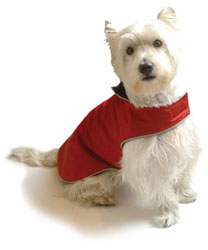
Teckelklub Dog Coat, from Good Dogs & Co.
Real Pet Stories
Prodigal Pussy
In 1999, we moved about a mile from one house in the
The day of the move we put our three cats on the screened-in back porch so that, as the movers came in and out, the cats would not get out of the new house. Unfortunately, I had not noticed the screen had a tear. Hawk found the opening and took off. The next day we put “missing cat” signs up  near both our new and old homes. After three days, Hawk turned up at our old house. We found him sitting on the “cat ledge” at the window where the pet door had been.
After retrieving Hawk, we planned to keep him indoors for several weeks until we felt he had adapted to the new digs. That plan was foiled about a week later when a repairperson left the basement door open. This, of course, was two days before we were due to leave on vacation. Day one he had not appeared at our old place. The next morning, just before leaving, I drove back to the old house and once again Hawk was sitting on the cat ledge. We were relieved to have him back and the house sitter had instructions to make sure he stayed in.
We entered a period of “adjustments.” We’d keep him in for several weeks, let him out under supervision, and bring him back in when we felt he was heading for the alley. After we felt he was planning to stay, we would relax our guard. He would lull us into complacency, going out and hanging around for a few days or more, coming in and out as if nothing was amiss. Then one day he would be gone again. He did this a total of 17 times in the first year and a half of living in the new house. We never knew his route, but I hoped he used the walk light button at Speed and
Retrieving Hawk began to be a challenge. He knew the game, and when we came to get him he led us on wild-goose chases through the neighborhood. We sometimes needed to go back multiple times to try to get him. Finally, on trip number 16 the tide turned. After he’d been gone for several days, and we had made a couple failed attempts to retrieve him, he made the return trip himself — much to our surprise and delight. Once he had made the return trip, the saga ended. He was AWOL just once more after that, for 24 hours beginning on New Year’s Eve. We can’t confirm that he went back to our old place, but I think he went back for one last party.
— Leslie Friesen
Our Cover Dog: ?Old Mr. Fitz
When you look at this little pampered pooch, you would think he has lived in luxury all his life. Wrong. Fitzgerald, or Mr. Fitz, as everybody calls him, was found at a bourbon distillery site — namely, the original Old  Fitzgerald Distillery. He was discovered by the security guards — Arthur, Rollie, Harry, Leroy and Carroll — when he wandered onto the property with several large dogs. The big dogs taunted Mr. Fitz, which may explain why today he acts like a very big dog in a little dog’s body. His hair had grown about a foot long and you could not tell one /files/storyimages/from another.
The security guards, concerned for Mr. Fitz’s well-being, ran off the big dogs and began  setting out food for Mr. Fitz. He was a bit shy of these guys, yet ate their food and slept under one of the old warehouse’s steps for months. Once he warmed up to the security guys, he began staying in the security station, making rounds with the guards, greeting guests and trucks that came in, and the very big dog in a little dog’s body became an official watchdog.
Time went on, and when the distillery became busier and busier with traffic, Mr. Fitz found a home with Brenda and Ron Gaffney. Fitz’s vet thinks he is a schnauzer/poodle mix, aka “schoodle.” He makes a very good watchdog at the Gaffney home, but of course he had very good training.
— Brenda Gaffney
Seeing Without Eyes
My three-year-old puppy, River Lucas Killian, is a wonderful example of persistence, tenacity and spirit. He was born completely blind (one of three pups in the litter born without fully developed eyes), and was taken by his breeder to the Doberman Rescue Society in
River has been such a great example to us. He (like many dogs) always has a positive outlook on life, is ready to go play every morning, and is always happy to see us. He and his golden retriever older sister, Kaya, get along well most of the time. They play and wrestle in our yard in Crescent Hill in between trips to the park. My husband and I get up every morning and take the dogs to the park to play and run. River has learned to fetch. So we have a special rubber ball for him that smells different from Kaya’s tennis ball. We give him the command to get “ready” and then we chuck the ball as far as we can throw it.  River’s keen ears listen for the ball to land and then he circles until he finds it. Sometimes, he marks where it lands and then circles just because he needs to run. He brings it back to us, dropping it within a few feet. Meanwhile, Kaya is chasing her tennis ball vigorously and staying out of River’s way. She quickly learned that he’ll smack into her if she’s not careful. Other dogs have a harder time learning that — my parents’ chocolate Lab, Cassius, still hasn’t quite figured out what’s wrong with River.
After the adventure in the park, we come home, feed them and get ready for work. River is still in a kennel (it’s his safe and happy place), but he always gets a peanut butter Kong as we leave. Most mornings he is anxious for us to go so he can have his treat. He sits in his kennel and waits until we leave. We usually come home for lunch and let the dogs out to play. Then after work, we take everyone back to the park or for a walk. In the summer months, it is easy to get enough exercise. In the fall and spring, though, it is tougher. The dogs are wound up, energetic and loving life!
River has been an inspiration to me and to so many others. When we tell people his story, they don’t believe it. And when people see him at the park, they can’t tell he is blind. He looks up at the sky as he listens intently for environmental cues. He walks with a high step so he can avoid running into too many things. He has memorized the layout of the house and the yard, but when he gets excited, he forgets where things are positioned. We have verbal commands for him so that he won’t hurt himself. So if he is running at full steam and is about to run into something, the command is a firm “EASY” and he puts on the brakes. I have never seen anyone or thing so trusting of another person. He fully anticipates that my husband and I will watch after him and protect him. And he is so appreciative of our love!
— Kate Killian
A Pig’s Life
Every day is just another day in paradise for
Callie slumbers the night away on the Boels’ sofa and starts each day with an early wake-up call. “She is pretty angry about getting off the couch in the mornings and I usually have to start persuading her 20 minutes before we need to leave,” says Boel. Pig and  owner then take a short walk to Zubrod Stables, where Boel trains saddlebred horses and gives lessons. Callie spends the rest of the morning wandering into stalls, scavenging bits of leftover horse feed.
The 150-plus-pound porker hangs out in the stables until evening, when she and Boel walk back to the home they share with husband Klaus. Callie returns to her throne on the coach. “She watches TV with us and will occasionally raise her head and oink for treats if she hears the refrigerator open,” says Boel, noting Callie’s sweet tooth and fondness for grapes. Her master’s only complaint? The pot-pellied princess tends to hog the couch.
— Melissa Duley
Reigning Cats and Dogs
Let’s see how much you really know about Buddy and Whiskers:
1. All cats are born with what color eyes?
2. Which dog breed is subject to the most genetic disorders?
3. Some dogs can quickly develop acute kidney failure by eating just a few of which fruit?
4. What’s the total number of toe pads a normal cat has?
5. The
6. Which internal organ becomes inflamed when a dog on a low-fat diet is fed turkey skin or ham fat?
7. Cats sp/files/storyimages/nearly 30 percent of their lives doing what?
8. Which is worse for your dog — raw or cooked chicken bones?
9. What distinction among animals do camels, giraffes and cats share?
10. What disorders do you invite by continuing to feed your dog puppy food after six months?
Answers: 1. Blue 2. German Shepherd, More than 100 3. Grapes 4. 18 5. Dogs — derived from the Latin word canis
6. Pancreas 7. Grooming themselves ?8. Cooked 9. Stride with both left feet, then right feet 10. Bone and joint
Did You Know?
1. People have more than five times as many taste buds as dogs, but only 1/40 the smell receptors — which explains why dogs want food so badly and then bolt it down with no relishment whatsoever.
2. Female cockatiels will lay eggs, even without fertilization, and protect them from intruders.
3. A University of 
4. Never feed a dog raw salmon or trout, which can contain the parasitic worm Nanophyetus salmincola — itself host to the deadly (to dogs) bacteria Neorickettsia helminthoeca. Another item you don’t want your dog gobbling is macadamia nuts, which can cause painful paralysis in a dog’s rear legs.
5. Because cats have a layer of light-reflecting cells called the tapetum lucidum, they see six times better than humans at night.
6. If you own a pet bird, get rid of any Teflon-coated griddles and pans. Teflon fumes are deadly to birds.
7. A sure sign that your cat is happy is when it walks around with its tail pointed straight up.
8. The Food and Drugs Administration has determined that the actual beef requirement in any pet food displaying the words “with real beef” is 3 percent.
9. The only place a dog has sweat glands is in its paws.
10. Among parrots, the most complex thinking and adeptly talking species is the African grey parrot.
Barking Up Wrong Trees
Contrary to popular misperception, says veterinarian Dr. Consuela Reinhart of the Chenoweth Animal Hospital on Frankfort Avenue, the treats you give your dog and cat don’t have to come from a can or box to be appreciated. Says Reinhart, who owns six dogs and 10 cats, “My pets only get fresh fruits and vegetables as their treats. And they get extremely excited about that. It’s all how we condition our pets.” Four animal-toxic produce exceptions are grapes, raisins, onions and garlic.
Steer clear of putting out a bowl of milk for your cat, or cracking a raw egg into it to improve kitty’s coat, says Reinhart, because cats can’t metabolize lactose and the salmonella risk is too high. “I myself am guilty of letting my cat lick the bottom of my cereal  bowl, maybe two or three little laps,” the vet says, “but I know that more than that and my cat’s going to wind up with gastric distention, gas and diarrhea.”
Another no-no: over-the-counter flea and tick collars and sprays containing old-tech organophosphates. “They don’t work,” Reinhart says. “They’ve been out on the market for so many years and the fleas and ticks are resistant, and you could actually /files/storyimages/up with toxicity because the drug is concentrated around the (pet’s) neck.”
Specific myths propagated, in some cases, by people’s physicians: that pets may be responsible for your child’s strep or pinworms or head lice. While there are infections that can be spread between people and animals, the vet says, “the classification of a strep bacteria that lives in a dog is different than the classification that can live in human tissue.” Pinworms, she says, are only transmitted between humans, and dog or cat lice feeding on an animal with a steady 102-degree blood temperature can’t deal with our 98.6.
Oh, and for pet owners whose dog or cat got ahold of a milk-chocolate Hershey Bar square and didn’t suffer any consequences, do not think for a moment that chocolate toxicity is nonsense. Dark chocolate contains roughly 10 times as much theobromine as milk chocolate and, Reinhart says, “is highly cardio-toxic to dogs and cats.” The smaller the dog, the more susceptible it is to internal bleeding and possible cardiac arrest caused by theobromine.
— Jack Welch
Chef de Canine
The whole-wheat muffin “celebration cake” looks delicious. Chef Brenda Miller has spread a peanut butter, low-fat icing over it’s cushiony surface, decorated its sides with unsalted peanut crumbs and placed it in a case, with other baked goods, for customers to see. The cake looks like you could serve it at a child’s birthday party, though its dog-bone shape would seem a bit unusual and out of place. It’s a perfect fit at Three Dog Bakery in Chenoweth Square, however, because here the treats are for the canines.
“The dogs just love them,” Miller says of the goodies, with names such as Puppermint Patties, Drooly Dream Bars, Pup Tarts, Ruffles and, of course, Snickerpoodles. “I’m like their aunt. I can spoil all the dogs.”
When Three Dog opened about eight years ago, in 1999, “pawprietor” Shelby Simpson didn’t seek an ordinary baker who could whip up ordinary dog biscuits. “I wanted a real pastry chef,” he says. “I wanted our bakery treats to be the best-looking dog treats you’ve ever seen.”
Miller — who calls herself a “pastry chef for dogs” — seemed to be a good candidate. She had just graduated with a culinary degree from Sullivan University and was working at now-defunct Chez Mann Patisserie and Chocolatier on Bardstown Road. Some days Miller would show up at 4 a.m. to start baking, and, after only six months, she was ready for new work. “Dog baker was a new concept to me,” she says, “but I was open to it.” Plus, the chef adds, there was a year-round job perk: “I’m not tempted to eat what I bake.”
She’s been at Three Dog since the doors opened there and does the “baking, dipping and decorating of dozens and dozens” of doggie sweets every day, using all-natural ingredients such as carob, whole-wheat flour, honey, applesauce and peanut butter. Sometimes she creates her own recipes, like the one for Puppermint Patties. “I just imagine what’s going to happen when customers take them home and the dogs tear into them. I think it’s hysterical,” she says.
Usually it’s the pooches peering into the treat cases, but even humans have been known to munch on Dottie’s Spots, which look like miniature chocolate chip cookies. “Some of them aren’t bad,” Miller says. “They’re just bland.”
— Josh Moss
Ferreting for Ferrets
Thanks to a January 2007 change in Jefferson County’s pet license application, a new type of furry fri/files/storyimages/is beginning to inhabit Louisville: the ferret. Jay Hockersmith, owner of Pet’s Palace in Bon Air Manor, a local distributor for these playful cousins to  weasels and minks, says he sold more than 500 ferrets during the first half of the year — after they were reclassified by Metro Animal Services to be licensed similarly to dogs and cats.
Why the new status? Animal Services director Dr. Gilles Meloche says he added them to the pet license application because there now exists an approved ferret rabies vaccination, which must be administered to the pets and which produces a record of the animal and its owner that can be tracked by county authorities. In the past, ferrets were considered wildlife and could only be kept here with an exotic animal license, obtained after a home inspection and a $100 fee to the county.
Meloche would prefer a dog or cat as a new pet (“I still consider ferrets not totally tame,” he says), but many others are uncaging them in their homes. Twice a month, Pet’s Palace brings in 48 young ones, places them in a display window and sells them for $125 apiece. The masked and mostly brown (though some can be white) ferrets grow to a foot or more in length and weigh one to five pounds as adults.
“They’re halfway between dogs and cats. They’re not as intense to keep up as dogs and they’re not as independent as cats,” says Hockersmith. The soft, furry critters might sleep in a person’s lap, but they’re inquisitive too. Ferrets will seek out dark places — up a pant leg, for instance — and often grab a few souvenirs.
“They’re collectors,” Hockersmith adds. “They’ll steal socks, or a shoe, and drag them away to their own private place.”
— Bruce Allar
Health Food for Hounds
Dog diets became a concern to Karla Haas in July 2006, when her 14-year-old chocolate Lab, Rudy Green, became ill. “He got a stomach ulcer, so the vet said I should cook for him to nurse him back to health,” says Haas, 47. But cooking for one shortly turned into dinner prep for all three of her dogs. “It wasn’t like I could cook for Rudy and the others would say, ‘Oh yeah, we’ll just have dry dog food,” she quips.
Once Rudy was well, Haas tried reverting back to the former food regimen for her pooches: dry food topped with canned. But that didn’t last long. “They went on hunger strike,” she says. “They just refused to eat.”
So later in 2006 Haas decided to cook for canines full time, founding Rudy Green Ventures and introducing Rudy Green’s Doggy Cuisine. Read the ingredients in your average dog food and you’ll begin to understand why dogs might prefer Haas’ meals to preservative-filled canned varieties. “My dog food comes frozen, so I don’t need to put any preservatives in it,” says Haas of her supplements to dry food. “It’s basically people food for dogs, but without the seasonings, spices and preservatives that aren’t good for dogs. It’s human grade, but made specifically for a dog’s diet.”
The ingredients are also fairly straightforward. The Pork, Pasta & Potato package contains pork loin, potatoes, pasta, celery, garlic, olive oil and bay leaf; Veggie Might includes lentils, barley, potatoes, spinach, corn, peas, carrots and flaxseed oil. According to Haas, who manufactures her product in a food-industry incubator building on East Market Street, several veterinarians and nutritionists she consulted while developing her product gave the recipes a thumbs-up.
Haas highlights the importance of combining Rudy Green offerings with dry dog food. “This way the dog gets all the vitamins and nutritional supplements that are in dry food, but they also get the benefits that come from real meat, real vegetables and whole grains,” she says. She adds a word of warning: “A lot of dry dog foods contain large quantities of byproducts. You want to find a food with real meat listed as the first ingredient versus a meat-meal, which is ground-up byproducts.” (Meat-meal contains “unpalatable” animal parts that people do not eat.)
Twelve-ounce packages of the four varieties of Rudy Green’s Cuisine (www.rudygreens.com) may be purchased locally for $3.99 at Metzger’s Country Store, Barkstown, Wild Oats, several Kroger groceries and Rainbow Blossom. Haas also is pursuing outlets in the Cincinnati, Nashville and Indianapolis markets.
— Lisa Aufox
By the Numbers
Louisville Metro Animal Services provided these statistics for Jefferson County, compiled from 2006 data:
Strays Admitted
Dogs/puppies 5,056
Cats/kittens 4,642
Other 98
Total 9,796
Total number of animals received (including confiscations, owner turn-ins and other sources): 14,165
Outcomes
Adoptions 940
Transfers 1,168
Returned to owner 1,216
Euthanized 9,481
Other 1,360
Kentucky Humane Society ?
(data for Jefferson, Henry, Trimble and Spencer counties)
Last Fiscal Year?
(October 2005-September 2006)
Pets Admitted
Owner Surrenders: 7,586
Strays: 2,039
Total Pets Admitted: 9,625
Total Pets Adopted: 5,070