
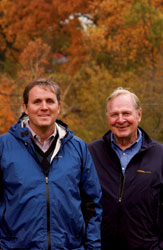

 One man carries powerful memories of Victory Park at 22nd and Kentucky streets, where he learned to play sports; of riding his bicycle to Shawnee Park for sandlot baseball; and of catching the streetcar with his parents and five siblings at 18th Street, changing at Oak and again at Fourth on the way to Iroquois Park. "We would go out there for picnics on Sunday," he says. "We’d go out there for the amphitheater."
The other fondly recalls growing up in the Highlands on Village Drive, two blocks from Cherokee Park. "My mom used to take me all of the time to Big Rock," he says. "I remember the swings with the little horses on them." Childhood trips to Bernheim Forest also helped ignite a passion for the natural world that drives him still.
These men have two things in common: a love of the Frederick Law Olmsted-designed green spaces in and around the city and the same genes. Now David Jones Sr., 75, and his son Dan Jones, 45, are putting their considerable clout and energies behind a project that will, if it matches expectations, produce massive new parklands in Jefferson County in the early 21st century that could rival the farsighted late-19th century work of Olmsted — whose vision had a hand in creating the lasting beauty of Louisville parks, from gems like Cherokee, which meant so much to Dan Jones as a child, to smaller-scale grounds like Victory, where a young David Jones found his recreation.
In a year that has seen accomplishments of note by several Louisvillians, the Joneses’ actions stand at the top for their long-term impact on the future of the metro area. Persons of the Year cases might be made for a number of newsmakers in 2006. The duo most responsible for reviving the Louisville Orchestra after its near-bankruptcy early this year — Brad Broecker and Jorge Mester — receive mention for the vigor and optimism that is returning to that once-beleaguered performing arts mainspring. Tyler Allen, with his tenacious campaign to revisit bridge-building and highway-construction plans that call for a larger elevated-freeway footprint over the city’s waterfront, has strong advocates among those who envision an interstate-free riverfront, and equally strong detractors, who consider him an obstruction to progress. University of Louisville football coach Bobby Petrino is revered for bringing the Cardinals within range of a first-ever national championship in that sport. And the power couple of Laura Lee Brown and Steve Wilson opened the 21C Museum Hotel, where sharp urban design and the ubiquity of contemporary art have made it a darling of the national media, while announcing plans to build a new architectural wonder off West Main Street, the $380 million Museum Plaza skyscraper.
But at the /files/storyimages/of the day — make that the year — we were drawn to the contributions of Dan and David Jones in building the funding, support and machinery for development of new parklands and trail systems that could well have as dramatic an impact on future Louisvillians as the Olmsted legacy did on generations before them. The Joneses are Louisville Magazine’s Persons of the Year for 2006.
The scope of Jefferson County’s parks project is immense. Planners are working with an expected total of 4,000-plus acres along 27 miles of the meandering Floyds Fork Creek valley bracketed by Shelbyville Road and Bardstown Road; more than 3,400 of those acres have already been acquired. There are also plans to fill in some gaps by adding land to Jefferson Memorial Forest, which at 5,650 acres is already the largest municipally owned urban forest in the U.S., and to construct 100 miles or more of a paved hiking and biking trail circling the outskirts of the county.
The Floyds Fork corridor is the area of biggest current emphasis. Philadelphia-based design firm Wallace Roberts & Todd was selected this year to develop a master plan for parklands and connecting trails along the waterway. Paul Rookwood, who heads up the firm’s design team, points to other significant urban-area greenspace developments — Wissahickon Creek in Philadelphia, Rock Creek in Washington, D.C., and Emerald Necklace in Boston — and says, "Floyds Fork is about three times the size of any of those projects."
Rookwood adds, "What’s really remarkable is that the county and 21st Century Parks and others involved are grabbing hold of a quite beautiful stream corridor that’s still in quite good shape ecologically — and doing it on such a large scale. We’re getting in early enough that you really have a shot at developing contiguous areas while dealing with the sustainability of the valley."
The opportunity to dream big along Floyds Fork has captured the imaginations of many, including Dan and David Jones. In the mid-1990s, then Metro Parks director Brigid Sullivan and Bill Juckett of the Olmsted Parks Conservancy were asking Louisville’s movers and shakers a 100-year question: What can be done in the present-day community that might match the impact of the Olmsted Park system, which was created in the 1890s? "They wanted to meet with my dad, and he knew I loved parks and asked me to come to the meeting," says Dan Jones.
Afterward, he says, "I went off and started thinking about it, and I finally decided that basically we should do the same thing, which is go out and try to find property ahead of development." The Floyds Fork area burst forth as the focal point for such an effort. "There’s an opportunity there to repeat what I call the Olmsted model," he says.
Working farms adjoin preserved Future Fund and Metro Parks land along the creek. The Joneses (left) foresee a ring of parks.
This year, Dan Jones took over as chairman and CEO of 21st Century Parks, which is acting as an umbrella organization for efforts to plan and build those new parklands and recreation facilities. And in 2006 his father put some real muscle into the initiative by completing, well ahead of schedule, a $21 million private fund-raising campaign that, combined with public moneys (most specifically $1 million from metro government in the current budget and $38 million in earmarked federal funds secured by Sen. Mitch McConnell), makes the project what David Jones describes as "in essence pre-funded. We have enough money to actually build out at least the first big park and the trail system, and probably enough to get started on the second park." He says there is $60 million now available for this work.

David Jones’ commitment to Floyds Fork goes back to the early ’90s, when the original visionary of land preservation in that watershed, Steve Henry, then a Jefferson County commissioner, approached him for funds and received $500,000 from the Jones family and the Humana Foundation (the senior Jones is a co-founder of Humana Inc.). With an added $250,000 each from Mary Bingham and his own funds, Henry began acquiring property and negotiating for land easements through the organization he founded, Future Fund — which as of 2006 has preserved more than 2,000 acres in the watershed along with several pledged conservation easements. "Steve Henry was the one who called my attention — and ultimately Dan’s attention — to the Floyds Fork," David Jones says.
Dan Jones took note of Future Fund’s efforts and, after determining that Floyds Fork could be the site for Olmsted-quality parks, put up $35,000 to finance a study by Dan Church, an architect with Bravura who had also been involved in Waterfront Park planning. The 2003 study presented an inventory and analysis of the properties along Floyds Fork and suggested how parks could be added into the mix. It was a typical approach for the studious and analytical third child of five to David and Betty Jones. "He loves getting input and information," says his father.
Describing himself as "overeducated," Dan Jones sees his current parks work as the perfect intersection of his interests. With a Chinese language and literature bachelor’s degree from Yale, he added graduate studies that led to a doctorate in the history of the American West from Indiana University, with a focus on land use, conservation and environmental history. After abandoning professorship as a career choice in the mid-’90s and returning to Louisville to pursue real estate development, he still had a dissertation to research and write to complete his advanced degree. He approached it with discipline. "I’d come in to the office about 6 a.m. and write for about two hours and then do other work," he says. "It took me 18 months to complete."
The subject: the career of John Wesley Powell, a one-armed Civil War veteran whose land-reform and preservation efforts out West made him one of the founding spirits of the American conservation movement.
Jones met his wife, Lisa Petrilli Jones, a fellow Louisvillian, when they were undergraduates at Yale. (Actually, they’d met previously, when they rode in the same kindergarten car pool.) She gave him a canoe for a wedding present. Their honeymoon took them scuba diving to the Great Barrier Reef and hiking along a pass at 18,000 feet in Nepal. The couple have two boys and two girls, ages 3 to 11, and live in Anchorage. She is a pediatrician.
While active in real estate, Jones helped develop the Mockingbird Gardens subdivision, the Waterside Business Center (former Belknap Hardware buildings now occupied by Humana) and Different Strokes Golf Centers. When his company made plans to move the original Different Strokes from River Road so that Thurman Hutchins Park could replace it (relocating at his business’ expense, he says), he met opposition from some neighbors at the new site just off of the Gene Snyder Expressway, who worried that lights on the driving range and nearby fields would be too intrusive. A compromise was reached and a lesson learned. "Even with parks and good deeds," he says, "people are still going to have an opinion about them. And I think you always should . . . talk to as many people as you can about what their issues are."
His participation in the development of Thurman Hutchins Park, as well as a small park already in place along Floyds Fork called Fairmount Falls ("I raised a little bit of money that allowed them to get a match and get it over the top," he says of his assistance to Metro Parks), fed his appetite for green-space projects. "I have diverse interests, but they almost always come back to land and conservation," he says.
When his son showed him the Church study of Floyds Fork, David Jones forwarded him to Mary Lou Northern, the cabinet member in metro government who oversees the parks. She set up a meeting with Mayor Jerry Abramson, who placed his support behind efforts to build up parklands along the waterway. "Dan had the vision in the beginning with Floyds Fork, which David has now fueled and funded to make a reality," Abramson says. The father’s involvement, adds the mayor, gives the project instant credibility and makes others confident that it will succeed. The son’s return to Yale for a master’s degree in the famed School of Forestry and Environmental Studies, completed this spring, shows his "intellectual commitment" to obtain the tools to see the initiative through, says the mayor.
"We are really excited about the collaboration and have no reservations whatsoever that it will come to reality," says Abramson.
Henry saw the Jones factor as a way to expand the reach of what Future Fund started. "I was too political in asking for money from government, especially with Republicans," says the former lieutenant governor, who recently announced as a Democratic candidate for governor in 2007. "It might be better," he thought at the time, "if we have another organization that is the fund-raising arm of this project."
From these and other discussions, 21st Century Parks was created in May 2005. "The value of 21st Century Parks is it got the three partners to the table," says Northern — the private sector represented by the Joneses, the conservation group in Future Fund and the governmental agency in Metro Parks, which now has approximately 750 acres along Floyds Fork. "When David Jones and Dan Jones formed 21st Century Parks, it gave them the tool to raise money," Northern adds. "It gave us a way to talk about the project without boundaries to the imagination."
When in 2004 Dan Jones left for New Haven, Conn., and Yale, his father became caretaker of the project. He called Northern and asked for a meeting, which he got that same day, for a better understanding of what had already been envisioned along Floyds Fork. Northern unrolled a map showing holdings by Future Fund and Metro Parks as well as jottings on sticky notes outlining ideas for interconnecting many of the pieces. "Now that’s a vision!" David Jones told Northern. "How much is this going to cost?"
"I was glad to serve as treasurer (of 21st Century Parks) because I have a lot of chits to call in," says the senior Jones. He and Abramson met with McConnell, asking the senator if he could find $10 million in federal funds for the new parks. In September 2005, McConnell surprised Jones with a phone call and news of a larger magnitude.
"David and Dan Jones have been the driving force behind the 21st Century Parks project and deserve praise for their heroic efforts to raise private funds," McConnell says in a statement released from his office for this story. "I found their vision so exciting that I secured $38 million for the project last summer so that the expansion of the parks could begin immediately."
Bolstered by gifts of $3 million from the James Graham Brown Foundation, $2.1 million from John and Annette Schnatter, $1 million from Sally Brown, as well as $5 million from the Jones family itself, the campaign went rapidly. Smaller gifts came easily as well. Jones, who retired from Humana in April 2005, spent half of his time in the succeeding year making calls, always in person, on potential donors. He estimates that he spoke with 110 to 120 people and, remarkably, only two turned him down. He usually expects a 40 or 50 percent participation rate for his fund-raising efforts.
"Everybody understands parkland because of the Olmsted legacy that we have here," David Jones says. "All you have to do is cite Cherokee or Shawnee or Iroquois or Algonquin or Seneca. I’ll tell you how excited people are: Seventy-five percent of the money came in cash. I’ve never had a project like that, ever." Only 25 percent opted to exercise the option to spread the payments over a number of years, and all of the donations of $1 million or more came through in cash or immediately convertible stock funds.
Now he plans to raise $10 million more for an endowment to maintain the new parks, plus an additional $4 million to $5 million to acquire more land. The convergence in 2006 of a thoroughly educated Dan Jones devoting full-time to the initiative and a motivated David Jones keeping the funding machine well-oiled is paving the way for what could become the signal community achievement of the next decade.
The two men see a modern-day-Olmsted future along Floyds Fork, where well-designed parks and preserved land set the stage for inspired home developments that make responsible use of the landscape. An $829,000 contract with Wallace Roberts & Todd to create a master plan for the area will be one of 2007’s top priorities. "We’ve told WRT that Olmsted is the bar," says Dan Jones. "Where we put our stamp is the process and the bar. . . . One of the things that I’m very committed to is that this be a very inclusive process — that is, we want to talk to the environmentalists, we want to talk to the developers. And what we want to do is be an advocate for good design with all of those people."
WRT expects to have a draft plan for parks and trails by next spring or summer and a master plan by the /files/storyimages/of 2007. To launch that process, Rookwood and other members of WRT team came to Louisville in October for a canoe trip down Floyds Fork with others intimately involved in the project. The firm’s managing principal recalls sitting in a field over lunch that day with David Jones, discussing the area’s potential. "He built up a very successful corporation," Rookwood says. "Now he’s using that experience to deliver something of lasting value to the community, and he’s really serious about that legacy."
David Jones says he doesn’t like publicity going to either him or his son for what he labels a team project. But he clearly has a passion for the promise of a 21st-century Olmsted-like legacy.
"When we get this project finished," he says, "there won’t be a city in the United States that has the recreational facilities that we have here in Louisville. And that will attract a lot of people to this city. And there will be wonderful subdivisions out that way. We want development there to mirror what’s around Cherokee Park."