
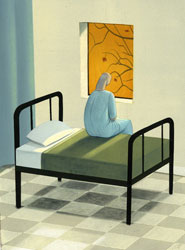

Illustration By Jon Krause
 George Klein considers himself lucky. Over the past decade, the 82-year-old Louisvillian has dealt with three bouts of colon cancer, a stretch of mysterious fainting spells, and a fall down a flight of steps that resulted in a painfully torn rotator cuff in his right shoulder. His good fortune is not only in having survived these ailments, he says, but also in the reasons why he’s survived — the “built-in support system” of three grown children and lifelong friends who live nearby, along with having access to skilled medical care.
A World War II veteran who survived an explosion on the Pacific
While the same can be said for patients of any age, it’s particularly true for older adults like Klein. Too often, it seems, elderly citizens in
Dr. Adewale Troutman, Louisville Metro Public Health and Wellness director, speaks as a public-health official and from long experience as a practitioner, including 13 years in emergency medicine in Newark, N.J. “The level of health care for senior citizens in this country is inadequate, to say the least,” he says. “There is an insufficient supply of people trained in geriatrics who know the subtleties of (caring for) an aging population.”
Statistics from the American Geriatrics Society (AGS) bear him out. The organization projects that by 2030 the number of adults age 65 and over nationwide will nearly double, to 70 million, yet there will be only one geriatrician (a physician with special training in care of the elderly) for every 7,665 older adults. If 2030 sounds far off, consider this: In less than nine years, the oldest of some 77 million Baby Boomers will turn 70. Depending on your point of view, there is either symmetry or irony in the fact that improved health care is responsible in part for boosting the population of seniors who, as a result, will need added health care — and soon.
The present health care system for the elderly also concerns Dr. James G. O’Brien, chair of the Department of Family and Geriatric Medicine at the
The good news is that the remedy is stunningly simple, with no high-tech medicine required: More time for doctors to carefully listen to patients and forestall problems, and minor changes in physical accommodations at hospitals and nursing homes, would go a long way toward improving geriatric care. The bad news is that the current health-care system and the economic structure that supports it are deeply entrenched and difficult to transform. “It would mean a huge sea change to create a very different system,” in
For example, many older adults would be able to avoid hospitalization if there were sufficient numbers of health-care providers and adequate funds to support early intervention at home when health begins to fail. A recent Medicare-funded study found that nursing home residents whose care was managed by geriatric nurse practitioners (nurses with advanced training in geriatrics) had significantly fewer and shorter hospital stays than those who received the usual relay of care between primary care doctors and nursing home staff.
Hospitalization itself presents a unique and troubling set of potential hazards for the elderly. “Hospitals are not really configured to care for older adults,” O’Brien says. “We have an acute-care orientation, and many older adults have multiple chronic conditions that need to be managed simultaneously.” (AGS estimates that 20 percent of adults 65 and older suffer from as many as five chronic conditions, such as hypertension, diabetes or arthritis.) Too often, O’Brien says, there’s no quarterback coordinating care and running interference for the patient and his or her family.
The increasing use of doctors who see patients only in the hospital, known as hospitalists, compounds the problem. “I went to a doctor for 16 years,” says George Klein. “When I was well, we were really good friends, but when I was sick (with puzzling fainting spells), he wouldn’t come to the hospital to see me.” As a result, Klein says, he was seen by a doctor, “who didn’t know me well enough to dig deep enough to know what to start doing.” (A third doctor finally delved into Klein’s problem and discovered that prior surgeries for colon cancer had left him with so little large intestine that he was becoming chronically dehydrated, unable to properly absorb liquids and nutrients. A simple prescription for the old remedy, paregoric, which slows down the bowel to increase absorption, plus appropriate nutritional supplements, quickly got Klein back on track.)
The bed rest frequently encouraged for hospitalized elderly patients is another example of problematic care. “The amount of strength that’s lost in a couple of days of bed rest is massive,” O’Brien explains. “If we leave an older adult in bed for two or three days, we’re shocked when it’s time for discharge. (The patient has) trouble standing, trouble ambulating.” As a result, many older adults who enter a hospital for an acute problem are discharged “less functionally capable than when they entered.” The easy solution would be to encourage more activity as allowed — but that requires a level of hands-on care that can be difficult to obtain and pay for.
A hospital stay for an older adult can also result in confusion or delirium, brought on or made worse by acute illness, an unfamiliar hospital environment and medication doses that may not have been appropriately adjusted. With hearing aids and eyeglasses tucked away for safekeeping, older adult patients can also find themselves deprived of normal sensory skills.
Janet Seron dealt with such issues when her mother, Marjorie White, was hospitalized briefly before she passed away last spring at age 94. In the Louisville assisted-living facility where she had her own apartment, White loved to play bingo, cards and horseshoes, and would “take off without her walker and dance” to musical entertainment whenever she had the chance, Seron says. A fall in her apartment sent White to the emergency room, where it was discovered that she’d suffered a small tear in her spleen. While surgery was not recommended, White’s doctor wanted to observe her overnight, and she was admitted to the hospital.
“The next morning,” Seron says, “we found her hooked up to a (urine) catheter and (intravenous medications). We were told that she kept trying to get up (presumably to use the bathroom) and that (the nursing staff) could not keep up with it.” The following day, Seron found that her mother had been sedated so much that “she slept through Mother’s Day.”
In contrast, in the nursing home to which White was admitted after leaving the hospital, Seron discovered an environment tailored to her mother’s needs. Beds that were low to the floor and surrounded by padding to minimize and cushion falls made it easier for patients to get in and out of bed independently. Call buttons attached to clothing alerted staff even if patients were unable to push them.
Similar accommodations exist in special hospital units that provide acute care for the elderly. Known as “ACE” units, they provide surroundings that help patients avoid becoming disoriented and allow for increased physical activity. But with little pressure on hospitals to modify or restructure, O’Brien says, such units are few and far between, with none currently available in Louisville.
Marcia and Aaron Simon have managed to avoid lengthy hospitalizations during their 64 years of marriage. Now 86, Marcia has had back surgery to help relieve painful arthritis. Aaron, 93, a retired orthopedic surgeon, received a heart pacemaker several years ago to correct chronic low blood pressure and suffers from macular degeneration, which hampers his vision, as well as acute short-term memory loss. Originally from Massachusetts, the Simons had been living in Florida when their daughter urged them last year to move into a suite in her Louisville area home.
In Florida, the Simons had a doctor they liked who was part of a health maintenance organization (HMO). But when he talked to the couple, Marcia says, “it was like he had one foot in the examining room and one foot out.” Aaron, recalling more than 40 years in his own medical practice, told the physician that in failing to get to know his patients he was missing “the greatest pleasure of being a doctor.” The time-pressed doc then explained to the couple how HMO regulations allowed him only five minutes per patient. “Medicine has made great progress,” Marcia notes, but has “gone backwards terribly in terms of personal relationships” between patients and doctors.
In U of L’s O’Brien, however, the Simons found a welcome touch of old-fashioned medicine. “The first thing he had us do was to make a list of the events of our lives,” Marcia says. “Whenever we go to see him, I like it that we can sit down and really talk to him in detail and he really listens.”
O’Brien’s approach is not only comforting to older patients like the Simons, it’s effective, says Dr. Toni P. Miles, who holds the U of L Wise-Nelson Endowed Chair for Clinical Geriatric Research. After working in geriatric research for more than 20 years, Miles says, “It bugged me that all the stuff we know now (to be important in caring for older adults) is not (generally) part of a routine visit to a primary-care physician.”
So in addition to doing research on the care of older adults, Miles and her team work with medical students to teach them about the essentials of geriatric care. Miles also visits medical practices in Louisville “to help them adopt effective strategies that can be used routinely (with older patients) and that don’t disrupt the normal flow of care.” The goal, she says, is to give doctors the tools to quickly and accurately determine a patient’s ability to function independently, both physically and cognitively.
Once again, the tools are elegantly simple. One, used for decades by psychologists, involves asking a patient to draw an analog clock face with the correct time of day. Miles says the test doesn’t require extensive literacy skills, but is extremely reliable at revealing even subtle cognitive impairments.
Likewise, simple assessments of gait speed, strength and flexibility can help doctors determine whether an older patient is able to walk up steps, turn to look over a shoulder while driving, or lift a bag of groceries or a grandchild. Troutman of Metro Public Health notes that healthy aging initiatives to promote and maintain such essential skills are part of Louisville’s strategic plan, currently being implemented through free fitness classes for adults of all ages in various locations throughout the community. (For information, visit www.louisvilleky.gov/health.)
“Medicine is so geared toward disease that we haven’t gotten to functionality,” Miles says. Such information, for older and younger patients alike, contributes toward what she calls “training for your life” — which, with luck and the right sort of support, can be a life that’s both long and healthy.
Health Care Checklist for Older Adults
Dr. James G. O’Brien, chair of the Department of Family and Geriatric Medicine at the University of Louisville, says the health-care needs of older adults are as different from those of middle-aged adults as they are from pediatric patients. The following are essential components of a health check-up for any older adult:
On a first visit to a new doctor, bring complete medical records.
Clearly describe, or have a family member, fri/files/storyimages/or caregiver describe, all significant past medical events.
Discuss the results of past screening tests and recommendations for additional tests, including, for example, cancer screening tests like mammography (for breast cancer) and colonoscopy (for colon cancer).
Bring or list all medications currently being taken, including prescription medicines, over-the-counter medicines (like aspirin or allergy medicines), vitamins, and nutritional and herbal supplements.
The doctor should screen for sensory skills, including vision and hearing.
The doctor should screen for cognitive function, including memory skills.
The mouth and teeth should be examined. Teeth and gums can reveal early signs of disease elsewhere in the body, and can also indicate whether a patient might be having difficulty getting proper nutrition.
The feet should be examined. Feet can reveal blood-circulation issues and the ability of a patient to walk, as well as general hygiene and the need for assistance with personal care like trimming toenails.
The patient’s ability to function at such everyday physical tasks as standing, getting up from a chair and walking independently should be observed.
The doctor should ask about the patient’s support system. “If you had a bad problem at two in the morning, whom would you call?” O’Brien asks.
Finally, O’Brien talks with patients about their goals for care, their priorities and what they expect of him as a doctor — including how they would want him to manage a serious or terminal illness.