

While replacement windows may call to mind those annoying telemarketers and infomercials offering “today only” sales, Uncle Sam is certainly sold on them. The Energy Policy Act of 2005 provides up to a $200 federal tax credit to homeowners who install energy-efficient windows and skylights in their primary residences before the /files/storyimages/of this December.
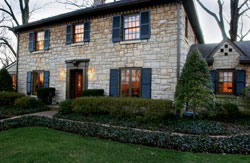
The double-pane replacement windows for this 1920s home include French casements below and double-hungs up top from The Door Store.
Tax incentives aside, soaring heating and cooling costs are forcing consumers to take a closer look at their windows. Windows are nothing more than “holes in the wall that you can look through,” says Kenny Smith, president of Progressive Fiberglass Windows & Doors in Bluegrass Industrial Park. “Thirty to 40 percent of your heat load can escape through your windows and doors.” Energy Star, a joint program of the U.S. Environmental Protection Agency and the U.S. Department of Energy, estimates that replacing single-glazed (one pane) windows with double-glazed can save Kentucky homeowners about $340 a year on utilities.
Unfortunately, buying windows is complicated. Among myriad factors to consider: window type, glazing, frame, performance ratings, aesthetics and warranties, not to mention cost. Last year Remodeling Online pegged the price of purchasing and installing replacement windows for mid-range to upscale Louisville houses at $9,525-$16,133.
Types of Windows
If you’re building a new home or adding on to an old one, the type of window you choose can markedly affect your utility bills. Double-hung windows that slide down at the top and up at the bottom are the least efficient, but have been the most popular style in American homes since 1850, Smith says. More efficient choices: casement and awning windows that open as a single unit either at the side (casement) or at the top (awning). The most efficient choice: fixed windows that don’t open at all.
Glazing/Glass
Peruse a pageful of window ads and you’ll see plenty of claims about the superior insulating value of the hawkers’ glass. The truth is, says Smith, that most window glass today is made by a handful of manufacturers and there’s little difference, company to company. What is important: multiple glazing, low-emissivity (low-E) coatings and insulating gas.
Lever-adjusted mini-blinds between window panes by Pella.
While old windows had single panes of glass, today’s insulated windows use two (double-glazed) or three (triple-glazed) with air spaces in between. For the money, most local companies recomm/files/storyimages/double glazing. “Triple is just overkill,” says Smith. The University of Minnesota backs up that claim. Estimated annual utility savings for triple versus double glazing is only about $100 for a 2,000-square-foot home in Louisville.
Definitely worth the money are low-E coatings that help keep your home warmer in winter and cooler in summer by controlling heat transfer through the window. Russ Gent, residential sales manager of Architectural Window-Door and Design Center on Chamberlain Lane, says the payback on low-E takes just one to three years. The newest permutation is low-E 4, which helps keep exterior glass cleaner and free of water spots, offered by Andersen and Eagle at no extra charge.
Also recommended: insulating argon gas between the window panes. “It only adds about $10-$15 to the cost of a window, but enhances its energy efficiency,” says Smith.
Frames
Just as important as glazing is the frame itself. “You can have the best glass in the world, but if your frame is lousy, your window is lousy,” Smith says.
Each framing material has pros and cons, explains Jim Benney, executive director of the National Fenestration Rating Council (NFRC), which grades windows on their efficiency. Vinyl offers two big advantages: low price and low maintenance. On the minus side: It’s not as strong as other materials and requires “stiffeners” to prevent large windows from sagging. Fading, too, can be a problem, unless the vinyl is treated with UV inhibitors. Aesthetics are also an issue, says Paul Miele of K-I Lumber. “Vinyl still can’t offer the color and the grill (muntin) options of wood.”
“Wood frames,” says Benney, “are thermally efficient and add to a home’s decor. The biggest downside is the cost and maintenance involved.” Vinyl or aluminum cladding can solve the exterior painting issue. Of the two, aluminum is more durable and allows more color options. “You can use dark colors such as black, brown or hunter green without the cladding breaking down,” he says. The company Jeld-Wen has also resolved the rot issue with its Auralast products, adds Miele, which include a 20-year warranty against rot, termites and water absorption.
Composite windows have been on the market for the past five years. A good example: Andersen Renewal replacement windows. Similar to composite decking, they’re made of wood fibers mixed with thermoplastic polymer. Among their advantages, Benney counts “the look of wood, the low maintenance of vinyl and high durability.” Cost is comparable to real wood.
The most thermally efficient windows are fiberglass, such as Pella’s Impervia and Progressive Fiberglass’ Permaglass lines. Other fiberglass benefits include high strength and stability (the least expansion/contraction of any window frame) and low maintenance, plus they come in dark colors such as black and they’re lightweight — advantageous for large windows that open and close. The only major disadvantages, says Smith, are that fiberglass can’t be bent (so arched and round shapes aren’t available) and the price. “They’re definitely a premium product,” he notes.
Performance Ratings
The NFRC rates windows on five performance factors:
• U-Factor: How well the window keeps heat from escaping. The lower the U-Factor, the more energy efficient the window.
• Solar Heat Gain Coefficient: How well the window blocks heat gain from the sun. For southern- or western-facing windows that get afternoon summer sun, look for a 0.3 to 0.5 rating, advises Benney. “Low-E coatings help, but it’s still critical to look at the SHGC,” he says.
• Air Leakage: The amount of air the window leaks, expressed in cubic feet per minute per square foot. Benney recommends a rating of 0.1 or less for new windows, but notes that can be difficult with big double-hung units. “Anything that slides will leak more air,” he explains.
• Condensation Resistance: How well the window resists forming condensation on the inside surface by preventing cold spots on the glass.
• Visible Transmittance: The amount of light that comes through the window. The higher the number, the more light is transmitted.
To qualify for Energy Star designation, windows must meet strict U-Factor and SHGC guidelines. Additional certifications are available for structural performance and water leakage. “Just remember that thermal efficiency doesn’t mean anything if your windows leak,” says Benney. “Ask about ANSI/AMMA/WDMA/101/152 (industry-approval) certification.”
Warranties
Window warranties can range anywhere from 10 to 20 years, and some companies even offer them for the lifetime of your home. But remember, warranties only last as long as the companies offering them. That’s why it’s advisable to purchase windows from reputable firms that have been in business for a while.
Improper installation can void a window’s warranty. While do-it-yourselfers can replace windows, it’s probably better to use a trained professional.
And though you may suffer sticker shock when you shop for replacement windows, keep one thing in mind, says Chris Cunningham of Cunningham Overhead Door & Windows on Frankfort Avenue: “In this day and age, only a rich man can afford cheap windows.”
RESOURCE LIST
Architectural Window-Door and Design CenteR
3600 Chamberlain Lane, 425-5699
Cunningham Overhead Door & Windows
2133 Frankfort Ave., 897-5700
The Door Store
4625 Shelbyville Road, 896-1717
K-I Lumber & Building Materials
Four metro-area locations
Pella Windows & Doors
11450 Bluegrass Pkwy., 240-5822
Progressive Fiberglass Windows & Doors
10801 Electron Drive, 261-0733