
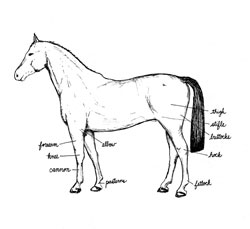

 Bet you didn’t know that a horse’s buttocks are located below the midpoint of its thighs. Or that its forearms (yes, it has two arms along with four legs) are above its knees. Or that its elbows are 24/7 tucked into its rib cage.
It just goes to show: Trying to equate equine (quadrupedal) physiology with human (bipedal) physiology can be a shaky proposition — especially when shared vocabulary terms mean different things. And it doesn’t help matters that, in the interest of “laymanizing” horses’ anatomical features, we t/files/storyimages/to replace certain horse terms with human terms.
Take, for example, the horse’s fetlocks — low leg joints that connect cannon bones with pastern bones just above the hooves. They’re often referred to as “ankles,” while the cannons are called “shins.” If you look at a horse’s limbs as similar to our limbs, it does stand to reason: That’s where our shins and ankles are located.
Skeletally speaking, though, the horse’s hocks, about halfway up its rear legs, are the equivalent of our ankles, and its front-leg knees are the equivalent of our wrists. Because its humerus (upper arm bone) and femur (thigh bone) are — rather than appendage parts — situated in the trunk of the animal, the horse’s limbs begin at its elbows and stifles (patellas).
So, you may be thinking, if the horse’s “wrists” and “ankles” are midway up its limbs, what’s the human skeletal equivalent of its cannon and pastern bones? The front cannons are the animal’s primary metacarpals; the rear cannons are its chief metatarsals — the bones that ext/files/storyimages/from our wrists and ankles to our first sets of hand and foot knuckles (our “fetlocks”). The two pastern bones and the hoof-hidden coffin bone in each equine leg line up with the three digital bones (phalanx bones) in our middle fingers and middle toes. The hooves are, of course, fingernails.
Needless to say, skeletal equivalents notwithstanding, it is never good for people to run on their tiptoes.