

While the graying of
The main home’s new old kitchen. The super-comfy sitting porch.
Pewee

“My parents are now in their late 70s and early 80s and they’re both very independent,” she says, “but everything can change overnight. They were still living in their family home that had a pool and required a lot of maintenance. But they didn’t really want to move to a retirement community. Then a fri/files/storyimages/told me how she’d built an addition on her house for her aging mother. We had the space — we’re on 2.8 acres — so my husband Brad and I talked it over and we threw the idea out to my parents.”
Kenneth and Nell Graham took awhile to mull it over but did decide that downsizing while they were still healthy made sense. “The time to do it,” Kenneth asserts, “is when you’re still able to make your own decisions!”
The plan called for adding a one-story addition to the Palmers’ house. “What my parents wanted was their own attached patio home,” Pat explains.


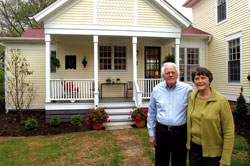
Theory of relativity (left to right): the Palmers’ extensively remodeled combination kitchen/family/breakfast room; the Grahams’ living room with reclaimed and remilled heart pine floor; the Grahams and their 1,460-square-foot patio home, which closely matches the historic main home (right in photo); the homespun view from the Palmers’ antique English dresser base to a sitting area.
Easy enough on the surface, but the real challenge lay in blending the addition with the existing house, a National Historic Register property and
Keeping the addition from “looking like an afterthought” was
The Grahams also were armed with a list of imperatives for their new residence. Things they absolutely couldn’t live without, says Nell, included a fireplace in the living room, a bath and a half, a sun porch for enjoying the outdoors and lots of storage. Rooms also had to be designed to accommodate the furnishings they planned to move with them, so
Attached to the side of the Palmer house, the 1,460-square-foot addition matches the original structure, from the lap siding and porch trim to the baseboards, wooden mantel and floors. It also incorporates many features that will allow the Grahams to age in place, such as a wheelchair-friendly shower, 36-inch doors and grab bars in the baths. Although steps lead to the entrance, a simple ramp is all that would be required to make their new home completely handicap-accessible.
Building the addition also presented the Palmers with a golden opportunity to update the original house. On their wish list was a second full bath upstairs — there was only one full bath for all four upstairs bedrooms — along with a larger closet in the master bedroom and a combination kitchen/family/breakfast room to replace the isolated “one-cook” kitchen and dark, boxy little den.
To create the latter,
Stain combined with barn red and black paint lends the simple wood-knobbed kitchen cabinetry country flair. For the countertops, the Palmers selected a Corian pattern that mimics soapstone. Rather than a built-in island, they opted for an antique English dresser base, adding a wooden shelf below for extra height and storage and a primitive wooden dowel for dishtowels on one end. The final effect is consistent with the rest of the home’s period furnishings — a look that Pat refers to as “American and English High Country.”
Adding more windows was also a priority, since the Palmers are avid gardeners and have spent years restoring the yard to its former floral glory. “We have information from the home’s second owners that William Alexander Smith was an amateur horticulturist and planted many different varieties of trees on the property,” says Pat. A new window above the kitchen sink, as well as the new window bay and matching door in the breakfast area, allows them to enjoy his and their own green-thumbing at last.
Another concern was making the addition flow with the existing interior. Floors were a major issue, says Pat. “We never were able to determine what type of wood was used in the original house, poplar or pine. We ended up having heart pine ceiling beams from an 1870 warehouse near the
The old kitchen and sitting room flooring, along with interior trim, doors and wainscoting salvaged from the first level, was reused in other areas of the downstairs and in the new second-story master bath, where an oval-shaped freestanding tub takes center stage. Though thoroughly modern, the bath has a vintage feel in keeping with the home’s history.
Dust-factor-wise, the decision to renovate the original house while making room for mom and dad was probably for the best. Start to finish, the project took their builder, Fred Bennett, just nine months. However, when the Grahams sold their old home in two weeks, conditions at the Palmer house got a bit crowded, with all four adults sharing the single hall bath and doing without a kitchen for almost six months.
Since the Grahams moved into the addition and the Palmers finished their renovation last November, the situation is exactly what both couples wanted. They visit back and forth, but retain their privacy. “I’m from