

 When Kathy and Stephen Pramik relocated here from Hinckley, Ohio, in 2005, they wanted an energy-efficient home. Years of living 27 miles from Cleveland, where they were forced to cope with below-freezing temperatures from December through February and shovel some 55 inches of snow most winters, had made them acutely aware of the high cost of heating.
The couple rented while searching for the right house. Kathy was immediately attracted to the upper Highlands area. “I liked the idea of being able to walk to all the shops, galleries and restaurants,” she says, counting Seviche and Sapporo Japanese Grill & Sushi among her favorite eateries. Stephen wanted a three-car garage — a challenge to find in that area. After weeks of searching, they found their solution at The Overlook in the Belknap neighborhood.
Overlook developer Mark Isaacs of Legacy Homes has been interested in environmentally responsible construction since receiving his master’s degree in architecture from the Massachusetts Institute of Technology in 1980. “We hold the answer on whether we’re going to save this planet,” he says. “I’ve been looking at different ways I can make a difference in Louisville, Kentucky.”
Built on 2.2 acres of land where a dilapidated house once stood, The Overlook is considered an urban infill development. Unlike new subdivisions built on undeveloped land, urban infill takes advantage of existing roads, utility lines and businesses. “The Overlook is not your typical subdivision,” Isaacs explains. “It’s patterned after existing pedestrian courts, such as Ivanhoe and Maplewood in the Highlands. It’s a walking neighborhood with 10 homes clustered around a central courtyard. Cars are relegated to the back alley, so the focus is on the houses, rather than on the cars. There’s green at every front door — an acre of green space in the center.”
Isaacs maintains that courtyards “provide a place to raise children safely in the city” and foster “a strong sense of community” for the residents. “People get to know each other while they’re sitting out on their porches,” he says.
The Pramiks’ home is one of 10 clustered around a common courtyard; a wine chiller (right) in the butler’s pantry.
To bl/files/storyimages/in the new neighborhood with its historic surroundings, Isaacs drew from the style of architecture known as the Prairie School, popular after the turn of the 20th century. Every home features wide, overhanging eaves; massive square porch supports; and geometric window grilles on the exterior. Inside, however, are all the elements 21st-century homebuyers prefer, from open first floors to large kitchen islands. It was a perfect fit for the Pramiks, who are longtime fans of the Prairie and Mission styles but wanted the advantages of a contemporary floor plan.

Legacy Homes routinely incorporates energy-saving construction techniques into its houses, Isaacs says, ticking off features such double-glazed, low-emissivity coated windows; two-by-six-framed walls with R-19 insulation; house wrap; and an advanced sealing package to stop air leaks around electrical outlets and in ductwork. The Pramiks, however, wanted some additional environment-friendly features. At the top of their list: geothermal heating and cooling. “I have two sisters in Ohio with geothermal in their homes, and they raved about it,” Stephen says. “It not only saves money on utilities; it’s a cleaner form of heat environmentally.”
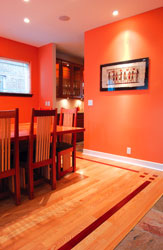
Clockwise from top left: the Energy Star kitchen; the great room’s soapstone stove; relaxing on the screened-in porch; a Mission-style breakfront in the breakfast room.
One of the most energy-efficient options available today, geothermal systems use the constant temperature underground to provide up to half of a home’s total healing and cooling needs. Though the initial investment is high — about $4,000-$5,000 per ton (12,000 BTUs) of capacity — the systems can save homeowners anywhere from 50 to 70 percent on their monthly LG&E bills. Geothermal system manufacturer WaterFurnace estimates that installing its product in a typical home is the “equivalent of planting 750 trees or taking two cars off the road.” In 2006, WaterFurnace was selected as one of the top 10 green building products by the editors of Sustainable Industries Journal.


Plus, Stephen says, their WaterFurnace geothermal system produces much of their hot water. “In the summer, our hot water is free. In the winter, it provides about 40 percent of what we use,” he estimates.
Some of the other energy-saving features the couple requested: Energy Star appliances in the kitchen; R-40 insulation, instead of R-30, in the attic; and a whole-house fan. Located in the ceiling of the second-floor hall, the fan is designed to pull cool air in from first-floor doors and windows and push hot air, which rises, to the vented attic. “When it’s 78 degrees outside and the indoors feels stuffy, I can open up the doors and flip on the fan. I don’t need to turn on the air conditioning,” Stephen explains.
He also uses energy-conserving compact fluorescent bulbs in some of the home’s lighting fixtures. “They’re great in the wall sconces and the step lights, because we leave them on for long periods of time,” he says, “but you don’t want to use them anywhere you want instant light, such as bedroom ceiling fixtures or in the lights over the bathroom vanity. They take awhile to brighten up.”
Finally, there is the Rais wood-burning stove that fills one corner of their great room. Made of natural soapstone, the stove is designed to accumulate heat and release it little by little. Kathy, who first discovered the stove in a magazine, would buy another “in a minute,” she says. “It’s the most comfortable heat when you’re sitting by it.”
Stephen says the stove is large enough to heat the whole room, if necessary. “People in Europe use them to heat their houses,” he says. “The unit we have is big enough to heat 1,000 square feet and it’s much better than a regular masonry fireplace, where 90 percent of the heat goes up the flue.”
According to Isaacs, those extras have earned the Pramiks’ home an “Energy Star,” awarded by the U.S. Environmental Protection Agency and Department of Energy to homes that are at least 15 percent more energy-efficient than those meeting the 2004 International Residential Code.
So what does all this really mean to the bottom line — that monthly tithe to LG&E? Stephen says they’ve never had a bill over $100, even during the spate of sub-zero weather earlier this year. Their highest bill in Hinckley, where they had a natural gas furnace, was $300, and the house was 300 square feet smaller. “That was also before the big hike in gas prices,” he points out.
As Isaccs intended when he designed The Overlook, the Pramiks are also benefiting from their home’s neighborhood setting. They’re walking more, and Kathy even walked to the grocery store once — a physical impossibility at their old home in Hinckley. And the courtyard’s open, friendly atmosphere encourages camaraderie.
Knowing their neighbors has helped the former Buckeyes acclimate to their new community. Though Kathy has yet to be introduced to the joys of bunco, the two have participated in another peculiar Louisville institution: playing cornhole, a beanbag toss game. “When we were first heard about it,” Kathy says, “we both asked, ‘What’s cornhole?’ Then Stephen ended up making a board for the courtyard.”