
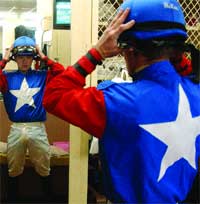

The jockeys’ room at Churchill Downs is located in a building adjacent to the paddock and just a riding helmet’s throw from Gate 1 and the
 The jocks’ room, as it’s known at the racetrack, is one of the few places left in the historic and fabled Churchill Downs that is still, well, historic and fabled. And what goes on inside the room hasn’t changed much in the years since Brokers Tip won that 1933 duel. Here they have a culture all their own, and few outsiders have glimpsed it. “Absolutely No Press Allowed” reads the sign taped above the door on Oaks and
“The box” is also known as the “hot box,” but it’s not a box; it’s just another name for the sauna in the jocks’ room. It’s not a remarkable sauna, no bigger or smaller than the one at the local YMCA, and not especially nice. Just your run-of-the-mill sauna. What’s remarkable is how long the jockeys sp/files/storyimages/in the box, sometimes up to two hours, just sitting, sweating. “Reducing,” they call it. All in an effort to shrink themselves down to a certain weight.
So they go in the box, they stay in the box, they get to know the box, they can’t get away from the box, and the box becomes a part of their daily routine.
I ask Herbstreit if I can go in the box. The former jockey, now a barrel-chested man with silver hair and a crimson face, is the man in charge in the jocks’ room. He looks at me, then puffs on a cigarette and smiles.
“So,” he rasps, his eyes twinkling, “you wanna go in the hot box.”
This is Derby Week 2004, and Herbstreit has a lot on his mind, but he gives me permission.
I ask him how hot it is in the box.
“Hell, I don’t know,” he replies. “But it’s hot.”
One of the jockey valets, Billy Metcalf, fixes me up with shower shoes and a towel. I strip off my clothes and hang them in Billy’s locker. Chuck Victory, a tall, slender valet for Pat Day with a smile like Will Rogers’, asks me if I need a robe. The valets seem to take delight in what I’m doing; it’s out of the ordinary, something new to see in the jocks’ room, a place where most actions are routine.
 I rinse off in the shower and weigh myself in the trainer’s room before I go in the box: 165 pounds. The
I have the entire sauna to myself. It’s a wood-paneled room with two tiers of benches along adjoining walls, low-watt light bulbs at the ceiling, a crate of stones in a corner by the door. Most of the jockeys, I observed in recent visits, sit in the sauna with their towels unfastened and spread out, on the lower bench. I do the same. A weathered Chinese checkers game sits across from me.
Herbstreit’s right - the box is hot, without a doubt. Right away I know that anything close to two hours is preposterous for my first time. But I vow to make it as long as I can.
After five long minutes my shower shoes are filled with what seems like water but must be sweat. I raise each foot in the air to drain them, and a stream pours out. I relax, fold my arms across my chest, quietly hum a song. I think about time. And about heat, the way your car gets in summertime, sitting in an asphalt parking lot, with the windows rolled up. I avoid the clock. I am bored as hell. Hot as hell, too.
I feel the urge to pee, wouldn’t you know it? I shouldn’t have had that large coffee. The minutes creep.
Then there is movement outside the door, a small commotion, the rumble of voices. Shadows pass by the sauna’s foggy glass door, and the door pops open. Gov. Ernie Fletcher pokes his head inside.
I wasn’t sure about protocol but figured it demanded I at least wrap my towel around myself and stand.
“H-hello,” I say, like I’m the host of a dinner party for which the governor’s arrived early.
“Nice to meet you,” Fletcher says. He is smiling, wearing a dark gray suit and tie, and no doubt thinks I’m a jockey. And then he does something I don’t expect, especially for someone in a suit: He steps inside. It’s not a large space, maybe 10-by-eight, but then there are the benches and the box of rocks taking up space, too.
“I’m Ernie Fletcher,” he says. He sticks out his hand.
I grip my towel and shake his hand.
“Oh, I know who you are, governor,” I say. We are 12 inches apart. “I think you’re doing a good job.”
It’s something nice to hear, even from a naked, sweaty stranger in a sauna.
“Enjoy the races, governor,” I say.
“Thank you,” he says, “and good luck today.”
He leaves in a swirl of steam, and I settle on the bench, go back to sweating in my shoes, my towel folded over myself modestly now.
When 30 minutes pass I leave the box. I take off my sweat-soaked towel and my slippery shoes and weigh in. 163. I have lost two pounds.
But what’s more astounding, and disconcerting, is how I feel. I am light-headed and punchy. Talkative. The tiled floor in the adjacent trainer’s room swims beneath me. I shower and go find my clothes. I feel euphoric, like the onset of a good, happy drunk. (The hangover would come later, of course; soon I would be dazed and depleted, slightly confused and not altogether there.)
I open Billy’s locker and start to dress.
“Well,” says a voice behind me.
I turn and Herbstreit’s smiling at me like I’ve just made his week.
“We all had a bet you wouldn’t make it 10 minutes.”
“Man,” Billy Metcalf says, “now they’re gonna try to mess with ya.” He shakes his head, smiles. “They’ll be mad if I tell you,” he says, “but I’m gonna tell you anyway.” He’s talking about a wooden crate up front by the clerk of scales’ desk. The crate holding the pet ferret.
There’s a furry tail peeking out, just enough to get you intrigued. You’re encouraged to pet it. Oh, he’s cute, they say. Go ahead; he likes people. And you look at that tail, trying to figure it out, and don’t notice the small crowd forming. It’s OK, they keep saying. Go ahead; he’s a nice ferret. You start to reach for that little tail - so soft-looking! - and just as you’re good and leaned in, committed, someone trips the lever, the top flies open and a furry piece of cloth is catapulted at your head. It’s extremely realistic and, well, accurate.
Billy’s busy at his valet’s station, what these jockey personal assistants refer to as their “corner.” At age 70, he’s the most senior of the 13 valets who work in the jocks’ room. And don’t get hung up on the pronunciation of “valet.” This is the racetrack; it’s pronounced “VAL-it.” Nothing fancy, and especially nothing French. The only things French in the jocks’ room are the Cajun riders.
Billy’s been a valet since 1968, but he’s worked at the track since he was 13, when he left his
 “I decided I was gonna get rich,” he tells me, “so I up and went.”
This is a familiar story in the jocks’ room. Many of the valets here were attracted to racing by the lure of easy money, the carrot on the string they never caught. But they stayed because of their love of horses, their love of the game.
Billy’s played the game. He figures he’s worked most every racetrack between Chicago and
“Most of the time (if) a horse don’t wanna go in the gate,” Billy says, “there’s something wrong with him.” These difficult, feisty horses required a starter to climb inside the gate, too. “You try to get up by his shoulder, and make sure he don’t tear your ankle off when the gates open.” Ear tongs are a common tool used by starters to grab a horse’s attention and keep him still.
One time, down at
At Suffolk Downs in
I ask him why in the world he didn’t stay in the house. Billy shakes his head impatiently because I do not understand. “That’s where I learned, stayin’ with them horses,” he says.
“Man, I wouldn’t trade the life I’ve had for nothin’,” he says, and you believe him. Hell, there’s a little of you that wants to be him. Billy’s one of those people you meet who has spent every moment of his life living, and when you shake his hand you hold on a little longer than you’re supposed to, hoping that something transfers over in that press of the flesh.
Except for the sciatica that nags at him from time to time - he wears a support belt around his waist underneath his clothes - Billy’s fit and handsome. He has a full head of Gary Cooper hair, two small eyes that light up when he speaks and a smile that is both wise and humble with years.
I’m not sure where the best seat is at Churchill Downs on Derby Day, but I wouldn’t trade mine for anything: I’m sitting next to Pat Day, one of the
“Man, it got so dark in there you couldn’t see nothin’, and one of those horses started actin’ up,” he says. They could hear the horse’s snorts, his hooves pawing the wooden sides of the boxcar. All they could do was wait for the horse to calm down.
“When we got some light we found that horse turned up on his head,” the valet says. “But we got him back on his feet and then the groom give him some bells.” Bells? “You know,” he says, “something they used to get from
 Day and I laugh. Billy has a way with telling a story. Day wraps a towel around his waist as, because it’s a special day, Billy irons his forest-green valet pants on the countertop in his corner.
The jocks’ room is buzzing like a hive. The valets are assembling their jockeys’ first-race tack on the numbers table, the hub at the center of the room - the saddles, whips, rubber saddle pads, numbered saddle blankets, numbered armbands, the straps and girts that fasten the saddles to the horses’ back along with the proper amount of lead weight. Chuck Victory stands quietly in his corner. He sprays Pledge on Day’s riding boots and shines them to a mirror-like sheen.
The valet offers as many services as a fine hotel. He makes the jocks’ room as comfortable for the riders as possible. He provides towels, shower shoes, soap, shampoo, hair gel, deodorant, lotion, baby powder, drinks, snacks and any requested items or specific brands. He also shines his jockey’s street shoes, arranges for dry cleaning and, if requested, will even make dinner reservations.
In addition, the valets saddle the horses in the paddock through a kind of co-op system. Typically, they saddle on a rotational basis, with each going down to the paddock about every other race because there are usually more valets than horses in a given race. The
Kent Desormeaux arrives. He’s a two-time
Desormeaux has the good looks of a movie star. He’s another rider who is taller than what you would expect, lean and toned. He’ll be riding Imperialism in the big race.
He’s brought a stack of patches emblazoned with the initials “P.T.” The initials stand for Pat Tillman, the National Football League player who enlisted for the war in
Most of the jockeys arrive early for a quick workout in the quarters’ tiny weight room, followed by a short steam. Jose Santos, who’ll be riding Limehouse in the
A cigarette hangs from the corner of jockey Calvin Borel’s mouth; he cocks his head shyly when he says hello and shakes my hand. He buys me a cup of coffee at the kitchen, where we talk about Sir Cherokee, whom Borel’s riding in the Woodford
Reserve Turf Classic.
“He’s got nice hooves,” Borel says, forming a generous circle with his hands. “That’s what you want on the turf.”
We take our Styrofoam cups back into the jocks’ room. It has the typical, fusty smell of a locker room, tinged with an ammonia cleanser. There’s the smell of Right Guard deodorant, Dial soap and leather. Cigarette smoke hangs in the air, thicker today, and you can’t avoid the sharp scent of Pledge, lemon-fresh, the valets’ spray tool.
Willie Martinez ambles by, his jock pants around his knees as he pulls his silks down, with a cigarette dangling from his lips. He has tattoos on his arms and is wearing a knit cap, the kind favored by skateboarders.
Jerry Bailey arrives, dressed like a businessman - creased navy slacks, light blue dress shirt with crisp white collar and cuffs, but no tie. He wears his cell phone clipped to his belt. There are five boxes of Wrangler jeans against the wall by his locker. Bailey is generous with the jeans, having signed an endorsement deal with the company, handing them out to the other jocks.
“Go get you a pair,” Billy tells me,
slipping into his valet clothes. “He’ll let you.” He gives me a quick once-over. “Might be a little snug on you, though.”
The jockeys continue to trickle in. Today the most accomplished jockeys in the country, if not the world, will be gathered in this room, waiting their turn to ride in the greatest two minutes in sports. There’s a shout behind me and I turn around to see J.J. Gloria, who manages the silks room, holding Raul Vizcarrondo, a much younger, part-time valet, as another valet, Matty Brown, staggers toward him like Frankenstein with his dentures hanging out. Like Billy, Brown goes way back. Hell, he taught Billy how
to drive his ‘37 Ford in the parking lot at Hialeah Racetrack.
Day opens the Daily Racing Form on Victory’s countertop and scans each page before he turns it. He whistles quietly.
Billy and his co-workers have been in this game long enough to see more than one generation of jockeys come and go. When I ask him if there’s a difference in riders today from 40 years ago, he becomes thoughtful. “Riders were probably on the backside longer back then,” he says. The backside is where young riders work as exercise riders and gain valuable experience. “But today’s riders are awful good, awful good.”
Billy can tell a lot about a jockey by how he sits in the saddle and his comportment during a race. Today’s jockeys are higher in the irons than their predecessors, a term that refers to the position of a rider’s stirrups. “The higher they keep them stirrups, the better, I think,” Billy says. “The horse wants that weight up on his back, not down by his sides.” He’s noticed that jockeys’ irons have crept up over the years. It’s a more precarious spot, to be sure, perched on the back of a galloping horse with your knees pinned at your chest. “But that’s how you get the
results,” Billy says. “You can tell the best jockeys in the final 16th of a race.”
I excuse myself for another cup of coffee. There’s a jockeys’ lounge, a common area adjacent to the jocks’ room, where both male and female jocks congregate with friends, meet with the media, grab a bite to eat and settle on the Naugahyde sofas to watch the races on two TVs. (The female jockeys have a much smaller, but just as nice, locker room off the clerk of scales area, with the same amenities.) There are a few tables and chairs, a ping pong table and two pool tables. Two glass doors lead out to the roof of the building, and in hot weather some of the jockeys take chairs out to sunbathe.
Back in the jocks’ room I see Mark Guidry and Jose Santos standing together in valet Danny Maline’s corner. Maline rolls
Maline tells me as he polishes the shoes.
Shane Sellers struts over in a towel on his way to the shower. He has $$ tattooed on his left bicep and a crucifix above the ubiquitous band of barbed wire on his right arm. He says hello to
Ron Herbstreit steps to the front of the room and calls the jockeys. “Wokay, jockeys!” he booms. “First race!”
As the jocks return from the first race they’re chatting, smiling, commenting on the race. They fling their mud-splattered silks and riding pants in a gray laundry bin, then sponge off their muddy faces and brush the dirt from their boots.
In a sense, jockeys are members of a protectivist club. Being a jockey is one profession whose participants have a vested interest in the abilities of competitors. In other sports, a competitor’s inexperience is taken advantage of; it’s a weakness to exploit. On a racetrack, an inexperienced jockey can cause calamity.
“So many things can happen in a horse race,” Billy tells me. “A hole opens up and three jocks see it and they all go for it.” He shrugs. “Well, somebody ain’t gonna make it.” Jockeys understand this, and they learn to accept it.
It’s been raining on and off all day. The track announcer comes over the intercom: “The track is sloppy, the turf yielding.” This means as much to a valet as it does to a jockey and those making wagers. For different
reasons, of course.
Chuck Victory prepares Pat Day’s goggles. He dips each pair in his bucket of soapy water, dries them with a soft towel and sets them on the counter. Then he sprays them with Pledge, which helps to repel the rain, and he polishes them, holding each up to the fluorescent lights overhead to make sure they’re spotless. When he’s finished he straps the goggles to Day’s helmet, one pair on top of the other, then carefully places a sheet of Cling Wrap over the goggles, just like leftovers, to keep the rain off between the paddock and the starting gate.
The jock wears all four pairs of goggles to start the race. When mud splatters the top pair, he’ll reach up and jerk them down around his neck and have a fresh set of goggles ready to go. It requires a certain touch, no doubt.
Guidry, currently the leading rider in Churchill’s 2004 Spring Meet (who has no mount for the
“Would you mind helping me with this?” he asks. I pull the jersey down until it’s smooth. Guidry thanks me as he dashes to the scales and out to the paddock.
Just then a woman’s scream is heard from up front by the scales and a few of the valets amble back in the jocks’ room wearing smiles, shaking their heads. Another visitor just met the ferret.
I find Pat Day sitting quietly in the lounge. Dressed in his riding pants, sleeveless undershirt and black riding boots, he’s reclined on the Naugahyde sofa with his feet crossed on the coffee table, his arms folded across his chest. Day parts his hair neatly on the left and is wearing bifocals. His eyes are blue. There is a program open on his lap, and he uses a red ballpoint pen to make notes. I sit next to him.
“I like to keep track,” he tells me. “That way if I see the trainer I can mention how his horse did. It’s a little thing, but I think it goes a long way.”
I ask him if I can look at his hands.
“Sure,” he says, a little surprised. He holds up both hands. “There they are.”
We look at them quietly for several seconds. They are not especially remarkable, Day’s hands. They are small and clean and strong-looking.
I say I’ve heard he has the best hands in racing. What does that mean exactly?
“You know what?” he says, “I think they use the hands as the outward expression, but it’s the whole way you approach the horse. I don’t think it’s just the hands.”
Day is articulate, to the point of sounding almost rehearsed, and extremely thoughtful about his profession. “Obviously I communicate directly through my hands,” he says, “through the reins, into their mouth and hopefully into their head, and get them to respond accordingly.” The call to the post for the second race sounds over the intercom. “And I’ve had good success with doing that with a light touch rather than an aggressive style. But it’s not just the hands. It’s my whole approach, I think, an innate ability to communicate with the horse.”
He begins to analyze his craft, digging deeper into what comes so easily to him, and he invokes two of the greatest riders, Eddie Arcaro and Willie Shoemaker. He has, no doubt, studied them.
“Arcaro said that he had to make horses run, and that they wanted to run for Shoemaker,” Day says. He threads his fingers together. “I found a lot of that to be true for me. I have an ability to get horses to respond for me and to me, whether it’s to set up early or to give me their best in the drive, with minimal encouragement on my part. And that’s, I think, what they’re talking about - OHe’s got good hands.’”
We watch the second race on the lounge TV and Day makes a note in his program. Someone breaks a rack of balls on the pool table and Day, who’ll be riding Minister Eric in the Derby, leaves to get ready for the next race. I watch him walk into the jocks’ room. He walks with a swagger, with his boot tips pointed out. Like a cowboy.
Billy’s sciatica is acting up, a burning sensation running down his leg. He takes a small bottle out of his locker. It has an applicator sponge on one end, and there’s a neon-green liquid swirling around inside.
“I can put this stuff on it, cures it right up,” he says. “Harthill No. 19 takes care of it.”
He’s referring to Dr. Alex Harthill, the legendary horse veterinarian, whose office is right across the street from the Downs. Billy calls him “Doc.” He drops his pants and rubs the medicine into the skin on the small of his back.
I ask Billy if what he’s applying is meant for horses. “Yeah,” he says, “but it’s for people, too, now. It’s in a bottle in Doc’s office that says OHarthill Number 19 Leg Brace.’ This is potent stuff now.”
Herbstreit shouts from the front of the room, “Wokay, jockeys! Let’s check third race!”
The jockeys and the saddling valets head for the door. Billy takes a can of Right Guard deodorant and sprays the sleeves of his jacket before going out to the paddock. “The smell’ll give the horse something to occupy his mind,” he says. He grabs the tack off the numbers table and is out the door.
An hour before the Derby, a crew from NBC, the Derby telecaster since 2001, enters the jocks’ room. The television network has paid big money to broadcast the Derby, so its crew can ignore the sign posted above the door. The production people position jockeys Alex Solis, riding Master David, and John McKee, riding Pro Prado, together and ask them to pret/files/storyimages/they’re talking. “Alex, pret/files/storyimages/you’re given John advice on his first race,” one of the NBC people says.
The rain is pelting the roof of the jocks’ room. The ceiling begins to leak, a few drops splashing down on the brick floor, but there are plenty of buckets to catch them. Pat Day, Stewart Elliott and Jose Santos talk together for the cameras.
Herbstreit hollers to the valets, “Check riders before the race!”
Shane Sellers, who is riding The Cliff’s Edge in the Derby, has his son with him. He borrows a hair dryer from his valet and starts to dry his son’s baseball cap, which is drenched from his walk to the jocks’ room. Sellers kneels down and fixes the cuffs of his son’s pants; he uses his valet’s lint brush on his son’s jacket.
People are moving in every direction, excusing themselves and stepping over cables stretched across the floor. The valets are on top of their game: There are fresh buckets of water waiting in all the corners, freshly folded towels are laid over them, their corners are tidy. The beat-up chest where the jocks sit to brush the caked-on dirt and sand from their boots after races has been covered with a threadbare rug.
The smooth brick floor, though, is covered with a gritty layer of sand and silt.
Billy helps his jock Victor Espinoza, whose Derby mount is Borrego, with his silks, pulling his sleeves right-side-out, as the jockeys begin the weigh-in process and head down to the paddock. Save one: Stewart
Elliott, who will ride Smarty Jones. I find him alone in the lounge, at a table near the kitchen. He is wearing vivid blue silks with big polka dots on the sleeves. He has his helmet on, and his whip is resting on the table. There are rubber bands securing the cuffs of his silks. Elliott is applying one of the “P.T.” patches to his right boot. No one is paying any attention to him.
Then Johnny Beach, a representative of the Jockeys Guild, appears at the door. “Hey, Stewart!” he says.
Elliott looks up and then back down at his boot.
“Hey, you feel like racing today?”
Elliott jumps up with a smile and dashes out the door. n