

 |
|---|
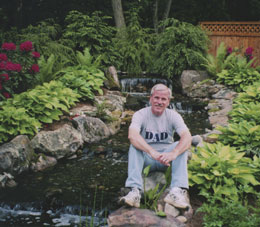
| Feature presentation: Houston Acres resident Mike Matthews and his watery back yard, certified by state and national agencies as a wildlife habitat. |
When Mike Matthews added a water feature to his Houston Acres homestead 15 years ago, demand for ponds, fountains and waterfalls in suburbia was barely a trickle. Today, however, the trickle has swollen to a swift-moving stream.
The percentage of American homes with water features nearly doubled between 1996 and 2005, notes George Davis, owner of the Pond and Fountain Store in Middletown, and industry experts predict it will double again to 10 percent within the next decade. "It’s by far the fastest-growing sector of the green industry," says Roger Killen of Sounds of Water in Sellersburg, Ind.
Davis believes surging demand is a natural outgrowth of the nation’s passion for gardening. According to American Demographics magazine (April 1997), about 25 percent of adults garden as a hobby, and as Killen asserts, "It takes three things to complete a garden: hardscape, such as walks and patios; softscape or plantings; and waterscape to serve as the focal point."
 |
|---|
Rocks and vegetation add natural beauty. |
Technology has made water features easier than ever to install and maintain. Once made of concrete, today’s ponds are usually fashioned with EPDM (a rubber compound) liners. Innovations such as skimmers to collect debris, biological filters to break down fish waste, ultraviolet lights to kill algae, and new "pondless" designs have significantly reduced maintenance.
Finally, amid the myriad stresses of modern life, there’s the soothing visual and aural delight a water feature affords. Nothing is more relaxing than being mesmerized by the sight and sound of water. "People are attracted and fascinated by it. It’s like a summertime fireplace," says Killen. "Your home is your own little paradise and your yard is your own little piece of nature. No matter what size project we do, the water feature always turns out to be the center of attention."
For Matthews, his 4,000-gallon babbling brook and pond was fundamental to creating a mini "Bernheim Forest" in his back yard. "You need three things to attract wildlife," he says, "water, food and shelter."
Certified as a wildlife habitat by both the National Wildlife Federation and the Kentucky Department of Fish and Wildlife, Matthews’ yard has drawn 81 varieties of birds, legions of butterflies and 17 different mammals, including deer, coyote and fox. "With all the development in the area, habitat is being taken away every day," says the Hikes Point resident. "When you garden for nature, you benefit tenfold."
Fountains
The quickest way to add water to your landscape is a fountain. Davis refers to them as the "plug and play" of water features because "all you do is grab them, fill them up, plug them in and you’re in business." The most difficult aspect of a fountain is probably the shopping, because so many styles, sizes and materials are available. North Hurstbourne Parkway’s Secret Garden, for example, sells tabletop, wall and freestanding models made of fiberglass, resin, concrete composite (concrete mixed with stone for texture), copper, wrought iron and stone. Some come with a choice of as many as 14 different finishes.
Costs can range anywhere from $30 for a tabletop model to thousands of dollars for a custom design. Whatever you decide to spend, if there’s a fountain in your future, here are some points to keep in mind:
•They all use electric pumps. If you’re adding an exterior outlet for the fountain, put the switch indoors so it’s easy to turn to turn off at night. Another option, says Steve Olson, manager of Frank Otte’s Bardstown Road location, is a fountain remote control ($25, Henri Studio).
•To attract birds, select a shallow fountain. Birds avoid deep water because of the danger of drowning, says Secret Garden’s Cheryl Susemichel.
•If you plan to bring your fountain inside for the winter, select lighter-weight materials such as resin or fiberglass.
•Protect outdoor fountains from freeze-thaw damage by emptying and covering them for the winter. Granite is the only material that will withstand freezing, says Paul Crane of the Stone Store on Old LaGrange Road.
•A capful of bleach every few weeks will keep your fountain algae-free. For a more environmentally friendly solution, try Fountain Blocks, two for $3 at the Stone Store.
Ponds, Streams and Waterfalls
While rectangular ponds are big in Europe, most Louisvillians prefer to go natural. Andrew Coombs of LandShapes (two locations), which built Matthews’ brook and pond, designs water features from weathered limestone or Arkansas sandstone with moss and lichens that look as if they’ve been transported from the woods. Rock selection, he says, is critical to creating a natural look. "If it’s free, there’s a reason," he cautions. "Some local rock decomposes quickly when water runs over it."
Davis agrees. "Don’t sell your project short by buying cheap rock," he says. "You don’t want broken edges or split faces, and you need to mix sizes and shapes. Water features built with lots of small rocks scream, ‘Contrived!’ Those built with all flat rocks /files/storyimages/up looking like chimneys."
Economy Aquatic Gardens (two locations) caters to do-it-yourselfers, carrying pond kits that range in price from $500 to several thousand dollars. Included are the pump, skimmer, biofilter, plumbing connections, underlayment and liner. What they don’t include, says owner Terry Knauer, is the rock. "An average project requires two to three tons," he says, "and you can pay anywhere from 10 cents a pound for creek rock to 25 cents for Missouri weathered limestone. Rock is not cheap."
The price for a professionally built water feature averages $5,000-7,000. If you’re planning to make that investment, local experts offer the following advice:
•If hiring a professional, get three estimates, visit their establishments and check references.
•Think big. Many pond-owners like their water features so much, they expand them within the first year. A good size beside a deck or patio is 180-200 square feet.
•Double your pleasure by placing your feature where it can be enjoyed inside and out.
•Plan for underwater lighting. It not only allows you to enjoy your water feature after dark, but it’s also safer.
•Buy quality equipment. Submersible pumps may cost less, but are harder to reach and wear out faster than newer models that fit inside pond-side skimmer boxes. Make sure replacement parts are available. Check out the warranty as well as the amps; the lower the amperage, the lower your electrical bill.
•Lengthen your liner’s life by shielding it from UV damage with a single layer of fist-sized rock.
•Hardwood mulches can turn water tea-colored. Use shredded pine or pine straw instead.
•Don’t put a water feature in a swampy area or at the bottom of a slope, where rainwater will fill it with silt or cause the liner to bubble.
•Cull your fish population regularly to avoid overcrowding.
Pondless Water Features
Recommended for people who travel a lot, have small children or don’t want to sp/files/storyimages/much time on upkeep, pondless water features include waterfalls, in-ground fountains and bubbling boulders where the water vanishes into the ground rather than collecting in a pond. Killen ticks off their advantages: "They’re cheaper to build, require the least maintenance and there’s no standing water for kids to drown in."
Another plus, says Davis, is that they can go in a front yard without fear of liability.
Kits are available for as little as $200 (plus the cost of the centerpiece and rock) and a professionally installed feature costs anywhere from $800-$2,200.
One final note: Consider your new water feature strictly as an investment in relaxation. Pond Magazine (Summer 2005) notes that while a water feature can increase your property value, expect to recoup only about 25 percent of the cost when you sell your home.