

By Alan G. Brake
Believe it or not, that ultimate symbol of suburban conformity, the 1950s ranch house, has become hip. There is a magazine devoted to them (Atomic Ranch) as well as a lushly illustrated coffee-table book (Ranch House by Alan Hess, Abrams, 2005). Once a ubiquitous symbol of postwar comfort for the masses, many have been altered almost beyond recognition in the intervening half-century, so walking into Tom Cannady’s nearly intact 1951 ranch is especially bracing. It’s like stepping into a stylish, swinging version of suburbia that never was. “I don’t want it to feel like a museum,” he says. “I’m a child of the ’50s, so I feel like I’m home.”
You enter Cannady’s house, set on a hill just off Eastern Parkway in the Highlands, after climbing a long set of low-rise concrete stairs bordered by stepped concrete planters. Above the front door, a small porch is supported by trapezoidally configured columns, which hint at the interior’s retro atmosphere. Inside, an open bookcase divides the entryway from the dining area. To the right is the open living room, bounded by a wall paneled in original knotty-pine planks. A corner fireplace has a distinctive angled hearth that mirrors the angled columns on the porch. Cannady decided to pick up this detail and has repeated it in several places throughout the house. He had a vintage curved sectional sofa re-covered in powder-blue Ultrasuede for a slightly more contemporary look. A white shag rug, a glass coffee table, an Eames molded plywood chair, a Saarinen marble-topped /files/storyimages/table, and chrome and striped ceramic lamps complete the room.
 Two paintings by Cannady hang on the walls, one an abstract canvas of blue and white, the other a brightly colored representational work depicting the grill of a classic car. He studied art in college, which explains his design sense and ingenuity, but has worked in business in his professional life and currently serves as the executive director of labor-management relations and mediation for the Kentucky Department of Labor in Frankfort. “I knew that I was too practical to make it as an artist,” he says, though he’s obviously been able to put his creativity to good use around the house.
The dining area has a light fruitwood table surrounded by four matching chairs with handsome rectangular backs. A George Nelson bubble lamp hangs over the table, which Cannady purchased at 2023 on Frankfort Avenue. “I only shop at three shops in town — Scout, 2023 and Work the Metal,” says Cannady (though vigorous reporting reveals that a few of his pieces came from The Deal on Barret Avenue). The open bookcase is filled with black-and-white photos, a classic black rotary telephone and colorful vintage dishes. A chrome and glass bar cart is fully stocked with bottles and barware (Manhattans, anyone?). He also enlarged several black-and-white family photos and mounted them in chrome frames.
A galley kitchen off the dining room has a vintage Formica-topped table with matching chairs and a blue enamel and chrome tea cart, along with a buffet/china cabinet filled with period dishes and crystal from his family. Corner windows overlook the sloping back yard, to which Cannady plans to add a swimming pool, incorporating the same angled form (and 1950s patio and lounge furniture, of course). He painted the existing cabinets white and added chrome pulls to the doors and drawer fronts, then installed a new vinyl tile floor with a pattern he created to pick up the same trapezoid-form motif. White tiles take up most of the floor, but a large trapezoidal shape made of two colors of grey/brown tile fills the galley and matches the tabletop.
 A vintage bar cart and |  A vintage fruitwood dinette set, George |  An early TV, '40s radio/record |  Blue Formica and gleaming |
|---|
Off the kitchen is a small sitting room with a TV on a retro skinny wire stand, a leather club chair and ottoman, and a vintage side chair. A shag rug with a geometric pattern fills the center of the room. Cannady carried the trapezoidal form onto the walls of this room, which he painted three colors of blue and turquoise. A small hallway leads to the master bedroom and bathroom, which were added to the house in 1966. The flooring switches from horizontal hardwood to parquet, but all the other details are consistent with the main house. The bathroom has original fixtures and multicolored tiles. The bedroom is furnished with a period double bed, a record cabinet used as a bedside table, and a coffee table from Cannady’s parents’ house that holds a television and a full-height mirror. A black Harry Bertoia Diamond Chair with a brown leatherette cover sits in the corner.
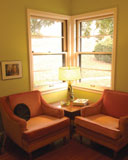
Back through the sitting room is another small hallway leading to two small bedrooms, one for guests and one that serves as a home office, and a second bathroom. The office has a multilevel desk with a pivoting lower level, two pink velvet upholstered armchairs and a vintage TV atop a 1940s radio/record player. The guest room has turn-of-the-century antiques that he brought over from his previous home, a Craftsman duplex also in the Highlands. “I have pictures of my grandparents in that room, so the older furniture seems to fit,” he says.
What started as an interest in 1950s furniture has evolved into a fully executed vision of home. It goes to show: Even the most buttoned-up periods can look comfortable and lively from a backward glance.