
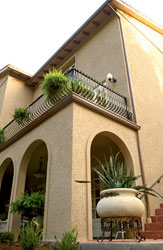

 Appearances can indeed be deceiving. At first glance, the two-story dwelling on a hillside overlooking Tyler Park appears to be a circa-1920s Spanish Mediterranean. In reality, though, the home is brand-new and its red tile roof and thick stucco walls conceal some of the 21st century’s most environmentally friendly construction technology.
Owners Jordan Michelson and Lenora Paradis built the home to replace a "nondescript 1960s ranch" they avow wasn’t worth saving. "It was small, with a galley kitchen and a raised hall with three bedrooms on one side and two bathrooms on the other," Paradis recalls. "Each of the baths had three separate doors to the sink, shower and commode. I think the architect who built it was drunk!"
Their decision to tear it down and start fresh, however, ignited a controversy. "A lot of people didn’t want the house built," Michelson says, citing opposition not only from neighborhood groups, but also from Metro Louisville’s Cornerstone 2020 plan.
The spouses are quick to say they’re not against preservation. They are well acquainted with the pleasures and pitfalls of old-house living. Paradis is a realtor and estimates she’s renovated some 50 houses during her career. Michelson, who grew up in the Highlands, owns Architectural Salvage, which has sold vintage and reproduction architectural elements on East Broadway since 1982. Their former home, though, a "gorgeous 1930s Tudor," was large and many of its rooms went unused, Paradis says. "All the bedrooms were upstairs and we were paying $700 to $800 a month to LG&E."
Four years ago they bought the Tyler Park property for its convenient location and spectacular view. Their plan was to build a new home with a first-floor master suite and a more usable layout. Of greater significance was building an environmentally "green" home, not only for energy efficiency, but for health reasons. Paradis was diagnosed with breast cancer in 1999 and is still battling the disease.
The home’s first- and second-level floorboards were cut from 130-year-old oak barn beams.

Neither had built a home from scratch before and Paradis says they "thought it would be fun." The process was anything but. Between hearings, permit-seeking, architectural plans and construction glitches, it has taken nearly three years to realize
their dream.
The Office of the Federal Environmental Executive (OFEE) defines green building as "the practice of (1) increasing the efficiency with which buildings and their sites use energy, water, and materials, and (2) reducing building impacts on human health and the environment." While popular on the West Coast, green building is rare in Louisville, which the couple learned when they began their search for an agreeable general contractor. "There weren’t many people who would work with us," Michelson flatly states. "I ended up serving as my own general contractor once the walls were up."
Their first decision was to use insulating concrete forms (ICF) rather than traditional stick framing. Reminiscent of LEGOs, ICFs are hollow interlocking polystyrene blocks filled with concrete. Among their many advantages: energy efficiency (insulation values of R-17 to R-26 versus R-13 to R-19 for stick-built), noise reduction (about 25 percent quieter than stick-built), longevity and resistance to fire and weather damage. Also made of concrete is the red-tile roof, as well as the flooring on the lower level and one of the home’s balconies. "All the concrete in the house is recycled and contains coal flash," says Michelson with pride.
The front door (top) is Andean walnut; the dining room’s 1830 French chestnut cupboard (top right and above left detail); the heated floor of the family’s lower-level rec room (above) is recycled cement.


Concrete is one of many recycled materials used in the home’s construction. The random-width oak flooring on the first and second levels, for example, was created by re-cutting 130-year-old barn beams. Some of the lighting fixtures are antiques, rewired for fluorescent bulbs. Also recycled were the balcony railings, which Michelson picked up in France and New York. "I bought the materials and had Okolona Fencing fabricate the railings," he says.
Another important consideration was the heating and cooling system. While the couple originally wanted geothermal, they opted instead for radiant heat in the basement floor, backed up by high-efficiency heat pumps. Designed and installed by Solar Designs Inc., the system also includes an air exchanger and HEPA filters to improve indoor air quality and prevent sick-building syndrome.
 Paradis notes that the home’s design itself contributes to lower energy use and cleaner air. Ten-foot ceilings, in lieu of two-story ceilings and interior open balconies, promote efficient airflow. Dust and bug collectors, such as tray ceilings, have also been eliminated. "They’re almost impossible to clean and then you have all that dust floating around in the air," she says.
To reduce volatile organic compounds (VOCs) in the air, all the paints and finishes are soy-based and the only rugs in the house are wool. According to the Environmental Protection Agency, exposure to VOCs can cause eye, nose and throat irritation; headaches; nausea; and even damage to the liver, kidneys and central nervous system. Clean water, free from chemicals such as fluoride and chlorine, was also a concern, so the home is equipped with a Wellness Filter that purifies "every bit of water in the house, from the faucets to the washing machine to the showers," says Paradis.
Finally, a special room off the kitchen is outfitted with a ceiling fan, tile floor, drain and hose spigot for growing bean sprouts, a staple of the couple’s vegetarian diet.
 Many of the home’s decorative features come from Architectural Salvage. What’s surprising is how many are reproductions. Stained-glass windows in the kitchen and master bath are Chinese imports. Arts & Crafts-style door hardware is by California-based Emtek, while the massive arched front door was custom-made of Andean walnut. Also from Architectural Salvage are the new bathroom vanities and stone-look living room mantel.
The home also contains some marvelous antiques. Taking center stage in the dining room is an 1830 chestnut cupboard from a chateau south of St. Etienne, France. The dining room chairs came from the Turf Club at Churchill Downs, while the chandelier is French Art Deco.
 One of the most unique pieces is in the living room — a pullout table that allows Michelson, Paradis and their two teenage girls to eat while sitting on the couch. Paradis saw it on a trip to France and says she badgered the owner until he agreed to sell it. Also unusual: the 19th-century birthing bed that serves as a couch in the master bedroom, the Arts & Crafts Brunswick "Arcade" billiard table on the lower level, the Victorian etched-glass pocket door into the pantry, and chevron-style French doors in the breakfast area. Above the breakfast table is a simple copper and stained-glass light fixture Michelson has owned since 1970. "I’ve had it with me in every single house I’ve lived in since I bought it," he says.
While he and his wife believe 75 percent of their neighbors are happy with the new house, Michelson says the best compliments have come from passers-by. "I’ve had four people ask me for the name of my builder and several others who’ve asked how long it took to remodel the place," he says with a smile.