

 One night not long ago — during the height of March Madness, to be precise — my mind turned to thoughts of murder. The constant blather of sports commentary coming from the TV tends to do have this effect on me. A British murder mystery being about as far as I can take such homicidal fantasies, I sauntered up the street to the local public library branch, where I decided it was time to reread my beloved Dorothy Sayers. The first novel I gravitated to was Strong Poison, which also happens to be the first one in which Sayers brought together the invincible pair Harriet Vane and Lord Peter Wimsey (neither of whom would ever have spent the night watching basketball on television). It is Sayers’ slimmest book, and a slim book is always a plus as far as I’m concerned.
In Sayers’ novels, the victims are constantly being knocked off by arsenic and other types of powdery poisons easy to disguise in food, toxins that were once easy to obtain at the local chemist’s. Not too far into the novel, we learn that the last meal eaten by the victim, one Philip Boyes (who at the time also happened to be Harriet Vane’s fiance), may have been laced with arsenic. As was the custom in early-20th-century upper-crust British dining, the meal — his last meal — consisted of a soup course, a fish course, a meat course, followed by a dessert course. The dessert in question was a sweet omelet. And because the omelet was prepared right at the table, by the victim himself, the court rules out that the egg dish could have been the source of the poison. The judge, addressing the courtroom, describes the conditions and procedure for making such an omelet:
“(Boyes was) very particular about eating an omelette the moment it came from the pan — and a very good rule it is, and I advise you all to treat omelettes in the same way and never to allow them to stand, or they will get tough. Four eggs were brought to the table in their shells, and (he) beat them one by one, adding sugar from a sifter . . . (then) cooked the omelette in a chafing dish, filled it with hot jam,” and served it to himself and the others.
Imagine a judge in a courtroom today advising the jurors on the matter of how best to prepare eggs. I thought to myself, standing there in the library, by Jeeves, I’m going to try this, except not with a chafing dish. I mean, I do not own, nor will I probably ever own, a chafing dish. And if I did own one, I would not use it for frying up an omelet. But what appealed to me about the sound of this sweet omelet was, first, that it sounded like a much easier way of achieving the qualities that one seeks in a souffle and, second, the filling possibilities were endless. As with crepes, the omelet might be filled with any number of jams, as well as with sour cream, creme fraiche, whipped cream, Greek yogurt, or even, if one wanted to keep it British, coddled cream.
So I went to work, experimenting. Because Sayers was writing a mystery novel and not a cookbook, she of course did not have the judge specify the amount of sugar to be used while beating the eggs. On my first attempt, I prepared it exactly as I would an omelet, only with the addition of a couple of tablespoons of sugar. This turned out to be too much, not only because sugar browns so quickly that it can turn things darker than they should be, but also because it made the omelet so sweet that the jam on top was rendered irrelevant.
I took a break to consult Mrs. Beeton, the doyenne of 19th-century British cookery. That hard-nosed lady said the proportions were two tablespoons of sugar per six eggs. I cut it back to one tablespoon for four eggs. Mrs. B further stated that extra egg whites were mandatory for the desired fluffiness of a dessert omelet. In this, she was absolutely correct. However, she also called for a half stick of butter, and in this she was dead wrong, which is one of the reasons people in her day didn’t live as long as they do now, besides which, a half stick of butter only results in an oily mass of eggery.
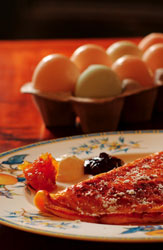
After a bit more experimentation, I arrived at the proportions in the recipe below. Playing around with the filling/topping was the most fun of all. I tried yogurt and honey, creme fraiche and various berry jams, sour cream and tangerine marmalade. Perhaps the best thing about the sweet omelet is that it can be either the first thing you eat in the morning or the last thing you eat at night. It lifts the spirits in the same way that a rectangle of tamago (made of egg custard) does at the sushi bar.
The trick (as with frying eggs, pancakes and crepes) is to get the skillet to exactly the right temperature over medium-high heat. Wait until the skillet is hot to add the butter. The moment the butter melts, pour in the beaten eggs. Fold the omelet when you see that the underside is a warm golden-brown. Make sure to omit the arsenic.
Sweet Omelet
4 eggs?
1 egg white?
1 tablespoon sugar?
1 tablespoon butter?
Creme fraiche
Blackberry preserves or citrus marmalade?
Powdered sugar for dusting??
Place the eggs, egg white and sugar in a bowl. Beat them thoroughly. Heat the butter in a small frying pan. Add the eggs and fry for two to three minutes before folding the omelet in half. Remove it from the heat and place it on a serving plate. Top it with the creme fraiche and preserves or marmalade, then dust it with the faintest amount of powdered sugar and serve immediately. Serves two.