

This is a food story that, like so many in my life, originates with one man’s doggedness. Plunk my husband down into the middle of any food mecca ’round the world and he turns into a wolf stalking its prey. Friends who have gone with us on trips have wanted to throttle him for how far out of the way he makes us go in search of the ultimate version of a given cuisine. You think you’re going to a Thai restaurant granted three stars by the New York Times? Think again. This guy’s going to take you to the northern Thai restaurant that serves mussel fritters and pork blood curry. (I am not making this up.) In Chinatown, he’s got to find the most hidden-away dim sum place where not a word of English is spoken. In Little Italy, he’s got to go where the Mafioso go. He takes his food questing so far as to deliberately book flights that will guarantee a layover in an airport with a raw oyster bar — even if the travel time is needlessly doubled. The most amazing thing is, he is always forgiven when the food arrives.
 How I came to be addicted to fire-roasted piquillo peppers from Spain is no exception to my husband’s rule of doggedness. This past winter we spent a long week/files/storyimages/in Chicago. While packing for the trip, I turned to the Weather Channel and learned that an arctic wind carrying record-breaking cold temperatures was heading down from the Northwest Territories. Into the suitcase went every pair of long underwear and wool socks, every hat, every mitten and glove that we own. I like to consider myself a woman who knows how to face down cold weather. In fact, I long for cold weather. I fantasize about living in Finland.
I would soon be fantasizing about living in the Canary Islands. On the Saturday night of said weekend, our son announced that he was too cold ever to go outside again and would be staying in the hotel room eating pizza and watching a movie, thank you very much. He further announced that he was “a million cusswords tired of Dad always dragging me to restaurants where I have to wait two hours for you people to finish eating your disgusting food.” So we left him behind, promising him that our intended dining spot, a tapas bar called Iberico, was a mere three blocks from the hotel. Ha!
First of all, Iberico was not three blocks away. It was nine blocks away — big, long city blocks that in normal weather I would love traversing, but this was not normal weather. Despite the fact that I had covered every part of my body in four layers and was wearing earmuffs under my hat as well as sheepskin-lined boots on top of two layers of thermal socks (oh, and also fur-lined gloves on top of glove liners), I was colder than I had ever been in my life. I was Iceland cold. I was a million cusswords cold.
After four blocks, I hailed a cab. The cab driver said, “Smart move.” He dropped us off at Iberico. We went in. There were 300 people at the smoke-filled bar, waiting for tables. The host said the wait was at least two and a half hours. My husband wanted to stay. “Are you out of your mind?” I asked, as is my wont. I told him no way was I waiting in a smoke-filled bar so far over the fire code that it could be shut down at a moment’s notice. I pictured a stampede — and our son back in the hotel room not knowing what had happened to his parents. My husband stepped outside to call a foodie fri/files/storyimages/in the city who knows all the best fallback restaurants if the prime ones are booked. After being disconnected three or four times, he finally got the name “1492” out of her. I said, “Is that the address of the place?” He said, “Uh, no. It’s the year Columbus discovered America.”
Back out on the street, we got into a fight about the words year, Columbus, discovered and America. And then we started walking really, really fast into the howling wind. He said, “It should be around the next corner.” It wasn’t. We ended up going around, oh, probably six more corners. Maybe seven. I started walking faster. I began to run. I was so cold I was crying. We kept passing other restaurants with no waiting lines: Vietnamese places, Italian, French, even a Peruvian place. I begged him to give up on the tapas bar. “You’re the one who loves tapas,” he said. “Let’s find this joint. It’ll be worth it.” I said, “I’m going to kill you. And after that I’m going to divorce you.”
Then we found the place. It looked like a small castle on a quiet corner. It was not crowded.
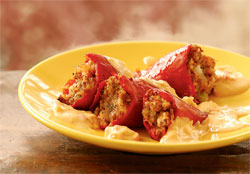
And guess what? It was worth it. At first my eyeballs were too frozen to read the menu. But once I could read it, and a mighty plentiful menu it was, I sat there completely dazzled. These little dishes were beyond the scope of anything I had previously understood as tapas. One recurring ingredient was the piquillo pepper, which I had heard about only the week before from a well-known local food maven, who had explained that these fire-roasted gems come only from the Navarra region of Spain and have to be ordered from a Web site called Tienda.com. The menu featured several dishes containing the wee spicy pepper, but I went for one with the piquillo as its chief ingredient: piquillos stuffed with shrimp. As soon as I lifted the fork to my mouth, I knew I would be ordering a case of piquillos the moment I got back home. And so I did. The best thing of all about these peppers is that you don’t have to do anything to them besides open the jar and remove them. Each one is perfectly shaped with an opening at the top that could not be easier to stuff. So stuff away. Here is my approximation of what went into that perfect tapa on that Arctic-cold night.
Spanish Eyes
 The night we first ate piquillos, our knowledgeable waiter recommended a “soft, simple” white wine or a rose to bring together the sweet and salty flavors in the stuffing and the spiciness of the peppers. My husband went with the rose, and I soon wished I had done the same. Nonetheless, in our tasting this month the top-notch rose below came in second to a white that is without a doubt one of the best buys on the market.
2005 Chivite Gran Feudo Rose, $11. One of the most popular wines in Spain, this brilliant cranberry pink rose uses all Garnacha (Grenache) grapes. And it bodes well that it comes from the same region (Navarra) as the piquillo peppers themselves. Though it has the aroma of fruit, on the palate it is quite clear and refreshing, with a balancing acidity. One of our tasters deemed it a “mental tonic,” while another said, “It’s like it’s calling out ‘What about me? I’m red, I swear I’m red!’” This is a clean and clear rose that you might want to stock up on for the spring and summer, when rose is at its very best.
2003 Peitan Albarino, $15. Peitan Albarino is recommended as the perfect accompaniment to seafood. This is the first release of the stainless-steel fermented wine created by Spanish winemaker Alistair Gardner. “Hallelujah for no oak!” cried one of our tasters. The most appealing in color of the three wines sampled this month, Peitan Albarino lies somewhere between amber and celadon. It is redolent of a summer harvest, with notes of peach and honeysuckle, but it hits the palate with the crispness of a Granny Smith apple. Fuller-bodied than the other two wines, it has moderate acidity, but it coats the palate on the finish with flavors that perhaps last too long and thus overwhelm the multiple flavors of the stuffed peppers.
2004 Osborne Solaz Blanco Viura, $8. The Viura grape is picked at optimal ripeness, de-stemmed and lightly crushed. It is fermented at a low temperature to extract and intensify the fresh and fruity character of the variety. Though the first sniff gives off a tropical fruit aroma with just the slightest hint of anise, the taste is bright and fresh, like a premium champagne without the bubbles. Though we all agreed that the Blanco Viura is a down-to-earth Spanish white (causing the pepper flavor to pop), one taster added, “These peppers were a heavenly thing to begin with, but now they’re becoming God.” Does a recommendation come any higher than this?