

 I can’t count the number of people I know who claim to love seafood “as long as it’s not fish.” My husband is one of them — all excited and anticipatory if he wanders into the kitchen and spies shellfish or any type of mollusk, but far less jazzed up if his eyes land on a fillet of salmon or a rainbow trout. He, like so many others, associates cooked fish with the low-fat diets of elderly aunts. “You sure you don’t want to make sushi out of that?” he’ll quip (as if I have a sushi chef’s skills with the knife or artistry with the layout).
But a recent trip to the Pacific Northwest proved even to this stubborn man that people are just plain wrong when it comes to the potential of fish to be tasty.
Coincidentally enough, just as we landed in Vancouver, British Columbia, I’d finished reading a funny little British novel called Salmon Fishing in the Yemen, which of course is an unaccomplishable feat. The book, with author Paul Torday’s intricate explanations of the life cycle of a salmon, whetted my appetite not for fly-fishing but for eating. It also taught me plenty about varieties of salmon the world over.
No single group of humans is more insistent upon wildness than the ex-hippies who run food establishments up and down the west coast of North America. These are the original “sustainable foods” people. No phony farming for them. They’re so opposed to farm-raised fish that they don’t need to get up petitions against it — the laws have long ago been enacted. And a diner can instantly taste the difference, not just in the fact of the wildness but in the distinct varieties of salmon as well.
On our first afternoon in Vancouver, in an outdoor shack down along the waterfront, we had both fish tacos and fish and chips made from salmon caught that morning. It was the freshest meat, of any kind, I’ve ever tasted. Even the breading of the batter didn’t begin to obscure the purity of the salmon’s flavor.
Still, it was to be outdone that night by the Skeena River salmon we were offered in a more upscale restaurant. Our friendly young Canadian waitress told us right off that this was the salmon that people (meaning locals) wait for. It was plain to see why, which I mean both figuratively and literally. The Skeena River and its tributaries, high in the coastal mountains of northwestern British Columbia, are regarded by many as the world’s best waters for steelhead (aka trout salmon), coho, pink, chum, and king (Chinook) salmon. The river has a glacial current that is swift and unrelenting, so the salmon have to be both muscular and layered with fat in order to survive their run. The steelhead is considered the biggest prize of these and is best served as simply as possible — grilled with a spot of butter and perhaps a few squirts of lemon. The less you do to it the better.
Nonetheless, most varieties of salmon take well to being paired with sauces. This is especially true here in the American Midwest, far from the Skeena River (where, in the right markets, we still manage to find salmon shipped in fresh most days). There’s nothing quite like dill, cucumber and sour cream or yogurt, for instance, for topping off a fillet that has been poached and chilled.
I recently began to experiment in salmon cookery, keeping in mind many of the practices I observed up north of using native local ingredients. Of course, the “local movement,” like any other kind of movement, can be taken too far. Where would we be (especially in the recipe below) if we had to rely on local wine, for example?
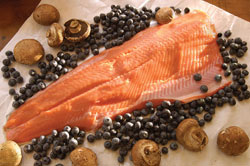
The more I cook, the more I grow enamored of mixing fruit in with savory ingredients to make a meal, and the fruit I think works most beautifully in this capacity is the blueberry. No one could argue against the marriage of blueberries and salmon. Aside from the by-now well-known anti-oxidant power of the blueberry and the only slightly less-well-known boost that salmon gives to aging skin, there is, pure and simply, the flavor explosion. So here is a recipe I’ve come up with. Certainly try to make this with wild, not farmed, salmon. And it pays to go to a real fishmonger rather than the supermarket.
Wild Salmon in Blueberry Reduction Sauce
2 wild salmon fillets
4 tablespoons of butter
The juice of one lemon
2 tablespoons shallots, finely chopped
? cup olive oil
1 cup of sliced crimini mushrooms
1 cup of dry white wine
? cup of good-quality chicken stock
? cup of fresh blueberries
3 tablespoons finely chopped parsley
Salt and freshly ground pepper
In a large heavy pan, sear the salmon in two tablespoons of the butter until it’s nicely browned on the outside. Remove the fillets to a plate, drizzle them with lemon juice, and set aside.
Saute the shallots in the remaining butter. Add the olive oil, then saute the mushrooms in the same pan. Add the wine and chicken stock, allowing the mixture to reduce by half.
Gently stir in the cream, the blueberries and the parsley. Sprinkle in some salt and lots of freshly ground pepper. Return the salmon to the pan, and spoon the sauce over it so that the fish warms through.
Remove the fish to a warmed platter, surrounding it with the sauce. Serve it with a crusty baguette and a green salad topped with even more blueberries. Serves two.