
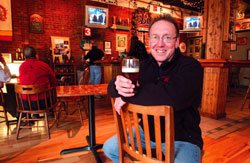

 On an early Friday evening, East Main Street is quiet, almost deserted, in stark contrast to the bustling gallery and restaurant district one block south on Market Street. A small sign above the door of a nondescript warehouse on the corner of Clay and Main reads “Bluegrass Brewing Company.”
Through the door is a room of less than 1,000 square feet, with hardwood flooring, a half-dozen tables and walls decorated with antique beer memorabilia. Eight ales are on tap, all bearing the same name as the sign outside. The unassuming bar is called a “taproom,” not a pub or tavern, because no food — unless you count popcorn — is served. What’s more, the low volume of customers might lead to questions about the sustainability of the business. Yet among the dozen or so patrons sits a man whose influence is spreading. He is David Pierce, the craftsman who brews the BBC beers you buy in liquor and grocery stores, and he is in many minds the most talented microbrewer in the Louisville area.
Pierce, 49, seems to really enjoy this place, since, after a full day of tending the mash tuns, he is still here, drinking his beer, smoking and shooting the breeze with his two-man crew and a handful of regulars. His low-key demeanor belies considerable professional success. Modest yet confident, Pierce never volunteers praise of himself, but he doesn’t diminish his accomplishments. Asked how many medals his beers have won at juried competitions, Pierce simply laughs and says, “I don’t know . . . a lot.” The number, by the way, is 12 medals and counting.
His Bearded Pat’s Barley Wine has been particularly successful, with five gold medals. Barley wine is a type of very strong beer served in what looks like a squat wine glass. It has almost four times the amount of hops as BBC’s next-hoppiest beer, the American Pale Ale (usually most prevalent in pale ales, hops give beer its bitter flavor), and carries a whopping 10 percent alcohol content. Among those to sing the praises of the barley wine is Michael Jackson (the Robert Parker of beer critics, not the former King of Pop), who wrote, “I was stunned by the hop aroma, superb clarity, fresh maltiness, smooth body and peppery warmth.”
 The barley wine wasn’t always a winner for Pierce. He describes the first batch of it as “the most fun disaster” he’s ever had brewing. Midway through the process, the morass of hops floating in the fetal barley wine was so thick that the only valve on the fermenting tank became clogged, allowing pressure to build. “I started undoing the clamp and it blew apart, and I got covered — I mean covered, from head to toe — with green hops,” Pierce remembers. Since then, he always keeps an extra set of clothes at work.
The BBC Beer Co.’s recent push into new markets is also bringing attention to Pierce’s craftsmanship in new places. Managing director Scott Roussell is leading an effort to distribute bottles and kegs of the brewery’s three core products — the pale ale, a nut brown ale and an attention-grabbing bourbon barrel stout (it’s aged in used whiskey barrels) — that has penetrated into Indiana, Tennessee, southern Ohio and Virginia. West Virginia will be added soon.
 BBC’s beer man is a good-natured, jocular and bespectacled ball of energy. Standing just 5-foot-7 and fond of wearing shirts from other breweries along with a baseball cap over his spiky hair, Pierce relays brewing stories that are equal parts humor and technical expertise, often peppering them with a bit of salty language. The beer in one hand and the cigarette in the other seem to be mere extensions of his hands as he waves them for emphasis during his stories.
Like many microbrewers, Pierce got his start by homebrewing, to which he was introduced by his father. One of his dad’s beer books was among Pierce’s earliest influences, and it is now one of his most cherished possessions. The tattered, yellow volume tells its readers, “If you follow instructions, your home brew will be good, very good — your first batch and every batch.” Actually, by his own admission, Pierce made four straight batches of some pretty bad “malt-flavored alcohol” following one of the Prohibition-era recipes in that book. The then 23-year-old future brewmaster was on the verge of giving up. His fifth attempt, however, showed improvement. “By the sixth batch,” he says, “I was like, ‘OK, I’m not quitting.’”
For 12 years, the hobby assumed an ever-larger place in Pierce’s life, until he was running what amounted to a week/files/storyimages/microbrewery out of his garage with $2,500 worth of equipment. “That included a draft system and all that,” he recalls, along with two dozen five-gallon kegs, two dozen glass carboys (multi-gallon bottles) and a separate refrigerator just for lager to control its temperature.
 All told, he was making up to 500 gallons of beer annually, which he confesses was “well-over the legal limit” for homebrewers. But Pierce qualifies this by noting that he did not personally drink all of it. “When you have beer on draft at home,” he says, “it’s kind of like putting in a swimming pool — all of your friends come over.”
When the first modern-day commercial microbrewery in Louisville opened in 1992 as the Silo Brewpub on Barret Avenue, Pierce was ready for a career change. He was burned out by his job as a construction manager for a company specializing in commercial interiors, so he applied to be the Silo’s brewmaster. Lacking a professional resume, Pierce got creative, submitting a case of his beer instead. The approach worked. He beat out two school-trained brewers with good curricula vitae but no actual beer.
Business started strong at the Silo, and he brewed at capacity there for about three months. But then the sales of Pierce’s handcrafted beers started to slip. “The drop coincided with every time they put a new bottle beer on the list,” he says. He left after less than a year, joining a partnership as a small-percentage owner in the original Bluegrass Brewing Co. in St. Matthews. There, he created more than 80 different ales, lagers, meads and other varieties. BBC eventually bought out the Pipkin Brewery and its facilities on East Main, and in 2001 Pierce split with his BBC business partner and former high school classmate at Southern Indiana’s Floyd Central, Pat Hagan. Hagan kept the Shelbyville Road location (later adding the Fourth Street restaurant and bar), while Pierce went to the warehouse to focus solely on brewing and bottling. The taproom was added “mostly for educational purposes,” says Pierce, as kind of a showroom and hangout for buyers and beer-enthusiasts. Now, despite having basically the same name and the same recipes, the two branches of the business operate as separate entities, with Jerry Gnagy serving as the brewmaster for the Shelbyville Road eatery. Fourth Street serves beer from both breweries, according to Pierce.
His domain, located behind the Main Street taproom, encompasses a 17,000-square-foot bottling and fermenting room. The 16-foot ceilings are barely tall enough to hold the dozen gargantuan stainless-steel tanks. The agglomeration of enormous metal casks, snaking hoses, clanging bottles, grinding gears and vats overflowing with frothy liquid all look something like Willy Wonka’s experimentation room.
A study in motion, Pierce whirls a forklift around a tight space, inserts its tines beneath a pallet of newly bottled beer and plants the huge six-by-six-by-six-foot cube on a massive stack of other pallets. He jumps off the forklift and connects one of many hoses to one of many valves on one of many vats. “I have to equalize the pressure,” he yells over the din of the bottling machines. If he doesn’t, the beer will lose its carbon dioxide and go flat.
Pierce then walks briskly over to another large tank — a mash tun, a name brewers share with distillers — and climbs the stairs to the top. Opening the hatch, he reveals a small sea of steaming barley mash that smells distinctly of Grape-Nuts, the breakfast cereal also made with barley malt. From this first vat, the liquid is siphoned off into another and, with certain types of beer, filtered before packaging. At each stage of the process the vats must be emptied, sanitized and refilled as soon as possible.
The job requires substantial multitasking, endurance and commitment, all of which separate the master brewer from the average homebrewing hobbyist. Contrary to what many beer-lovers might think, Pierce says, “It’s not a glamorous job. You’re basically a high-paid janitor.” The work is hot, sticky, stressful and unrelenting. Pierce’s personal record: working shifts of 40, 28 and 20 hours — all within the same week. Maintaining the necessary consistency from batch to batch and bottling to bottling for BBC to satisfy more markets is a major challenge.
The beer he’s personally most proud of is the American pale ale. He experimented with it for two years at home before trying it professionally. “Every time I brewed it, I would change one thing. I was looking for the ultimate pale ale,” he recalls. He seems to have found it, evidenced by the APA’s status as the best-selling BBC beer.
In 2006, Pierce crafted 4,000 barrels of beer, or 124,000 gallons. This year he hopes to reach 186,000 gallons and foresees eventually producing 22,000 barrels, or 682,000 gallons, per year. Through his prolificacy, relative longevity and affability, Pierce has become a leading influence on local beer professionals and aficionados. He regularly leads “BBC Beer School” seminars, through which local pub managers, owners and bartenders learn about the history of beer and the brewing process. He is also the host of annual “brew-ins,” where homebrewers can swap swigs, stories and experience, all within the environs of a bona fide microbrewery.
Even his former business partner, BBC restaurateur Pat Hagan, has nothing but praise for Pierce, saying, “Dave’s a great brewer. Restaurants come and go, but we’re still here because we’ve got great beer.”
Pierce says he has never tired of brewing. In fact, with the launch in recent months of what he terms a “single-batch series” — seasonal and specialty brews in limited release — he’s been invigorated. An India pale ale was the first in the series and he’s planning in the near future a German hefeweizen, an Octoberfest and a Belgian-style ale called Hell for Certain.
It’s a return to the more freewheeling days of his youth. “The single-batch series,” Pierce says, “is letting me play again.” n
With 26 years of amateur and professional microbrewing under his belt, Bluegrass Brewing Co. virtuoso David Pierce has yet to lose the fire for creating the next great small-batch beer.