
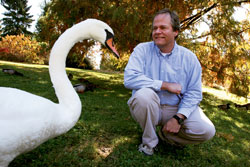

 While big media fans the flames of a fire started three years ago when officials at U.S. and world public-health agencies began issuing stern warnings about a possible pandemic flu outbreak as lethal as the 1918 "Spanish flu" (which killed tens of millions of people worldwide, including 600,000 Americans), University of Louisville evolutionary-biology professor Paul Ewald self-assuredly assumes the role of contrarian, saying such a threat is "essentially nonexistent."
He’s been making that point from podiums and in print for 15 years, ever since he proposed in the scientific journal Human Nature that the deadly virulence of the 1918 flu evolved solely because World War I soldiers were packed like sardines in trenches, trucks, triage tents, rail cars, ships, hospitals and port facilities as the disease picked up steam. Confusion in the ill-equipped medical community and the freakishly huge war population — remember, 65 million men were mobilized for the conflict and 37.5 million of them became casualties — ensured that the quick-killing disease organisms could take advantage of ideal toxicity-growing conditions and rapidly spread — among the soldiers, among their caregivers, among support personnel, among civilians back home.
Because those conditions are unique to history, says Ewald, author of the books Evolution of Infectious Disease (1994) and Plague Time (2000) and director of U of L’s evolutionary medicine program, such a scenario could never play out again, a contention some health experts ridicule. He bases his argument on Charles Darwin’s principle of "natural selection," also known as "survival of the fittest," which says that in competitions among species — and particularly within species — the survivor will be the one whose traits better enable it to adapt to environmental pressures and perpetuate its survival through propagation.
In the case of parasitic flu-virus strains (or variants), you might think that faster propagators would dominate and flourish, and they would, says Ewald, if their aggressiveness didn’t guarantee that they would be stranded in a dead or otherwise immobilized body, unable to secure new targets for their progeny. "If you don’t immobilize the host, you have your best long-term chance of survival," Ewald says, because "a person who is stuck at home in bed is not going around sneezing on friends," creating new propagation colonies. "That explains why the rhinovirus has evolved to be fairly mild." By immobilizing its host, negating its chances of infecting new hosts, an aggressive virus is in effect committing suicide, and a milder pathogen becomes king.
Unless, that is, the nasty pathogen is supplied with a way other than host mobility to reach new victims. For malaria, mosquitoes provide the taxi service. For cholera and other diseases causing diarrhea, it’s an unfiltered or badly filtered water system. Bubonic plague was spread from rats to humans via fleas and from humans to humans via lice. Smallpox organisms are so durable that they can sit on a surface for 10 years after a host has died and still infect a passerby (whereas ultraviolet light destroys a flu virus "within minutes," Ewald says). During the peak of the 1918 flu, huge concentrations of virus-riddled people were delivered by troop ships into the midst of healthy people in port cities. In those cases, deadly variants are favored by natural selection.
"What this tells us," says Ewald, "is it’s not just a quirky, bad throw of the dice that has led some parasites to be so harmful, like smallpox and malaria; rather, it’s specific aspects of their life history — the way they’re transmitted, for example — that had favored the more predator-like ones over the less predator-like ones."
Low transmissibility, Ewald says, explains why other feared 20th-century flu pandemics — the 1957 "Asian flu" and the 1968 "Hong Kong flu" — evolved toward mildness. (Virus-strain evolution can occur quickly — "within weeks," says Ewald, but the process requires a series of transmissions.) The 1957 flu killed about 60,000 susceptibles (people with weak immune systems) in the U.S. and the ’68 flu killed about 35,000 — about the same number "normal" influenzas kill here each year.
The 52-year-old Ewald, who was lured to the University of Louisville in 2002 from Massachusetts’ Amherst College, says he became interested in evolutionary medicine during the late ’70s while studying for his zoology doctorate at the University of Washington in Seattle. He had gone on a field trip to Kansas with his advisor and the advisor’s family, and their young daughter developed diarrhea.
"I picked up whatever it was, maybe from utensils or something. I was terribly sick," says Ewald. "I thought, well, thinking from an evolutionary point of view, I’ll just let my body take care of it. As I was sitting there I realized there was another explanation: that this organism inside my intestinal tract could be manipulating my body for its own spread. If my body was defending itself by flushing out this opponent, I wouldn’t want to take something to stop the diarrhea. But if the organism was manipulating my body, then I would, to stop it from manipulating my body."
In the early ’90s, while at Amherst, Ewald’s lab sent for and received waterborne cholera bacterial organisms from South America. "The cholera organisms got into some places with bad water (purification systems), some places with good water. Chile has good water; Ecuador has lousy water," he says. "The organisms were variable when they came into Peru, and then Ecuador and Chile, in 1991, and the harmful strains just dropped out in Chile. In Peru, where you had moderately bad, but not the worst, water supplies, they stayed constant in terms of how much toxin was being produced. In Ecuador, where you’ve got the worst water supplies, the toxin levels actually went up; they became more harmful," meaning that deadly organisms had won the evolutionary competition there because, while ravaging the bodies of immobile hosts, they were afforded a free ride to susceptible healthy people through the bad water system.
"In Chile, where they have clean water supplies, they had about one death from cholera every other year," says Ewald, whereas thousands died annually in Ecuador and Peru.
"What that says is that if you clean up water supplies, you can cause the organism to evolve to mildness," he says. "In places where they haven’t cleaned up water supplies they still have the harmful ones. And they’re coming into JFK, probably Louisville airport, LAX every day. So we’re continually being rained on by these harmful strains, but because we’ve got clean water supplies they don’t go anywhere. Our infrastructure protects us against these harmful strains."
Right now, the organism that public-health officials are worried, even panicked, about is known as the H5N1 avian flu virus, which has yet to be confirmed spreading from human to human. (The 1918 flu was tagged H1N1.) It is carried by waterfowl and other birds, which show varying degrees of infection, but has proven to be notably virulent in chickens, especially those crowding Southeast Asian chicken farms, and in a relatively minute number of humans who have regularly handled or otherwise come in close contact with sick birds. (The pathogens aren’t airborne-transmitted; they require contact with a bird’s saliva, nasal secretions, feces and blood.)
The first strain of the H5N1 influenza-A subtype was discovered in Scottish chickens in 1959, then mutated and meandered around the wild bird population before re-emerging with vengeance in Hong Kong in 1997, where the first chicken-to-human transmission was recorded. Since then, about 250 people worldwide have contracted the bird flu, some 150 of whom died — an alarming percentage for sure — and millions of Southeast Asian chickens have been slaughtered. The fear is that a mutation will occur that creates a deadly strain readily transmissible from human to human and start a 1918-level pandemic. Thus the increasingly urgent calls for the H5N1-repelling vaccine Tamiflu.
"We have no interest in feeding panic and we don’t do that," says Louisville Metro Health Department director Dr. Adewale Troutman. "I think the whole notion of referring to 1918 is an example of what could be. No one that I know of has ever said that it would be as bad as 1918."
And that’s true. Dr. Robert Webster, director of the Memphis-based U.S. Collaborating Center for the World Health Organization, only said, "The answer is absolutely yes," when asked in a late-2005 interview whether we could have another 1918-like outbreak — although he did say that if H5N1 "learned" how to transmit between humans, "1918 would seem like a duck walk; this would be much, much more severe." And he did tell ABC News that he had a three-month supply of food and water in his house in case. Meanwhile, a United Nations health official announced that up to 150 million people could die worldwide from a human-to-human H5N1 outbreak.
"People get so fixated on the potential for something that’s on the horizon that they ignore what’s definitely going to come," says the Metro Health Department’s medical director, Dr. Matthew Zahn. "Particularly last year, there were a lot of statements made by people that (an H5N1 pandemic) was simply going to happen. Well, we don’t know that that’s the case. We do know that this virus will have to undergo a fair number of changes before it would be able to pass efficiently from person to person."
Rather than wait for that to happen, and in the meantime rush the production of vaccines for U.S. citizens in anticipation of it happening, Ewald says we should be developing measures to coax the virulent pathogens in the Southeast Asian bird population to evolve toward mildness by vaccinating chicken flocks and otherwise interfering with the pathogens’ transmissibility. "We will continue to get severe influenza epidemics in chicken farms so long as the conditions in chicken farms, like the conditions at the (1918) Western Front, allow transmission from immobile chickens," he says.
"I think that spending billions of dollars stockpiling bird-flu vaccine for U.S. citizens in anticipation of a highly lethal pandemic that will never materialize is a poor use of limited funds," Ewald says. "I would prefer to see such vaccines used to immunize those people who have a high chance of coming into contact with infected chickens. This kind of use would lessen even more the chances that H5N1 would be able to evolve transmissibility between humans."