

By Lewis L. Gentry
Photos By John Nation
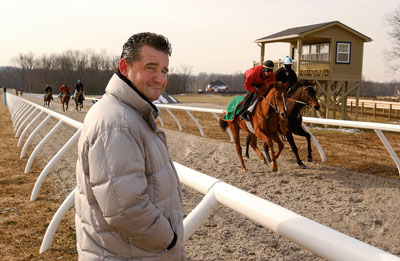
It’s a crisp February morning and four horses are being led out of their beige and blue barn at the High Pointe Farm and Training Center, just outside of LaGrange. A cold wind sweeps across the land and the trainer Niall O’Callaghan calls out instructions to two of his exercise riders.
“All right, Jenny? All right, Gavin? Good? You’re sure?”
The riders are bundled tightly, with ski pants and heavy jackets and scarves around their faces so that they look like a couple of desperadoes.
“I ask the riders their opinions,” O’Callaghan says. “Feedback is the most important. They ride the horses every day. You know, a trainer listens.”
There is a colt in a circular pen at the top of a rise and it is rearing up playfully, pawing the air with its hooves. Three doe step gingerly out of the trees and cross the open field. O’Callaghan looks away from the deer and points to his line of horses.
“That one there, the filly, she’s part of our 11-horse syndicate this year, but she doesn’t have a name yet.” Horses don’t require a name until they’re raced. The filly is a two-year-old O’Callaghan purchased in a group of 21 horses. He separated the horses into three syndicates of 11, five and five.
O’Callaghan sniffs against the cold, watching the filly go by.
According to the trainer, horse-racing syndicates were first conceived by W. Cothran “Cot” Campbell, president of Dogwood Stable, which is located in Aiken, S. C., and has syndicated horses on a national scope since 1969. (The first of O’Callaghan’s two Derby horses, Smilin Singin Sam in 1994, was part of a Dogwood syndicate; he also trained 2001 Derby starter Keats.)
Racehorse syndicates have a democratic appeal. In some ways, allowing individual investors to pool their capital and purchase a share in one or a group of horses is a unique — even revolutionary — concept in a pastime known as the Sport of Kings. With a modest investment, compared to the cost of sole ownership in a Thoroughbred, the members of a syndicate become “owners” who share in the expenses and the spoils. In multiple-horse syndicates, the inherent risks are spread among members and opportunities for success are increased by the shared interests in more than one horse.
Perhaps the best-known racing syndicate to date was the group of friends who owned Funny Cide, the winner of the 2003 Kentucky Derby and Preakness — a near-winner of the Triple Crown.
|

The members of that syndicate, Sackatoga Stable, arrived at every Triple Crown race in a now-famous big yellow school bus.
Louisville has its share of Thoroughbred racing syndicates. Two of these local groups, one managed by Gary Drake and the other by Bill Malone, both local businessmen and outsiders to the racing industry with a passion for the game, have met with success in recent years. O’Callaghan, on the other hand, is an insider who calls upon his skills as a trainer and his relationships within the racing industry to develop his syndicates. He markets them heavily, particularly on the Internet, to those on the outside who would like a taste of the action as a Thoroughbred owner.
His as-yet-unnamed two-year-old filly is a chestnut color with a jagged white blaze running down her nose. She is smaller than the others. “They’re about 90 percent grown at three,” O’Callaghan says. “So she still has some growing left.”
The trainer started in the horse business as an exercise rider in Ireland at the age of 15. He had dreams of becoming a jockey when he came to the U.S. at age 18. By 1990, O’Callaghan, who turns 43 next month, had his own stable in the U.S. He trains 50 horses — those not syndicated have other owners — and this number fluctuates as new talent arrives and lesser horses are culled.
There are two ways to acquire horses, and O’Callaghan uses the acquisition of players in the NFL — he is a huge fan of professional football — to illustrate. “If you buy a yearling, it’s like going to the draft and building a team,” he says. The other option is akin to football free agency: You buy a horse that has been raced. “You pay a little bit more with free agency, but you get the proven champion,” he adds.
In 2002 O’Callaghan unofficially, and quite by accident, started his first syndicate. Accustomed to finding a lot of his horses on the European circuit, where he says he can buy them a little cheaper because the prices, like the purses, aren’t as high, he hoped to purchase a proven horse in Ireland named Wiseman’s Ferry. But he couldn’t afford him. He was determined, though, and with an owner for whom he has trained put together a group of almost 20 investors to buy Wiseman’s Ferry. The horse came to America and won the $600,000 Grade III West Virginia Derby and the $500,000 Grade III Lone Star Derby, and ran ninth in the Belmont Stakes. After Wiseman’s Ferry was sold as a stallion, the accidental syndicate earned three times its original investment.
|

O’Callaghan thought he’d learned something about racing’s future. He went to last September’s horse sale at Keeneland with his mind on purchasing horses he could syndicate. “What I did was, I went to the draft,” he says. He selected the 21 yearlings now at High Pointe and packaged them into the three syndicates. Some of these horses will start racing in April as two year-olds under the ownership of Epona Racing, named by O’Callaghan for the Irish goddess of horses.
He has assumed the triple roles of part-owner, trainer and syndicate manager. It is a bold endeavor. He will retain the shares that are left unsold in the syndicates, so he has a direct financial stake in the performance of these racehorses. Ten-percent shares in the 11-horse syndicate are being sold for $59,000. This amount includes 10 percent of the purchase value of the 11 horses ($34,560), plus 10 percent of the estimated costs incurred for the first eight months of the syndicate ($24,440), which includes the trainer’s fee as well as an estimate of the anticipated expenses, veterinary exams, transportation and blacksmithing. A 10-percent stake in the two five-horse syndicates is lower, either $30,000 or $15,000. There are currently 25 investors in the three syndicates, some also with 5-percent stakes.
Profits from moneymaking horses are applied to future expenses or redistributed to investors. However, if the horses have not made a return on investment, then the syndicate’s members will be billed for those expenses. O’Callaghan decides if a horse should be sold, either for poor performance or because it has done well and will make a nice profit. “My investors are buying into the idea that I’ve learned X about racing,” the trainer says, “and they trust me to make the right decisions.”
O’Callaghan’s syndicates will terminate after three years, at the conclusion of the Thoroughbreds’ four-year-old racing season, and the horses will be sold and the syndicate dissolved. The profits (assuming the horses run well) will be distributed to the partners, or the profits can be reinvested in a new syndicate.
“There’s a Fantasy Football-type feeling about a racing syndicate,” says O’Callaghan. “Yes, it’s an investment and I strive to make people money. And you also can’t forget that you can lose money. But the intangible is the high level of social interaction, entertainment and fun that people won’t realize until they’re in it.”
Gary Drake is a tall, neat-looking man. He is 48, balding and has cropped his gray-brown hair short so that it stands on end. His mustache is neatly trimmed and graying. He wears silver-rimmed glasses and a crisp-looking royal blue dress shirt with a Cross pen clipped in the pocket.
Drake was bred in Franklin, Ky., and trained at the University of Kentucky. He started his own business, Phoenix Process Equipment Co., more than two decades ago. The firm supplies industrial filtration for water and wastewater treatment to an international list of customers. We’re meeting in the conference room, where a large map of the world hangs on one of the walls. Drake and his wife Kitty, with whom he has two school-age sons, had one of their first dates at Churchill Downs. He was impressed that she could read a racing form.
This year Drake is operating two syndicates, each made up of a single horse. One horse, named Motivus, has six investors and is being trained in California. The other is a yet-to-be-named two-year-old filly by top sire Hennessy that has three investors and is being trained in Florida. He prefers one horse per owner group and thinks it provides a focus that allows each racer to achieve its full potential. He has taken over 100 horses to the races since he became involved in the business 15 years ago; of those, approximately half have been syndicated and half owned exclusively by Drake. Each of his syndicates bears the same name, New Phoenix Stable.
Investors must pony up a minimum of 5 percent for inclusion in a specific syndicate. He’s never had more than 10 individuals in a given group and prefers a number closer to five. His own stake can be a very high percentage — even sole ownership if no one joins him on a horse he buys — or it can drop to the minimum, 10 percent. “It’s always so speculative,” he says about generating investors in a syndicate, “that if I get squeezed down to 10 percent and it doesn’t work out, then I haven’t lost as much money.”
And if it goes the right way? “Then I’ve got 10 percent of the deal.”
His syndicates are set up to offer an “active” ownership, where the partners have a voice in making decisions in the racing career path a horse will take, although most decisions about the horses are deferred to Drake. His syndicates have no termination date. A Thoroughbred will race as long as it’s healthy and performing well, thereby enhancing its class and improving its value in the marketplace as a broodmare or stallion. Drake estimates that about half of his syndicates turn a profit. “But how do you quantify winning a stakes race at Churchill Downs? Or winning the Belmont?” he adds.
Drake spends as much as 25 hours a week analyzing the Thoroughbred industry, trying to stay ahead of the game. “It’s already a tough game,” he admits. “So how do I try to increase my odds of success? By using knowledge.”
He does not consider Thoroughbred racing a hobby. “I run it as a business,” he says. “I’m fortunate in that I’ve found a second business I’m passionate about. I sp/files/storyimages/too much time working on it and studying it for it to be a hobby.”
He operates “closed” syndicates. His partners are friends and acquaintances, and occasionally friends of friends. He does not advertise his syndicates or attempt to bring in outside investors, as is the case with O’Callaghan’s open syndicate.“We’re not getting people in it who don’t understand or don’t culturally recognize the risks associated with investing in Thoroughbreds,” Drake says.
Although he’d like to focus on one-horse syndicates, his typical setup groups two or more horses in a single package and sells shares in that package. Thoroughbreds are generally purchased at $200,000 to $250,000 with the hope that they’ll improve enough to win at the graded-stakes level and then increase in value.
Ironically, Drake’s greatest success as an owner came outside of syndication with Sarava, a turf horse that had been racing in England. The way things looked in late 2001, Sarava’s career was a disappointment. The horse previously was purchased as a two-year-old in training for $250,000 by Paul Roy, of Surry, England, an acquaintance of Drake’s. “But he wasn’t running like a $250,000 horse,” Drake says. “In races where he was the favorite he was running fourth, beaten two or three lengths.”
Sarava did train well. “And that’s typical for a horse that likes a different surface,” says Drake. He saw great potential on dirt for Sarava and he jumped at the chance to invest. The Louisville syndicator won’t be specific about how much he paid for 50 percent of Sarava, but “it was substantially less than $50,000, substantially less.”
Then he tried to syndicate the horse. “I contacted all of my regular guys who like to get into horses and like some action,” he recalls. “I said, ‘Go look at him; he looks pretty good, it’s not a lot of money, he’s two-years-old. I think he’s going to be all right. He trains OK.”
All of them passed, and Drake understood. “I never get insulted by that,” he says. “It’s not like I’m going to buy a horse that I can’t afford to own myself anyway. It’s really just a way of spreading the risk around.” Typically he keeps his interest in a horse at 25 percent, but this time he ended up owning all the shares that New Phoenix Stable held in the horse. “And it turned out to be the best horse I’ve ever owned,” Drake says with a smile. “Sometimes it just happens that way.”
Sarava ran in a maiden race at Churchill Downs the day before Thanksgiving 2001. He went off at 37-1 odds — and he won by five lengths. The following day there was an offer for half a million dollars for the horse, and Drake refused. He also got calls from two partners who were rethinking their decision not to invest. But Drake has a rule about that because a horse’s value begins changing as soon as it starts racing. “I decided a long time ago that every syndicate closes when the horse races. It’s a done deal. That way nobody can complain.”
Drake and Roy, now sole partners in the horse, set a course for the 2002 Belmont Stakes, with Drake mapping out races along the way that would prepare the colt. “The understanding is that every time you’re in a race you’re trying to accomplish something. With Sarava in the Belmont, we were not there to win,” Drake says. “But every time we’d asked him to do something he’d done it.”
To Drake, the horse had the pedigree to compete, and if he were to hit the board it would add significantly to his breeding value. Sarava went off at 70-1 odds. The colt denied Bob Baffert-trained War Emblem the Triple Crown and crossed the Belmont finish line first.
Drake scratches his head. “You know, we had won a fortune at the racetrack that day. We cashed $50,000 worth of tickets.” The purse for winning the Belmont was $1 million. It was Drake’s biggest payoff ever.
After the Belmont, Sarava was discovered to have an evulsion fracture, took a year off and never returned to form. “That’s another reason why you take a shot,” Drake says, “because they are animals and they do get hurt, and if you don’t, you miss the opportunity to build their value before their breeding career.”
Sarava was retired to life as a stud in Florida. Eleven mares were bred to him last year and 17 more are scheduled so far for this year. “So we’re going to have a lot of babies,” Drake says. He plans to sell some of those foals, but he wants to race others.
“We plan on putting together syndicates for those babies,” he says. “If they run, and they run prolifically, they’ll beat down our door to breed to Sarava and you can raise the stud fee up and up. Who knows? Maybe we’ll get lucky.”
In the 20 Years that Bill Malone has operated his syndicates, there have been more than 500 members and more than 200 horses that have been wheeled and dealed. This year Malone has 12 syndicates up and running, an investment somewhere in the neighborhood of $400,000. Typically his syndicates terminate after three years and any profits are reinvested in a new group of Thoroughbreds. One syndicate has 150 members.
Malone’s syndicates are open, perhaps to the extreme. He allows anyone to invest. The minimum investment is $100, and there is no maximum. “I’m constantly being critiqued,” Malone says. “People ask me, ‘Why do you let all these little people in? You need to have a $10,000 minimum.’”
|

But it’s not about the money. For Malone, it’s about competing.
He and his partners have met with some terrific highs. “We claimed two horses once that were really good, one for like $17,500, and another for $20,000,” he says, “and they both went on to win stakes and a couple hundred thousand apiece.”
There was Sky Terrace, too, a horse that won the Grade III Derby Trial in 2002.
But Malone cautions that in horse racing, “it’s a quick trip from the penthouse to the outhouse.”
Malone is 67 years old. He is tall and slender and has a thick head of snowy hair he parts neatly on the side. There’s a Bogart-esque quality to his voice, although it’s softer and carries a slight accent from growing up in Eastern Kentucky. He is an accountant. His firm is Deming, Malone, Livesay & Ostroff, now in its 31st year. We’re meeting in a conference room, with a broad view north of Shelbyville Road. Malone has never been married. He says, “I always say nobody ever asked me.”
Malone’s syndicated horses are trained by Churchill-based Vickie Foley, who is also an investor. He names each syndicate using a combination of the horses’ names, although in a racing program the syndicate is usually listed as “Vickie Foley et al.” About 10 years ago he and Foley started attending the two-year-old-in-training sales because the prospects of racing unproven horses that might possess the talent to win graded stakes races was more enticing than claiming older horses with less potential. In the last five years he and Foley have established a relationship with a Florida “pinhooker” named Carl Bowling. A pinhooker buys yearlings, breaks and trains them, then resells them for a profit at auction.
Bowling has become a partner — although a rather silent one — in Malone’s syndicates. If at the auction one of Bowling’s horses doesn’t get the price he feels it’s worth, he pulls it back and offers Malone a chance to invest. In the case of a filly named She Says It Best, the bidding went to $130,000, but Bowling refused to take less than $150,000. He then sold Malone a 50-percent interest in the horse for $65,000, keeping the other half for himself. With this fortunate setup, Malone is responsible for raising only half the cost of a horse.
Malone, who is semi-retired from his accounting firm, spends about 20 hours a week operating his syndicates. Many potential investors meet with him in the conference room at Deming, Malone. “It’s a very soft sell,” he says. “I never really pressure anybody. Every week somebody calls and says, ‘I’m a fri/files/storyimages/of so-and-so and they’ve had so much fun in the horses. The next time you put something together I want to get in.’”
His syndicate will take as little as $100 or as much as someone wants to invest. Malone keeps an approximate 5-percent share in his syndicates. “I don’t want to sp/files/storyimages/any more than that personally because I’m the one who, if something doesn’t fill totally up — and usually it does — but if it doesn’t, I’m the last resort,” he says. “I’m the one who’s gonna have to take 10 percent instead of 5.”
For the most part any profits from a terminated syndicate are funneled into a new syndicate. He has accommodated the few members who have wanted out, assuming their interest in the syndicate himself. “Fortunately, most people have understood our mission, and when they got in they stayed in,” Malone says. Investors align with his syndicates because they want the action of being part-owner in a racehorse, not as a profit-making venture.
With so many people involved in each of his syndicates —and there were more than 180 investors in She Says It Best — it’s virtually impossible to allow each person a say in what to do. “I have to try to do what I think is fair,” Malone says. “What I tell people all the time is that you should approach this kind of like you would dues to some kind of club. . . . You pay those dues and you don’t worry about it. That’s how you should approach the races.”
She Says It Best is the most successful horse Malone has syndicated. The filly had four wins and two seconds in eight starts. She won $382,000 in purses in some prestigious races, including a win last fall in the Grade II Darley Alcibiades at Keeneland. That qualified her for the 2005 Breeders’ Cup Juvenile Fillies at Belmont Park, where she finished ninth.
“We had all kinds of people wanting to buy She Says It Best,” Malone says. “I mean, we actually turned down a million dollars about 10 days before the Breeders’ Cup — one of those Dubai princes who buy all those big horses at the Keeneland sales.”
It is an unbelievable scenario. Malone had gone from mentally cobbling together the money from two syndicates to buy the unproven filly to suddenly wheeling and dealing. Had gone, to flip his own words, from the outhouse to the penthouse.
The filly was retired by Foley and Malone after an injury early this year and sold for $450,000 as a broodmare. Malone had been advised that if his syndicate itself bred the horse to a top sire, which might cost $150,000, and put her in the November sale, She Says It Best might bring $1 million. But Malone is content staying where he is, managing his syndicates.
“It doesn’t make sense for us to try to get into the breeding business with one horse,” Malone says, “because if we can get half a million dollars, we’ll give Carl his and take our $250,000 and go buy two or three more horses.”