
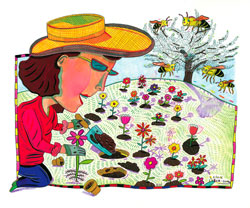

Illustration by Leslie Cober-Gentry
Tips on planting in our problematic soil
 Anyone who has ever driven the blades of a posthole digger into the unamended clay soil of
So, tell us about our native soil.
“We’re sitting on basically the remnants of the Devonian fossil bed that you see at the Falls of the
“The really important thing for a plant is air space — the air space between these granules of clay. That’s where water goes when it rains; that’s where the roots grow. Also, there’s a certain amount of gas exchange that a root does and soil does, and these gases need to be able to leave the soil. So when you have heavily compacted clay, unless something happens to loosen that (density) — I mean, you do get a small amount of loosening of the very top layer of soil from freezing and thawing during the winter, but for the most part the stuff that’s compacted stays compacted, and when that happens, it’s really tough for plant roots to get started.”
The ground around here, unlike in some other cities, seems to hold its wetness for a long time. Is that good or bad?
“Clay has some weird properties — it’s really difficult to penetrate it to get it wet, and once it gets wet, it’s really hard for it to dry out. There are certain plants that are renowned for having difficulties with ‘wet feet.’ Evergreen hollies are one of them; taxus (yew) is another. These are two of the most popular foundation plants, but they need good drainage. We’ve got the soil difficulty to begin with — clay doesn’t drain well — and then a lot of times people will create a problem by planting them near the downspouts for their gutters, which is a death warrant for those plants.”
What do you do about planting if part of your property tends to stay waterlogged?
“There’s a lot of interest in rain gardens these days. If you have a low place like that, you can also create a bog garden; there are plants that really enjoy that kind of environment. We have a whole list of them, plants specifically selected to withstand the wet when it happens and then when it stops. For example, Iris pseudacorus. It’s an iris that grows very tall (four feet plus) and it’s a sulfur yellow — quite a stunning plant. In fact, most iris like damp areas. Ligularia — “the rocket” — is another good one.
“Also, Ilex verticillata (winterberry) thrives in boggy soils. It’s a deciduous holly. They’re the ones you see along I-64. In the fall we get lots and lots of calls about, ‘What are those plants with the beautiful red berries and no leaves?’ It loses its leaves in the fall and the berries remain, and it likes damp soil, too.”
Any trees particularly tolerant to heavy clay that you’d like to mention?
“Gingko is a great tree for that. Hawthorne. Honey locust. Also walnuts, alder, poplar, bald cypress. Why? Because they can tolerate low oxygen, and they can also handle staying damp. I mean, if you think about it, willow, redbud, bald cypress, alder — they’re almost floodplain kinds of trees. Bald cypress, in fact, grows underwater. Now, they will develop ‘the knees,’ you know, the root bumps in the lawn, but they can certainly handle damp, heavy soil. And they’re kind of an interesting tree because they’re one of the few needle trees that lose their needles in fall. Somebody’s working on a new weeping cypress.”
And you buy them balled and burlapped?
“You can buy them either container-grown or balled and burlapped, the latter of which has advantages and disadvantages. Nowadays they put these wire cages around them that you’ll need to cut at least some sections out of. It used to be that when you bought a balled-and-burlapped plant, you always got something in a natural fiber that would decompose in the ground by the time that the roots were needing to leave that area. Even then, you don’t want the collar strangling the tree, so we suggest you cut that off and then cut out the top section of the burlap, because if the dirt gets washed away from the top, the burlap can act like a wick and pull moisture from the plant.
“The advantage of the caged ball is that you have a much larger root ball than (in the past). A lot of plants die from transplant shock, which can go on for three to five years. It sometimes takes that long for a plant to fully accept the site and grow out into the native soil. So the larger ball is good, once you deal with the wire and the synthetic stuff. You can’t really get rid of the wire because the roots are wrapped around and growing through it. I would take a wire cutter and remove as much wire as I could easily. The hole you dig should be just as deep as the root ball and two to three times as wide.”
Is it good to pile a hill of mulch around the base of a new tree?
“Oh, the horrible volcano mulch! It’s doing two things. You’ve got six, eight inches of wet stuff around the trunk of the tree, so you’re rotting the tree. You’re also creating a nice, warm, dark, wet environment that all kinds of creatures can live in — bark beetles, voles and mice that will chew away at the bark of a young tree. So you don’t want any more than two or three inches of mulch. If I bought a house with trees with mulch volcanoes, I would rake it out around the tree till it was about two inches high. The farther I get away from the tree with a nice layer of mulch, the less likely I’ll be to get up there with my string trimmer and nick the tree. If you cut through the cambium layer you have severed the communication between the leaves that are photosynthesizing and the water coming up from the roots. Once you cut through the cambium layer, that’s it for the tree.”
What’s to be done about the tent caterpillar webs that you find in the branch crotches of pretty flowering trees each spring?
“The eastern tent caterpillar. You can’t really kill them while they’re in their webs, although you can tear the webs down when they first hatch out. The web itself is waterproof and nothing really penetrates it. These little worms are like little campers. They stay in their tent if it’s cold in the morning. When it starts to get a little bit warm they’ll come out and hang out in front of the tent. When it warms more and they feel more active they leave and go out into the tree and eat the leaves. In the evening when it cools down they come back to the tent. The best time to spray them is in the morning when they are out sitting in front of the tent and in the evening before they go back in.
“When they’re a half-inch or smaller you can use a product called Bt. (Bacillus thuringiensis), a bacteria that paralyzes the intestines of eastern tent caterpillars, which stops them from eating and destroying your fruit tree. The only concern we have about Bt is if you have an ornamental fish pond underneath the tree, because Bt’s hard on aquatic life. If it’s a small tree and you want to be pro-active, check its branches in late winter and you’ll notice something that reminds me of burned marshmallows from my campfire days — black and bubbly. That is the egg case of that insect. They always select really small branches, so they’re almost always out on the edge. If you just prune that out you won’t have a problem.”
What actions can gardeners take to help reverse what seems to be a shrinking bumblebee population?
“Basically everything that’s a flowering plant is pollinated by something; I don’t want to single out bumblebees as being the only important pollinator. I’d say grow as many flowering plants as you can, and I’d also say don’t use Sevin dust — ever — because it kills all bees.”
If you’ve got a 30-foot-tall red maple growing in your back yard, what can you grow underneath it?
“Sometimes growing a garden underneath them is a great thing because then you don’t have to worry about hitting your lawn mower blades on the roots — just go in with some ground covers and some woodland plants, put a bench under there and enjoy it. But the reason why they’re difficult to garden under is, they really soak up the water, so the ground under them is going to be really dry. And their leaves are very big so it’s very dense shade. You need plants for dry shade, which there are not a lot of, but one that seems to do well is Epimedium grandiflorum, bishop’s hat.”
Can you recomm/files/storyimages/a few fast-growing trees that provide shade, but not dense shade?
“My favorite would be the lacebark elm. Now, some people think that tree’s a little invasive, but I think it’s got everything going for it. If you look over there in front of the Water Company on Frankfort Avenue, there are quite a few of them. They have fabulous bark and very small leaves — half the size of the American elm. Then there’s the river birch, a very popular native tree with lots of light underneath. I like the Japanese zelkova, with its small, deep-green leaves. The Japanese pagoda tree, Sophora japonica, is another one I like.”
How about trees that would look good in a small garden?
“I like amelanchier, the serviceberry, and aesculus, the red buckeye or horsechestnut. Another tree that’s really neat is the yellow wood (Cladrastis lutea). There’s one of those at Whitehall. I think a lot of people don’t know what a really terrific arboretum that is. It’s a great place to make a selection for your own garden.”
What mistakes or misperceptions do people share about planting a tree or shrub?
“The worst one — and I don’t know where it started but it seems like everybody wants to do this — they want to add stuff to this hole. They’ve learned that you don’t want to go any deeper than the root ball and you want to go two or three times as wide. But then they think: I’ve got this new little tree and I need to feed it. This soil doesn’t look too good and I want to give it a good start. So they’ll go out and get compost, topsoil, peat moss, all kinds of granular fertilizer, and they’ll mix this in with the native soil and then put the plant in there. What happens is something called the ‘bathtub effect.’
“OK, remember about clay — it’s hard to get it wet and hard to dry it out. Once it’s wet, and the rain continues, that water’s got to go someplace, and it’s going to go to the place of least resistance. And of course the soil you’ve just loosened up is where it’s going to go, and if you’ve got all this peat moss and compost that’s moisture-retaining, it’s going to hold all of that water and you’re going to have this plant with really wet feet — that’s in transplant shock — that you’ve just tried to boost with fertilizer, which would be like giving somebody at the Run for the Rose with a sprained ankle a bunch of coffee and saying, ‘Go on out there and run!’ That’s essentially what you’re doing when you fertilize a brand-new plant. So we say wait one whole year. If you do spring planting, and ordinarily people fertilize trees in November, you want to skip that first year and wait till the following November before you fertilize.”
If you’d like to grow some sweet-smelling aromatic bushes, like the camellias down in Florida, what might they be?
“We’re probably talking about viburnums. There’s a really nice one — carlesii, the Korean spice, which has a terrific scent. About camellia — there are some hardy ones here, but you know they don’t have any scent. A huge breeding program has been going on for several years now to get one or two that are both fragrant and hardy.
“There’s a shrub that you really don’t see the flowers on, but you smell them. That’s clethra, summersweet (Clethra alnifolia); there’s a pink one called ‘Ruby Spice.’ And then I also like Calycanthus floridus, Caroline allspice, with pointy little petals hidden under the leaves. You can find a whole lot of them at Gardencourt, back in the area by the house after you go through the pergola. People will sit there and not know where the delightful fragrance is coming from.”
Is there another planting essential we should know about? Any final thoughts on that?
“The main thing is keeping a young plant sufficiently watered. A lot of people think, well, you just water once when you plant it, then maybe a week later, and then it’s on its own. And actually, as I was saying earlier, it takes a new plant up to five years to fully accept the site, and all of that time it’s still in transplant shock. And the best thing you can do to protect it from transplant shock is not let it dry out. You don’t want the plant to show wilt. A plant that loses turgor, you know, it takes a lot of energy to raise those leaves back up again.
“We suggest that people learn to do the screwdriver test. After watering as usual, wait a half-hour and then — where you think the root ball ends, because you don’t want to damage its roots — take a piece of rebar or a long screwdriver and make a hole in the ground about eight inches deep. Dig out some around the opening and then put your finger deep into the hole; see if it’s damp. Not cool, because the ground always feels cool — damp. It doesn’t need to bet wet, like mud, but it needs to be damp. You don’t want to overwater but you don’t want to underwater. I mean, nothing could be worse than thinking you were doing this great job, only to find out that the plant died because the amount of water you were putting on only penetrated a few inches.”