
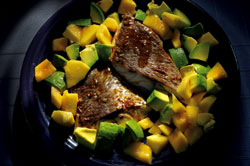

 The red snapper is my favorite fish in the sea. Not only do I love how snapper tastes but also how it looks and comports itself underwater. It’s such a friendly fish, downright gregarious, really. When you see a school of snapper hanging out around a reef or a shipwreck, it’s as if they’ve just escaped from the classroom and can’t wait to get out and play, play, play!
I’m the kind of person who can eat fish first thing in the morning and then eat it as well for lunch and dinner. It’s too bad I’m not a fan of steamy weather because I do have an island kind of palate. On a trip to
The woman of the couple in question was an ICU nurse from a small northeastern state, and she was obsessed with bacteria. In particular, she was obsessed with a marine toxin, called ciguatoxin, found in certain micro-algae growing on dead coral reefs — a toxin that perhaps one red snapper in 500,000 might, at some point in its life, have come in contact with. Our first night at dinner, as we were browsing the menu, she said sternly, “You’ve heard about the danger with red snapper, right? Ciguatera poisoning.” Then she made a throat-slit motion and pretended to die. Only she didn’t. And I began to wish she had because every single waking hour that I spent in this woman’s path on the island, I had to hear about the blasted ciguatera poisoning. On the third day, I finally said, “You just like to say that phrase, don’t you.” She looked taken aback, so I added, “I mean, you know, it sounds so poetic and all, though I’m sure the symptoms are ghastly.” At this point I received a lecture, in gory detail, of the symptoms, which were like all other symptoms, whether you read them on the back of the aspirin bottle, inside a prescription insert of side effects, or, for that matter, in the Diagnostic and Statistical Manual of Mental Disorders.
I told my husband that we needed to take a ferryboat to another cay so that I could get away from this nurse’s hyper-vigilance and eat some damned ceviche. He arranged the ferry ride, but when we got to the dock, I don’t need to tell you who was there. I suspected some kind of prearrangement just for the sake of a practical joke, but my husband, to this day, swears his innocence. Anyway, I no longer cared. From that lunchtime on, I ordered red snapper whenever and wherever I felt like it. And I did not get ciguatera poisoning.
I should add that I happened to have with me what has turned out to be one of my favorite novels of all time, The Snapper, by the Irish writer Roddy Doyle. In
The Belizeans really knew what they were doing with snapper. Pretty much anything you can think of to do to a snapper (by way of cooking) these folks did. But my absolute favorite way to have it was grilled whole and served on a platter surrounded by freshly made salsa. The fish was beautifully scored and crisped up by its time spent over the charcoals. By the /files/storyimages/of the week, Nurse Toxin Warning’s husband had even stopped listening to her dire predictions, so irresistible did this fish dish look and smell to him. He had to taste it.
Before this trip to the
One word of caution that has nothing to do with Nurse Toxin Warning: Over the years, the demand for red snapper has led in some places to over-fishing and in many others to fraudulence. Many grocery stores will give the name red snapper to any whitefish carrying just a hint of pinkness. The rule, as ever, is to buy your fish from people who actually know what they’re selling. Trust the locally owned and operated seafood markets around town rather than the chain supermarkets.
Grilled Red Snapper
For the marinade:
2 large fillets of red snapper
? cup soy sauce
2 tablespoons melted butter
The juice of one lime
1 clove garlic, minced
1 teaspoon of cayenne pepper
For the sauce:
4 tablespoons lemon juice
1 tablespoon grated fresh ginger
1 tablespoon fresh minced garlic
1 minced shallot
1 teaspoon of honey
1 teaspoon of tamari soy sauce
1 tablespoon tahini (sesame paste)
1 avocado, peeled and diced
1 large papaya, peeled, seeded and diced
Whisk together the ingredients for the marinade and pour them over the fish pieces in a shallow bowl. Marinate the fish for a half hour or so while the grill is heating.
In a heavy skillet, combine the lemon juice, ginger, garlic and shallot. Reduce by half over medium heat. In a small bowl, combine the honey, tamari, a half-cup of water and the tahini and whisk into the heated lemon mixture. Set this aside, keeping it warm.
Grill the fish approximately seven minutes per side, depending on how thick it is.
Serve with the warm sauce drizzled over the finished grilled snapper, garnished with the avocado and papaya. Serves two to four.