|
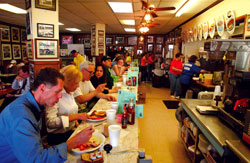
Regulars and first-timers line Wagner’s fountain counter on Wednesday of Derby Week 2006. |
Wagner’s is Churchill Downs; Churchill Downs is Wagner’s.” That sentiment, or something close to it, is echoed by almost everyone who walks in the joint — both regulars from the old school of horse racing and first-timers there to join the club, if only for a day. It’s a history written all over the walls, which hold a collage of past Derby winners along with famous figures who have graced the pharmacy’s fountain through the years. What started out as a low-key meeting spot for coffee and conversation among horsemen and racing writers was eventually “discovered” by the mainstream media and now has been written about and videotaped by everyone from the Los Angeles Times to Southern Living to local TV news crews. It’s become another stop for out-of-towners in the whirlwind of activity that is Derby Week, but through it all has retained its unassuming, down-to-earth character.
Wagner’s, which is celebrating its 85th year in business, opened in 1922 when Leo Wagner bought Hagen’s Pharmacy on the northeast corner of Fourth Street and Central Avenue, where he had worked since he was 14. Threatened by the presence of another newly opened pharmacy on the block, Wagner looked for a market to corner — and found it at Churchill Downs. He let the horsemen buy their cigarettes and other weekly staples on credit and generated a friendship and loyalty that has lasted for three generations.
 As Wagner became a trusted figure around the Downs, he began to t/files/storyimages/to the pharmaceutical needs of the trainers and veterinarians, who would come to him for hard-to-find ointments or liniments, or with special recipes for treatments. The pharmacy developed some of its own products — you can still find Wagner’s Liniment on the back shelves — and son Lee followed in his father’s footsteps, attending pharmacy school at the University of Kentucky and taking over the business upon Leo’s retirement in 1965. Veteran sportswriter Billy Reed credits Lee Wagner with continuing a winning tradition. “I think it was the local trainers, the local horsemen who really made Wagner’s special,” Reeds says. “You could always go in there and have breakfast and get a tip or get some gossip. (Lee) kept being a good fri/files/storyimages/to the horsemen.”
During his first year in charge, Wagner’s acquired the neighboring Becker & Durski Turf Goods (makers of many a Derby silk) and added tack to its list of offerings to the Downscommunity. The addition of a grill to the fountain permanently established the drugstore as not only the main supplier of goods to the track, but also cemented its position as the grab-a-bite social center for local horsemen and track regulars. Karen Zega, Lee Wagner’s daughter and a Downsemployee since 1980, grew up working the fountain, watching rapport develop between her father and such big-name trainers as Nick Zito and Bob Baffert.
“He’s great friends with most of the trainers,” she says. “They all come in so much that it just happens,” adding a word of playful caution: “You can never believe them, though. They all think their horse is going to win. Just try not to take too many of the tips too seriously because you could get in big-time trouble.”
Churchill Downs’ director of horsemen’s relations, Julian “Buck” Wheat, began working for Wagner’s as a boy, delivering medications on his bicycle, and has been a Downs employee off and on since 1949. (He’s known there as the “mayor of the backside.”) Wheat recalls some of the early regulars — jockeys who would toss quarters to the winos on the corner and bookies looking for inside information. Of the latter he says, “They all had their own spot and sat there drinking coffee. They never did any bookmaking here, but would hang out. It was their gathering place.” Word eventually spread about the insiders’ hangout, and members of the media — particularly the racing press — started calling Wagner’s home, too.
In a substantial way, the Derby’s ever-growing hype from national and international media has been a contributing factor to Wagner’s broad-range Derby-time popularity. For years the race was covered by a small corps of mostly newspaper writers like Red Smith, Blackie Sherrod, Jim Murray and Eddie Pope, who were free to roam the backside and chat up horsemen, often gathering with them later at the pharmacy. Reed is nostalgic for the days before television transformed the face of the Derby— and subsequently, Wagner’s. “Back when I first started covering racing, Churchill Downs and Wagner’s were institutions that had not yet been ‘discovered’ by the (general) media; they were racetrackers’ places,” he laments. “Somehow that’s been co-opted by (TV crews) who always want to come in there and film their stories during Derby Week.”

Freelance Central Avenue concessionaire and Wagner’s regular Earl Scheler, 72, moving “I Luv Derby” shirts. |

Retired seven-time Derby jockey Bobby Ussery doesn’t miss a chance to dine at Wagner’s. |
The so-called mainstream media takeover can be attributed to figures like Howard Cosell and Jimmy “The Greek” Snyder, giants in the sports world who, in the mid-1980s, began making Derby predictions from the booths in Wagner’s. From that point on, the barrage of media and celebrity attention has been an annual occurrence, to the chagrin of some and expectation of others. “Wagner’s didn’t become famous because of celebrities coming here,” Wheat points out defensively. “They came because it was already famous among the horsemen.”
It should be noted here that when Wagner’s was forced to move about 40 yards down Fourth Street in 1999 due to the expansion of Central Avenue, virtually nothing changed about the place — everything took a short ride and was reassembled in a Downs-owned building at 3113 S. Fourth. Kathy Armstrong, a 59-year-old Louisville native who attended her 51st consecutive Derbyin 2006 and has been dining at the drugstore for more than 50 years (she even had a stint as a waitress there), concurs. “Other than the location, not much of anything has changed,” she says. “A few of the employees have changed over the years, but the counter, the breakfast, everybody hovering here at Derby time — almost exactly how it was 40 years ago.”
Next to her, first-time customers John and Marcia Courson, Thoroughbred owners from California, are all smiles about their initial experience. “It’s perfect,” says John. “It’s an institution. It’s all part of the atmosphere and what you want on the backside of the track. We’ll definitely be back.” A man with a voice that shouts hard living and a cowboy hat atop his head reveals himself to be Bobby Ussery, jockey of the ’67 Derby winner Proud Clarion (and disqualified ’68 winner Dancer’s Image). He raced in seven Derbys in all and says he doesn’t miss a chance to dine at Wagner’s. Another retired jockey, agent Randy Romero, fills up a booth with his entourage.
“It has its mystique,” say Buck Wheat, “but for the most part it’s just a nice place that’s got a great reputation for good racetrack food and good racetrack people.” There’s nothing contrived about it, he says.
It’s not an entirely rosy picture, though. Lee Wagner, now 68, has been having health problems. His daughters Karen and Brenda, who works at Wagner’s, hope to keep it open. “We do want to keep it going because of the tradition that surrounds it,” Karen says, “but the main thing is that Churchill Downs is always expanding. Hopefully, they will let us keep using the space — I’d hate it if we had to close down.” Aside from the diner/pharmacy/tack shop, Wagner’s has operated Churchill’s track kitchen for the last decade and a half.
While the pharmacy’s future may be uncertain, for now, if you plan on visiting this local legend, here’s an insider’s tip from Reed: “It’s exciting to be there for the Derby, but if you really want to experience Wagner’s you probably should go after the race. You should go when there’s no national media in town — when there are just horsemen, when there are just folks. To me, that’s the real Wagner’s.” Everyone there would nod in agreement.