

The writer, an associate professor of history at the University of Louisville and author of Louisville in World War II (Arcadia Publishing, 2005), became intrigued by the role African-Americans played during the transformation of Bowman Field from a civilian airport to an Army Air Forces airfield after Pearl Harbor. In the course of his research, he met an elderly Marguerite Davis, who lived alone in Louisville with her memories — and photographs and documents — from her years working with members of the armed services as they evolved from segregation toward integration during those war years. Here, based on interviews with Davis and those who knew her, as well as research into the documents of the day, is the story of a woman who moved between black and white as the military geared up for World War II.
The first question I ask during an interview is, "When were you born and where?" I asked Marguerite Davis Stewart and she replied that her name was Marguerite Nelsenia Davis and she was born in Louisville, Ky., on Sept. 1, 1911. She was from a mixed-race parentage — her father was African-American and her mother was from a German family in Munfordville, Ky. Her parents were Preston Davis, a black commissioned lieutenant during World War I, and Luverta Davis. The two did not stay together long because, my interviewee said, "My father and mother were incompatible." Her father nevertheless stayed in contact and helped support mother and daughter in Louisville.
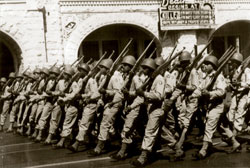
The 43rd Aviation Squadron on the march past City Hall during the 1942 Armistice Day Parade; Davis (above) in ’42. 

Apparently, Luverta Davis did not approve of Preston Davis’ lifestyle. Marguerite Davis said that her father smuggled Canadian whiskey in through Chicago and brought it to Louisville and sold it to the white-owned hotels during Prohibition. He did not do this work himself, according to his daughter, but paid others to do it. He had several white partners. He also had business involvements with several nightclubs that catered to blacks, although some whites patronized his clubs. Davis did not link her father’s underworld and nightclub lifestyle to the breakup of her parents, but this seems a strong possibility to me. I learned to not say or ask something that might get me tossed out of her home and /files/storyimages/my interviews or frequent telephone conversations with her in her declining years. She made it clear to me on several occasions that she sought to have her professional life recorded for posterity, not her personal life, though she often turned our conversations to the latter.
Davis and six members of the 43rd Squadron after laying out a volleyball court at Bowman Field. Segregated troops often mixed on base during sporting activities.

Although Davis held strong views about race relations, she repeatedly told me that she wanted to downplay race as much as possible. She thought racial distinctions were silly and highly destructive to her and the human rights of people. Davis was light-skinned and could have passed for white, but she completely rejected any such notion. She admired her father and said nothing to disparage him. "My identity was irrelevant to me," she said in one of our interviews. "The places I went and the work I did (in the Red Cross) were important to me. If you want to know the truth about it, I have no racial identity. I liked my black college. I enjoyed Fisk University (a historic black school located in Nashville, Tenn.).
"I liked black people; I liked some white people; I liked some Japanese; I liked some of everybody, and some I didn’t like. Race has no meaning to me and never did in my family."
Perhaps Davis, part African-American and part Caucasian, was in a unique position to bust through some stereotypes. In the workplace, on military bases and in war zones, she saw human beings at their best and worst, and race had little to do with it. Her color-blindness may explain why she asked the white Army Air Force’s 567th Band to play for black troops at Bowman Field during a time when the mixing of races was rare. She thought it normal and nothing to get excited about.
A white band plays for black jitterbuggers during a Davis-organized dance contest.

Davis graduated from Central Colored High School at Ninth and Chestnut streets in 1929. One of her teachers, Carrie Alexander, who graduated from Central in 1889, paid her tuition, at least part of it, to att/files/storyimages/Fisk University, where Davis received her bachelor’s degree in general science in 1934. Alexander clothed herself in old-style black dresses and never married or had children. She adopted Davis in her heart as her own daughter and helped make her education possible with financial support. After her graduation, principal William H. Perry hired Davis to replace a teacher on leave at Madison Colored Junior High School in Louisville for one year, from September 1934 to 1935. Davis taught general science to accelerated classes and one, in her words, "retarded class." From 1935 to 1941, she worked for the Works Progress Administration (WPA), a major New Deal program created in the Depression to provide jobs by employing citizens for public works. Her jobs and locations varied widely.
Davis worked as a junior clerk in the Louisville Public School system. However, she was terminated because there was "insufficient room to segregate white and colored workers," according to a notice dated June 9, 1939. Davis said she could not take care of herself and her mother on the salary of a teacher and did not see it as a career choice. Her employment difficulties after her graduation from Fisk were telling because, as a black professional doing white-collar work, she still had difficulty making enough money and spent a great deal of time searching for a career. The racial segregation system limited job opportunities for blacks and the black community was limited in developing jobs to employ its own people.
I learned in part from conversations and much later from a copy of Davis’ federal employment records and resume that she completed a human rehabilitation program under the auspices of the WPA. She also helped train and supervise 40 National Youth Administration women for roles they played at community center playgrounds and in recreation work. From 1938 to 1941, Davis was employed at Central State Hospital, a state facility for the mentally ill, in Lakeland, Ky., as a recreation therapist.
The bombing of Pearl Harbor 65 years ago on Dec. 7, 1941 forced the Works Progress Administration across the nation — and Davis — to turn to emergency war work. Louisville’s main airport, Bowman Field, was placed under Army Air Forces command and all civilians, at least for a while, were banned from the base until military conversions were well under way and command control established. Many black men were employed at Bowman Field under the auspices of the WPA to prepare the base’s expansion for military use. Davis was transferred to Bowman Field as a recreational director for the African-American troops based there. She was the only black woman, civilian or military, on base at Bowman Field. She wore civilian clothes and was classified as a federal civilian employee. There were, according to Davis, no black commissioned officers stationed at the airfield.
The Army Air Forces established at Bowman Field Airport the First Troop Carrier, the Combat Glider Pilots Training Group, the Medical Air Evacuation Training units (one-third were women combat nurses) and several support units, including the 43rd Aviation Squadron Base Unit (also known as the 808th Base Unit), which consisted of African-American troops for whom Davis was recreation director. The 808th wore sports uniforms in surviving pictures, which also verify their designation as the 43rd Aviation Squadron, and the base unit numerals became their popular identification. I concentrated on learning their story — along with that of Marguerite Davis — because I recognized it as a forgotten history of Louisville during wartime.
During Bowman Field’s transition to a military base, and with the arrival of troops, according to Davis, citizens of Louisville were asked to donate sofas, pianos and other items for "day rooms," or recreation rooms, carved out of base airplane hangars or other buildings. The Coca-Cola Co., at Davis’ request, gave her playing cards, checkers and other games. She organized pingpong and pool tournaments in the squad rooms. She raised money by holding dances for black troops at the popular Brock Building, 639 S. Ninth St. It was owned and named after dentist Theophilus Clay Brock, who had been a World War I veteran along with his dentist brother Alonzo S. Brock. Dances were also held at the Madison Square Rink, a roller skating facility at Ninth and Madison streets. Davis held picnics at all-black, segregated Chickasaw Park and swimming pool parties at Central Colored High School’s indoor pool or at the William H. Sheppard Park Pool (named after a black Louisville Presbyterian minister and missionary to Africa). She sold tickets to events at these places in order to buy baseball equipment and other sporting goods from Louisville’s Sutcliffe’s store, which extended credit to her.
Davis arranged for the Army and Navy Colored Chestnut Street YMCA/USO, 920 W. Chestnut St., to get screened USO "girls" for dances. Troops also caught local buses from Bowman Field to att/files/storyimages/USO programs hosted at the Chestnut Street facility and locations elsewhere in the city. Soldiers could have civilian guests for dinner and meet in the day rooms to accommodate family and friends. Davis engaged the all-white 567th Army Air Forces Band for Bowman Field dances and those at the Brock Building at a time when it was unusual for whites to be among all-black crowds. Among her memorabilia, Davis kept photographs of the band playing and black troops and black USO girls dancing, with others standing near the bandstand. It all seemed as if nothing was out of the ordinary, but this was not the norm on most military bases in the South or North. Davis told me that she had no second thoughts about asking an all-white band to play for black dances.
According to her, the black troops were mainly laborers or handymen who helped to transform the Bowman Field Airport facility to military specifications. Bowman had white and black softball, basketball, football and wrestling teams and held inter-racial boxing in makeshift airplane hangars or outdoors in rings. Intra-mural racially integrated sports among the teams on base were common, but these activities were not taken off the base. Davis believed she was hired because she was partially black and could serve black troops. She said, "The only reason I was there was because they had black troops. The rich white people entertained all the white folks (troops). Nobody entertained blacks."
Out of ambition and some frustration, Davis later applied for an overseas appointment. On her annual leave from August to mid-October 1944, she reported to the American University in Washington, D.C., for the American Red Cross in-service training program in preparation for overseas service. "I was studying at night," she said, "auditing at the Statler Hotel in Washington, D.C., with a white girl (preparing) to work a year or two in a military hotel." One of two blacks in her Red Cross program at American University, she was sent to the Pacific theater of war at the /files/storyimages/of her training.
The troops regarded the South Pacific as the worst assignment. They faced jungle warfare with Japanese troops who fought to the death rather than surrender. The European theater was preferred because it afforded leaves in European cities and capitals, with USO dances and interaction with European women. Also, Europe-assigned soldiers could att/files/storyimages/the best USO shows with big-name entertainers and Hollywood stars.
Davis embarked for Hollandia, New Guinea, in January 1945, where she served as a Red Cross Club director until August 1945. She supervised three female employees and five servicemen. They set up a club and canteen and visited troops on the jungle’s perimeter to serve coffee and donuts and provided musical entertainment. This involved developing a "clubmobile" to transport themselves and their wares. Then, from August 1945 to May 1946, Davis worked in Manila doing welfare work among the troops for the American Red Cross. Her duties included prisoner of war relief and checking the incoming and outgoing mail of released American POWs. She handled the sensitive task of establishing communications between released POWs and their families at the close of the war.
One more appointment followed: From May 1946 to March 1947, Davis served as club director for the all-black 24th Infantry Regiment in Okinawa, Japan. With her team of four employees, she set up a canteen and a mobile library service. Apparently, this is where she met her future husband, who served with the 60th Transportation Company.
Davis returned the United States in 1951 to handle the final affairs of her mother, who had passed away. She took over as Service Men’s Club and program director at Fort Knox until her retirement, the date of which she did not remember and does not appear in Fort Knox records.
Edward V. Stewart must have been a career soldier because he wrote Davis letters from Korea and talked about the war. It seems they married sometime in the post-war years before 1950. He was a very handsome black man. He must have been educated too. Marguerite early on made it clear she did not want to talk about her "personal life," so I steered clear of these questions. She wanted her professional life story told and this was what she was most proud of.
Marguerite Davis Stewart died on Feb. 11, 2005, at the Episcopal Church Home and her funeral was held four days later at the Church of Our Merciful Savior, 473 S. 11th St. Ada Lee Kane, who met and befriended Davis at Fort Knox, recalled her just as she would have liked. "Segregation kept many blacks and whites apart," Kane said. "It’s unbelievable to me that I lived through that era. It was normal in that era. She (Davis) had her blacks and their band and we had our whites and their band. That’s the way it was then.
"She knew what she wanted," Kane said of Davis. "She was all out for the boys, I’d say. She was a good director."