

 Photos By John Nation
There’s something cognitively dissonant about planning vacation time for outdoor activities near two of the biggest boomtowns in the
Despite the crush of development, much of what originally made these locales along the
I think you might best begin an immersion in southwestern
A great egret basks in the sun at the Ding Darling National Wildlife Refuge, while vacationers show their plumage — and wheels — on Naples’ Fifth Avenue.
During our visit in early spring, photographer John Nation and I soaked up this improbable Roaring ’20s history lesson during a midday stop in 

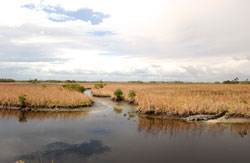
That ride was my introduction to the mangrove estuaries, however, and it brought up some questions about this unique ecosystem that were later answered during a deliberate — and quiet — kayak paddle through the Rookery Bay National Estuarine Research Reserve. This haven from development along western edge of the Everglades reaches far enough north to include a few miles of coastline between
Our guides, Cyril Marks and Karen Relish, led us through a labyrinth of red mangroves, the trees best adapted to surviving high salt concentrations at water level in these estuaries. Mud clumped against the contorted roots — which can “breathe” oxygen from the air — and clinging barnacle and oyster shells revealed themselves at low tide. Waterways serpentined between the mangrove stands, but our guides knew them like the passageways of their minds, leading us to the bird-breeding island in 


A pelican and kayaks share space at Rookery Bay, the beach on Marco Island, lunch on the docks in Tin City and a Naples “playhouse.” 
After 26 years in this part of Florida, this native of the region in Africa now known as Zambia has an encyclopedic knowledge of the special environment where the Gulf waters mingle with the lowlands of southwest Florida. Marks Kayak Tours (239-595-8211) takes small groups for two or three hours into the estuary, sometimes spotting manatees and dolphins using the shallow waters for feeding (mostly in late spring and summer). Our guides also set us straight on what we missed by going “tourist” on an airboat ride near Everglades City. Better nature-watching can be found north of there on State Route 29 in Fakahatchee Strand Preserve State Park. This forested swamp habitat is home to bald eagles, Florida panthers, American crocodiles and other sought-after species, as well as an amazing variety of orchids and other flora in its stands of cypress and royal palms.
I was struck by the persistence of the wildlife in the midst of this region’s human infestation. Perhaps the appeal of mild weather and abundant coastal resources keeps the animal kingdom as involved as the Homo sapiens. Alligators occasionally show up in Naples back yards, and burrowing owls nest in small patches of grass surrounded by homes on subdivided Marco Island. During happy hour on Marco, we sat on the patio overlooking a large pond at the Lakeside Inn’s Sushi Blues & Steaks restaurant. As we noshed on sushi rolls and sipped wine, an acrobatic small osprey took flight from a tree on the far side of the water, glided over the surface and then plunged 30 feet in an unsuccessful dive for dinner. We were treated to a handful of passes by this fishing bird as we lingered over our appetizers.
Marco Island is the snowbirds’ Venice. It had its own Barron Collier-like dreamers in the three Mackle brothers, who used massive dredge work in the 1960s to lay out a series of bays and canals running through man-made spits of land where homes could be developed. Today, most residents have a boat or two docked just beyond their back yards and the means to cruise to fishing grounds or other islands to the north and south — or to a friends’ dinner party elsewhere in town.
This northernmost island in the 10,000 Island chain that extends to Key West now has a permanent population of 15,000, which more than doubles during the winter months, when tourists fill the resort hotels and condos along its western beaches. We enjoyed a spectacular sunset on this high-rise-studded stretch of sand. A pod of dolphins bobbed past in the orange-yellow light of the sinking sun, the day’s final rays backlighting a cloud canopy and skipping along smooth ridges in the placid, robin egg-blue gulf waters. Families on spring break applauded as the last solar sliver slipped away for the night into its aquatic bed.
Two nights later we watched the sun go down near the Naples pier — a glorious natural-light show for this cosmopolitan vacationland. The Naples-Marco Island area has swollen to an estimated 315,000 residents, a number that jumps during the peak travel season from late fall to early spring. At day’s end, the coast draws one and all. A casual crowd lines the sand near the blue luminance, while dressed up residents from stunning vacation homes and mansions make their way to wooden ramps above the beach, champagne flutes in hand, to glimpse the spectacle before moving on to the evening’s entertainment.
Most of us know Naples as a warm retreat for wealthy Louisvillians, and it’s always been that way. Today, a good number of our city’s moneyed members retain homes there, in a sense allowing them to move their social circle south for the winter. Among the prominent Louisville residents with second homes in the area: David Jones, John Schnatter, Anne Northup and Dr. Allan Lansing. Currently, more than 350 Naples-area homeowners list Louisville as their primary address. They’re joined by affluent sun-seekers from many other locales, all combining to give Naples a status-conscious vibe. It really matters that you drive a Lexus (or a sporty convertible), wear the most fashionable dress-casual clothes and keep your face cleanly shaved or your hair stylishly coiffed — even on vacation. March and November are considered the best months to be in southwest Florida, and that’s when Naples comes alive with its parade of prosperity. Fifth Avenue is the promenade, a people-watching paradise of shops and restaurants that fills in the cool of the evenings. By midnight, the captains of industry have tucked themselves in and their progeny take to the streets, hitting the bars and clubs.
A few miles up the coast, Fort Myers — the hub of that third-fastest-growing metro area with nearly 575,000 residents — swarms in March with vacationers and baseball fans, who follow both the Boston Red Sox and the Minnesota Twins to their spring training headquarters. A tip for baseball fans: Tickets to “Grapefruit League” preseason contests featuring the big-name stars are getting harder to come by, as the stadiums regularly sell out. True fans, however, would be fascinated by the action at the training camps, where minor leaguers (and sometimes the big leaguers) go through drills and game-situation scrimmages at multi-field complexes. You can walk in for free and see firsthand the emphasis on full-speed repetition that creates fundamentally sound ballplayers.
Beachcombers know this region for the shelling on Sanibel Island. I was aware of that only in a vague sense until John and I made a dawn excursion to the island to see the beaches at first light (and to avoid the horrible bridge traffic that builds during the day). At that quiet transition time, with the sand and water still dark, we fortuitously bumped into a king of ’combers, Harlan Wittkopf, who has authored one book on colorful seashells (The Sanibel Kaleidoscope) and co-authored a second (Beach Treasures of the Gulf Coast). He explained how a quirk of geography set crescent-shaped Sanibel and its northern adjunct, Captiva, in perfect juxtaposition with the Gulf currents to serve as a repository for deep-water gems that roll in with the waves. Savvy hunters stoop over this carnival of calcification at low tide to see what’s left behind on the sand bars near shore. They’re especially alert after any autumn hurricanes tear through the Gulf or when winter storms blow in big surges.
Wittkopf, a snowbird from northern Iowa farm country, has been coming to Sanibel for more than 30 years, harvesting its crops of whelks, tulips, scallops and other prizes. The morning we encountered him, he walked out to the first sand bar and, while other beachcombers passed him by empty-handed, pulled up a coveted alphabet cone, with intricate markings in patterns that sometimes resemble letters of the alphabet. He claims to have found one a few years ago with his initials, HEW, on its tapered round surface.
Sanibel and Captiva, as you might suspect, have been built up tremendously in recent years, so traffic gets heavy. Much of Sanibel’s inner rim facing the Intercoastal Waterway and Pine Island, however, has been preserved as the J.N. “Ding” Darling National Wildlife Refuge. Famed political cartoonist Ding Darling admired the area and helped secure its place as a refuge in the 1940s. Morning hikes in its 6,400 acres allow visitors to spot several of the 220 species of birds that have been logged there, as well as other wildlife in this unique mangrove forest and marsh habitat. Oh, yes, there are 51 species of reptiles and amphibians, including the one we love to fear — alligators.
Like southern California, southwest Florida offers sand, water, traffic and congestion. In many ways, the popularity of both regions can be their own worst enemies. But the subtropical playground that runs south along the coast from Fort Myers to the Everglades retains more of its wild former self. On a coastline known for golf and boating, amidst a wealth of fine dining and upscale shopping, opportunities to enjoy a rich natural heritage somehow, against the odds, have not vanished in the sand.
Editor Bruce Allar may be reached at ballar@loumag.com
Where Dreams Die Hard
A group of Kentuckians became the first to visit Naples on a regular basis during the late 1880s, when south Florida was being marketed to potential land buyers as the “Italy of America,” a sunny and warm peninsular retreat. Principal among them was Walter Haldeman, owner and publisher of the Louisville Courier-Journal. He was the most financially committed of a consortium from the Bluegrass State who assumed control of The Naples Co., which, in addition to selling plots of land in the undeveloped beach community, promoted the area for tourism. The group built a hotel that opened in 1889, erected the still-standing (though rebuilt) pier and acquired the steamship Fearless to transport guests and goods to the isolated retreat. Hunting for bear and panther and fishing the abundant coastal waters drew many outdoorsmen; the quiet beach and soothing climate attracted others. Alas, Haldeman and his partners went bust before the boom now echoing through Naples, a century after they dreamed of it. However, even after unloading most of their properties, the publisher’s family and other Louisvillians continued to winter in Naples at what became, for a time, their private resort.
One of the regulars who migrated there during Louisville’s cold months was famed Courier-Journal editor and editorialist Henry Watterson. A small residence built in 1895 for him by Haldeman remains today as a last vestige of early Naples. Called Palm Cottage, it is maintained by the Naples Historical Society on 12th Avenue South and has a first-floor room furnished with Watterson’s desk and other memorabilia. The grounds, known as Norris Gardens, have been planted with a rich display of the area’s subtropical flora. Tours of the cottage and gardens are available Tuesdays through Saturdays, 1-4 p.m., from November to April and on a reduced schedule the rest of the year (239-261-8164; www.napleshistoricalsociety.org).
During the 1920s, even grander visions drove Barron Collier, who used some of his vast fortune, founded in streetcar advertising, to finance work on the Tamiami Trail. With hopes of turning portions of the Everglades and areas to its north into major commercial and travel destinations, Collier shipped in road-building equipment, provided electrical power and even ran a streetcar through remote Everglades City for his workers and their families. He operated a company town, where employees were provided with a hospital, laundry services, schools and other amenities and paid partially in scrip redeemable only at Collier-owned businesses.
The entrepreneur’s goal was to open the Gulf of Mexico side of Florida — which had been nearly uninhabitable — for development with the auto- and truck-moving Tamiami Trail. (By then, Henry Flagler had created, and cashed in on, growth on the other side of the peninsula in Miami and Dade County.) Formerly isolated southern sections of Lee County, where Fort Myers is the seat, were split off, named Collier County and essentially delivered to his jurisdiction. At a then-staggering cost of $25,000 per mile, Collier’s 76-mile stretch provided the last piece of the trail (now US 41), which opened in 1928. Mosquito-plagued workers braved the swamp to dynamite limestone bedrock and dredge canals along this roadway; earth dug to form the canals was then used as fill to elevate the trail above flood levels.
The ambition and difficulty of this project speak volumes about aspirations in parts of south Florida. The combination of a devastating 1926 hurricane and the Great Depression caused the state’s land boom to collapse, and Collier never realized his vision of developing his namesake county. Today, Everglades City remains a wilderness town, but the story the museum there tells with exhibits and artifacts makes it clear that, had he not been stopped by strong winds and weak finances, Collier may well have had this section of the county bustling before it could be incorporated into Everglades National Park, which opened in 1947.
RANDOM TRIP-NOTES
Exactly where you squeeze yourself in for accommodations among the multitudes in southwest Florida often comes down to matters of taste and convenience. Beachfront hotels, condos and other units are available throughout the region, and wise travelers will network extensively before selecting a place to stay during a visit. Here are a few observations made on the move while canvassing some of the region’s attractions:
Fort Myers-Sanibel: A good general reference is the Lee County site at www.fortmyers-sanibel.com. Bays and islands in this vicinity make the beaches accessible even among high-density development, but you’ll need strategies to deal with bridge traffic and other congestion during the peak season. A must-stop: Breakfast at the Lighthouse Cafe on Sanibel Island (941-472-0303, www.lighthousecafe.com). Still favored by the original snowbirds, its delectable Hungry Fisherman omelette and Ocean Frittata are both stuffed with fresh shrimp, scallops and crabmeat — enough to fuel a full day along the water’s edge.
Naples: An overview of the Naples and Marco Island areas can be found at www.paradisecoast.com. Upscale shopping, dining and people-watching can be found on Fifth Avenue South (www.fifthavenuesouth.com). Third Street South offers a smaller stretch of fashionable shops and eateries in a section of Old Naples near gorgeous homes and the pier. More laid-back is Tin City, where pleasure boat traffic headed to Naples Bay passes dockside restaurants and shops (www.tin-city.com). Recommended in Tin City: Kelly’s Fish House, where the tables are glass-covered sand and seashell still life scenes and the seafood platters are immensely satisfying.
Marco Island: High-rise condos line the Gulf-facing beaches. For a surprisingly placid respite on the interior of the island, consider Marco Island Lakeside Inn (239-394-1161, www.marcoislandlakeside.com), which affords private spaces and patio dining along a placid pond. Also worth touting: Stan’s Idle Hour Seafood Restaurant on nearby Goodland Island (239-394-3041, www.goodland.com/stan.htm). The zany owner performs his “Buzzard Lope” song and dance every Sunday afternoon and hosts the annual Goodland Mullet Festival in late January.