

Photos by John Nation
 For the homebred colts, fillies and mares ready to compete at Churchill Downs Nov. 4 in the 23rd running of the Breeders’ Cup World Championships, life’s road there has been a straight shot from foaling barn to the Cup. But the great majority of the Thoroughbred entrants for the eight BC races have had their ownership change hands at least once, whether through person-to-person purchases or as weanlings, yearlings, two-year-olds or older horses sold at auction in several U.S. locations and in other countries from Canada to Australia.
The most prestigious of all those auction sales is the 14-day Keeneland September Yearling Sale, whose record gross receipts this year were a hair under $400 million for about 3,500 horses, headed by 32 yearlings that sold for $1 million or more. "There’s not a sale in the world that will even come close to comparing with Keeneland," says 50-year veteran freelance auctioneer Peter McCormick. Graduates of the track’s yearling auctions (which until this year were held in both July and September) include not only Derby winners Spectacular Bid, Alysheba, Winning Colors, Sunday Silence, Thunder Gulch, Real Quiet, Fusaichi Pegasus and War Emblem, but also Breeders’ Cup champs A.P. Indy (Classic), Johar (Turf), Azeri (Distaff), Da Hoss (Mile), Cajun Beat (Sprint), Caressing (Juvenile Fillies) and Action This Day (Juvenile).
What relatively few horse-racing fans are aware of is that this major annual Thoroughbred event — where you might see the next Barbaro and rub shoulders with Bob Baffert or even mega-buyer Sheikh Mohammed bin Rashid al Maktoum and his Jordanian princess wife — is open and free to the public. Just don’t wear a cowboy hat and inadvertently raise your hand at the wrong time in the sales ring.
Intrigued by the prospect of seeing top-pedigree yearlings and possibly witnessing a bidding war of the magnitude of the $9.7 million shelled out last year for a colt sired by Overbrook Farm’s monster stud Storm Cat, photographer John Nation and I rode out to Keeneland Sept. 12 for the second of the sale’s first two days — the much-ballyhooed segment when almost half of the sale’s total gross receipts are accumulated and all but one or two of the million-dollar yearlings are sold.
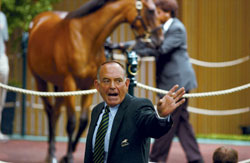
Clockwise from left: The walk from rear show ring to auction "runway"; horse-training greats D. Wayne Lukas and Bob Baffert; studying yearling pedigrees; and Peter McCormick locking in on a hesitant bidder.


The arresting sight of, not one, but two Maktoum family jumbo jets parked on the fringe of Blue Grass Airport just off US 60 made it impossible to miss the left-hand turn into Keeneland, whose sales pavilion is located just beyond the clubhouse gift shop. From the look of the crowd entering the pavilion — not a loud blazer to be seen and very few frilly dresses — I guessed these were in large part buying and scouting horse people.
The freedom we were afforded as we walked around the complex was truly remarkable. Not only are visitors able to slip into seats in the sales ring (even though they’re technically reserved for bidders), but they also can wander back among the horse barns, ogle Thoroughbred youngsters and people (Was that Nick Zito in the scruffy ball cap?) in the rear show ring, and follow consignors and their equine charges from show ring to the auction-block holding area behind the sales ring.
The yearling sale’s biggest buyer by far, Sheikh Mohammed bin Rashid al Maktoum, in the rear show ring.
In the ring, three auctioneers (two who switched off calling duties each hour and one who read pedigree highlights to entice bidders) sat like British magistrates on a stand 12 feet or so above the floor. "I’m the only one who sells from the middle seat; I guess it’s tradition," senior auctioneer Ryan Mahan told me later. "Other auctioneers sell from the left seat." 
Below them on the floor were five bidspotters, three positioned at the feet of aisles and two a third of the way up other aisles. Two more bidspotters scanned areas behind the ring, where representatives for the auction’s two goliath bidders — Sheikh Mohammed’s Darley Stable and Ireland-based archrival Coolmore Stud — like to hang out. They had battled for the $9.7 million colt last year (Darley won), and on this year’s opening day had duked it out for a Winstar Farm colt that went to Darley for $8.2 million.
"You get two entities like Coolmore going against Sheikh Mohammed and you kind of throw the record book out," said Mahan.
(Coincidentally, these two fierce competitors for worldwide racing and breeding domination own horse farms just across from each other on US 60 outside Versailles. The Maktoum family owns Gainsborough Farm, as well as Jonabell and Shadwell farms outside Lexington and Raceland Farm in Paris, and Coolmore owns Ashford Stud. No word as to whether they borrow sugar or eggs from each other from time to time.)
We were in for a treat. The two giants locked horns over two colts whose final bids bested Monday’s high — $9.2 million for one at lunch hour that had spectators rushing from the cafeteria into the sales ring, followed later in the afternoon by a sale-topping bid of $11.7 million (the all-time yearling record is $13.1 million) for an impeccably bred son of Kingmambo, whose mother was sired by Seattle Slew and whose father had Mr. Prospector and two-time Breeders’ Cup Mile winner Miesque as parents. Sheikh Mohammed, to the dismay of Coolmore, won out on both.
Perhaps most entertaining for me, though — more than hearing the whoosh of breaths when the aforementioned bidding passed $10 million and more than momentarily insinuating myself into a Bob Baffert-D. Wayne Lukas conversation — was tracking the visual communication between bidder and bidspotter as the action heated up — even on the $150,000 horses. "It might be just — because you have eye contact with these people — a little nod or a wink or a little flip of a finger," Peter McCormick told me. "They might have a pen in their hand and just kind of move that pen the littlest bit."
It’s a perfect metaphor for what is essentially a laconic business, much like poker: Don’t give away your intentions and maybe that other guy won’t see you and raise you.
"They’ll be looking down at their program, then make eye contact with a bidspotter; it might be nothing more than that," said Mahan. "They just look at you and you have to read that as a bid, because they’ve always done it that way."