

Practice has not yet begun inside Freedom Hall, and several members of the University of Louisville women’s basketball team sit on padded folding chairs near the baseline. They talk and lace up their red-and-white Adidas shoes and stretch their hamstrings. "Isn’t practice canceled?" junior guard Courtney Simmons jokes, noticing that coaches are tardy for a scheduled noon start time.
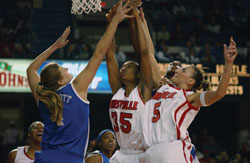
McCoughtry (35) has moved front-and-center for the tournament-bound Cardinals.
The players chuckle and continue chatting. All but one. As her teammates wait for the coaches, sophomore Angel McCoughtry, who is still wearing a backwards, white ball cap over a black bandana, pulls a basketball from a rack and walks onto the court. It’s a Friday afternoon in early January, two days after her team suffered its first loss of the season at Providence in double overtime, and McCoughtry isn’t in a talkative mood. It doesn’t matter that the Cardinals began their season 15-0, the longest winning streak in school history. It doesn’t matter that the 41 points she dumped on Eastern Illinois broke a nearly 13-year record for most points scored in a game. And it doesn’t matter that the coaches are still in the locker room. 
"I’m always trying to get better," McCoughtry says.
She dribbles to the right-elbow side of the free-throw line, pulls up and sinks a 15-foot jumper. She does the same from the left elbow, the baseline, from all over the court. Three-pointers. Layups. Foul shots.
At the free throw line, McCoughtry runs through a ritual: a) dribble with right hand, b) place ball in left hand and spin back into right palm, c) repeat a and b three times before d) a final dribble. "It helps me focus," she says.
She completes the routine and shoots the basketball. It clangs off the back of the rim. She gathers the rebound and shoots another. Misses.
The courtside seats are empty. Coaches aren’t barking orders. Darkness blankets Freedom Hall’s upper levels. McCoughtry keeps shooting, though. And after four straight misfires, she finally nails her fifth attempt. Then she sets back up at the free throw line and releases another shot.
McCoughtry’s hard work, hunger to win and, quite simply, raw athleticism have made her Louisville’s most dominant player during a season when the team hopes to make a breakthrough in the season-ending NCAA tournament. As a freshman last year, she led the Cardinals in rebounds and steals and was second in blocks. That production, which came in just 19 minutes a game, earned her a spot on the Big East All-Freshman team. This time around, McCoughtry plays nearly 30 minutes per contest and, by mid-January, led the team in scoring, rebounding and steals and was second in assists and blocks.
McCoughtry scored a team-record 41 points against Eastern Illinois.
"We always knew she’d be a rebounder," head coach Tom Collen says of the 6-foot-1 high-scoring forward, "but she’s exceeded expectations."
She even surprises herself.
"I really had no idea that I’d have this type of impact so soon," she says. "I just thought I would help the team and be an average player."
As an eight-year-old growing up in Baltimore, McCoughtry had to make a decision: tee ball or basketball? Financially, McCoughtry’s parents, Sharon and Roi, who was a forward at Coppin State in the late 1970s, could only afford one sport. Her mother wanted her to play basketball. For McCoughtry, the decision was simple. "I chose tee ball," she remembers.
That’s when Sharon McCoughtry made the wise decision her young daughter couldn’t. "Angel was too tall to play tee ball. She looked awkward out there," her mother recalls. "So I said, ‘Let’s give basketball a chance.’ We never looked back to tee ball."
At first, McCoughtry cried about having to shelve her baseball glove. She couldn’t shoot a basketball, which, in turn, made her hate the recreational league her mother signed her up for. But she still practiced every day, even as an elementary-schooler. When she showed up at the run-down outdoor court near her house, the boys forced her to "play with the scrubs." And she did. And she started to beat them. By the time she was in middle school and the outdoor court had been fixed up, the "good players" wanted to pick McCoughtry first. If they didn’t choose her, she’d beat them.
"It was like she was supposed to pick up a basketball," her father says.
In high school, she was known all over Baltimore. As a senior at St. Francis High School, she averaged a double-double (10 or more of two of the four key individual statistics from a single game — points scored, rebounds, steals or assists). St. Johns and Florida State noticed her skills, but McCoughtry had a low SAT score and enrolled at a college preparatory school. While at Patterson School in North Carolina, she vanished from many college-recruitment radar screens but kept playing basketball and kept logging double-doubles. Louisville assistant coach Timothy Eatman eventually noticed her at a tournament and knew she was a special athlete.
"There are certain things that God blesses you with that coaches can’t teach you," Eatman says. "The thing that Angel possessed was a lot of God-given ability. She was blessed with an enormous jumping ability, great quickness, long arms. She had a feel for the game."
After a year in prep school, McCoughtry planned to move up to New York and play at St. John’s. Eatman was recruiting her, though, and she agreed to visit Louisville. "I thought, ‘Kentucky? I’m not trying to go to Kentucky,’" McCoughtry says. "I just came to visit and really liked it. I liked the family atmosphere. I had never felt a family atmosphere like that anywhere else."
Before each Cardinal practice, Collen reads a "thought for the day." Sometimes it indirectly relates to a player — like, "McCoughtry can’t go for every steal." Sometimes it refers to a team issue — "Do not slump after losing to Providence." Sometimes his speech is just a life lesson that has nothing to do with basketball. "Some of the girls may think it’s corny," Collen says.
One thing the coach’s players do not dispute is his ability to win. At Colorado State from 1997-2002, he compiled a record of 129-33. Under Collen, the Rams earned four NCAA tournament berths, including a trip to the Sweet 16 in 1999. Since he took over for Martin Clapp in 2003, Collen has re-created that winning attitude at Louisville. Over his first three seasons, he had a record of 61-29 and only lost twice at Freedom Hall. The Cardinals made the NCAA tournament in each of the past two years, and the 15-0 record to start this season could signify a team prepared to win come March.
"It may appear that the program is all of the sudden just emerging all at once . . . but it’s been a long, slow process," Collen says. "As much as we’re striving to build a national powerhouse and would love to go to the Final Four someday and win a national championship, I think we’re much more concerned with the community of Louisville."
That’s why the players sign autographs and talk to fans on the court after home games. The theory is that establishing a solid relationship with the community can help fill Freedom Hall’s seats. Although the men’s team, whether it is competitive or not, will probably always attract mostly full houses, about 2,500 fans typically watch Collen’s team at home. Against Kentucky on Dec. 3, a record 12,342 showed up to cheer as the Cardinals beat the Wildcats. "We’re doing everything we can on our end," athletic director Tom Jurich says. "People and fans just need to go and see one game and I think they’ll fall in love with it."
The national spotlight is already on Louisville and shining brighter than it ever has before. To keep that spotlight burning, Collen knows the Cardinals need to win. Especially in the postseason. Vanderbilt beat Louisville in the first round last season, and Southern California trounced the Cardinal’s in the first round in 2005. A good gauge of how the Cardinals might perform in next month’s NCAA tournament will be how the team executes against Big East teams on the road, such as Notre Dame (Feb. 7), Connecticut (Feb. 13) and Marquette (Feb. 17).
Collen doesn’t use a the-sky’s-the-limit cliche to describe his team’s potential. "We’re certainly talented enough to go to the next level, and the next level for us, right now, is to get into the NCAA tournament and win and advance," says the coach. "Whether this team can advance to that level still remains to be seen."
McCoughtry will play an enormous role in determining that. Nobody doubts her physical ability — she has a muscular frame, great endurance and quick hands that are big enough to palm a basketball. (McCoughtry says she can dunk, although she hasn’t done so in competition.) It’s her mental game that her coaches would like to see improve. "When she becomes visibly frustrated, that sets the tone for the rest of the team," Collen says. "I think the only thing holding her back from being admired as a true leader, on and off the court, is her ability to control her emotions."
McCoughtry’s frustration stems from other teams dedicating more and more defenders to her, which is something that she did not deal with as much as a freshman. She finished the 2005-2006 season hitting 47 percent of her field goals and just 55 percent of her free throws. She had work to do in the offseason and stayed in Louisville over the summer, taking classes to improve her grades and working daily on her shot — often alone, at Cardinal Arena in the Student Activities Center’s basement. For at least three hours a day she practiced. And she wouldn’t quit until she took at least 500 shots.
"She worked as hard as any player we have over the summer," Collen says. "During the off-season, we really geared our offensive sets towards finding ways for her to score."
McCoughtry’s diligence seems to be paying off. Her field goal percentage has gone up and she now hits more than 70 percent of her free throws. If opponents swarm McCoughtry, her coach wants her to realize that it can be a good thing. It can open up the lane and give senior center Jazz Covington or junior forward Yuliya Tokova a chance to score an easy bucket. It can give McCoughtry the opportunity to kick the ball out to three-point specialist Brandie Radde. It can even be a chance to pass the ball to junior point guard Patrika Barlow so she can reset the offense.
When the Cardinals played at home against Seton Hall on Jan. 6, McCoughtry held the basketball behind the three-point arc and drew two defenders late in the first half. Instead of looking for a teammate, she slashed into the lane between the defenders and the whole Seton Hall team quickly collapsed around her. McCoughtry leaped off her left foot, absorbed contact and flipped the basketball toward the hoop with her right hand. The shot went in as she crashed to the floor.
Sometimes that works, too.
It’s a Monday afternoon, and the players are squeezing in a quick practice at Cardinal Arena. In less than 30 minutes a bus will haul them to the charter plane for a flight to their game at Georgetown, and Eatman needs to know that his players understand how to def/files/storyimages/the Hoyas. McCoughtry has just missed her assignment.
"Do you know what you’re supposed to be doing?" Eatman asks her.
That lights the fire, and McCoughtry makes sure Eatman can see that she knows what she’s doing. She sprints to the ball-handler at the top of the key and crouches into her defensive position. With each pass, McCoughtry yells. "I got the switch! I got the switch! Watch the cutter! Watch the cutter!"
Satisfied, Eatman blows his whistle to /files/storyimages/the drill.
"I was excited about that one, coach," McCoughtry says as she walks to the baseline.
If McCoughtry can continue to learn how to position herself to make the best defensive play, and if she can better grasp Collen’s offense, the coaches think she can get even better. And that could get scary. "I’ve never coached anybody quite as athletic as her," Collen says. "She’s already opening some eyes from the WNBA scouts as a sophomore."
Practice ends and the players huddle around an orange cooler to fill cups with water. They have to get ready to load onto the bus and, eventually, they all disappear into the locker room. Well, all but one. McCoughtry stays on the court to practice her shot. "Don’t be late for the bus," Eatman says as he exits the gym.
McCoughtry is the only one on the court, and it’s quiet, except for when her sneakers squeak as they skim the court’s surface. She fires from all over. Three-pointers. Layups. Foul shots. And when she drills a shot from about two feet behind the three-point arc, she simply picks up the basketball again, faces the rim and releases another long, arching jumper.