

 A key ingredient in this month’s salad is the artichoke heart. Succulent as they are, artichokes contain cynarin, an acid that tricks your taste buds into tasting flavors that are not actually there. For at least 80 percent of humans who eat artichokes, cynarin creates a sweet taste, making even water seem as if it’s been infused with sugar. It makes milk taste like ice cream. Thus, a light, fruity wine will become sweet to the point of saccharine, and many tart, dry wines will seem to have lost their acidity. Artichokes, in other words, are the bane of the sommelier’s existence. I found one food/wine-pairing website where the maven in charge insisted that the only wine in the entire world suitable for artichokes is the 1999 Muller Catoir Hambacher Romerbrunnen Weisburgunder Kabinett Trocken Pinot Blanc. Now, imagine trying to remember, let alone pronounce, that on your next trip to the wine store.
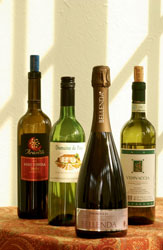
What this expert appears to have neglected is the Italians, who know better than anybody how to make wines to go with their food. Conveniently enough, Italians also eat lots and lots of artichokes — all parts of the artichoke — and there is no way they are going to eat any foodstuff without a wine to accompany it. Best of all, most of them are going to be inexpensive, even the bubbly ones. The good people at Gemelli Wine and Spirits suggested the three Italian wines below and, for good measure, also recommended a tart table wine from southern France’s Gascogne area.
2005 Fontaleoni Vernaccia, $12. This is an Old World wine — so old that Michelangelo once described it as the wine that “kisses, bites, stings and caresses.” It’s a white wine that will have your friends who claim to be “red wine only” drinkers asking for seconds and thirds. The mineral flavors are bold, the acidity almost like an astringent, and the balance between the two is ideal. It’s remarkably easy to swallow, with or without artichokes.
2003 Arancio-Nero D’Avola, $8. The guy who runs the wine blog Enotheque (a fancy way of saying wine library) claims to have such unconditional love for this wine that he is compelled to talk about it in terms of “philosophical morality.” Why? Because these “ancestral varietals are the fountain of humanity, quality and innovation that Enotheque draws upon.” Not a whole lot of humility here, but with good reason. While the other wines sampled this month started off fruitily and ended with more of a bite, the light red Arancio-Nero was the only one that kept its astringent bite from start to finish, almost like cranberries without sugar. Plus, it has a really cool slate-blue cork.
2005 Bellenda Prosecco, $19. Prosecco tends to be thought of as a summer wine, but the Italians drink it year-round, particularly as an aperitif. The ever-so-knowledgeable Jay McInerney, who has a second career as a wine connoisseur, puts it like this: “At the right alfresco moment, Prosecco can be immensely refreshing, with its sweetish come-on and its slightly bitter finish — rather like a flirtatious look exchanged across a courtyard that briefly illuminates the scene before the other party turns away forever.” This salad presents the right alfresco moment.
2005 Domaine de Pouy Vin de Pays, $11. This white table wine comes from the Ugni Blanc grape, the predominant varietal used to make Armagnac and Cognac. The cold fermentation process results in a vibrant, mineral-laden wine that begins like wildflowers and ends like a shot of espresso. It has a tangy aftertaste that hangs on and on, gradually changing from lemon to tangerine. As easy to swallow as the Vernaccia, it’s much better than its Vin de Pays classification.