
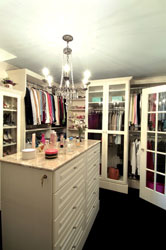

 Most kids believe there are monsters in their closets. Though parents attribute those fears to overactive imaginations, I suspect something more sinister. Clothes-consuming monsters would certainly explain the mysterious disappearances of one of my black dress shoes, a pair of sandals and my favorite capris.
Of course, so would the overstuffed condition of my closet — a spacious 27 inches deep by five feet wide when it was added in 1937, but Lilliputian by 21st-century standards. Matthew Stetten, president of Closets by Design on Chamberlain Lane, estimates that the minimum size for a functional master closet today is six by eight feet — and many builders are taking space away from the master bedroom to make the walk-in even bigger.
One cause of ballooning American closets is general affluence — we own more clothing than in times past. According to Cheryl Meyer of California Closets in
Add to that the fact that closets are being called on to perform tasks they’ve never done before. Particularly in two-income households, the closet often doubles as a dressing area. “A lot of people want to get away from dressing in the bedroom,” says Bill Gibson, manager of Designer Closets & More on
Stetten has even been asked to create packing stations for job-related travelers, such as UPS pilots, who want a place to pack and unpack without disturbing their spouses. “We usually suggest a table or a two-level island for laying out their suitcases,” he says.
Purge, Sort and Label
No matter what your closet’s size, organization is key to making it work for you instead of against you. The first step is getting rid of everything you don’t wear, says Tracie Utter of Utterly Organized. “People have too much stuff and don’t commit to the purging process.” The most common excuse she hears: lack of time. Time, however, isn’t the only factor preventing a size-12 woman from getting rid of her pre-pregnancy size-8 wardrobe, even if the baby is 10 years old. “For a lot of women, it’s emotionally very difficult to give up their old clothes, but having five different sizes in your closet just sets you up for stress every time you get dressed,” Utter says.
Nicknamed “The Organizer” by her family and friends, Lauren Hofstetter of the home shop Sorted Life teaches her clients this simple acronym from the book Organizing for Dummies to cut down on clutter throughout their homes:
W Is it worthwhile?
A Are you ever going to use it again?
S Can you find it someplace else if and when you need it?
T Can you toss it?
E Do you need the entire thing?
What about items with sentimental value, such as wedding gowns and special shoes? Save them, but don’t store them in your closet, advises Utter. “The real estate is too valuable.”
Empty hangers are another space waster, according to Meyer. “You can increase your rod space,” she says, “by simply moving all your empty hangers to the laundry area.”
This ironing board pulls out, swivels and drops down from a six-inch-wide cubby.
The next step is to sort. Small-business owner Jennifer Gorman hired Hofstetter to organize her closets when she moved from a condo to a house and says her hanging space is now divided into neat categories — suits and jackets, dress pants, shirts and blouses, jeans, and fun jackets, with each category colorized — making it faster and easier to get dressed.
Finally, items stored in boxes, such as
While neither Utter nor Hofstetter sells closet organization systems, they do recomm/files/storyimages/them. Utter believes they’re especially important for those who live in older homes, where closet space is at a premium. “People with small closets have to be able to use every bit of space from top to bottom,” she says.
Organizational strategies that both recomm/files/storyimages/include double-hanging to increase rod space; drawers for socks and underwear; reserving upper shelves for lightweight items; and using hooks for clothes you plan to wear soon again (tidier than draping them over a chair). Another tip to improve access: keep shoes off the floor.
Closet systems come in a wide range of materials. At the low /files/storyimages/price-wise is wire shelving, which, though preferable to a single wood or metal hanging rod, is less versatile than other options and can collapse when improperly installed. Meyer only recommends wire to homeowners who are on tight budgets or won’t be in their current homes very long.
A pull-out mirror and spiral corner clothes rack, a closet safe and shoe rack.


At the top are built-in wood or melamine systems, which cost three to five times more than wire. However, they provide more bells and whistles, such as drawers, belt and tie racks, islands, pull-down rods, pull-out mirrors and ironing boards, benches and fan-out pants racks. They’re also much more attractive; aesthetics have become increasingly important in the closet organization industry. “We’re working on a closet right now where all the changes are purely cosmetic,” notes Meyer. “The homeowners are painting, putting in hardwood floors, a new chandelier, a reading chair and even pictures. People sp/files/storyimages/so much time in their closets they want them to reflect their personalities.”
Closet Design Basics
If your closet is still overstuffed despite purging and organizing, you probably need a bigger closet. Some homeowners simply convert a spare room to a closet. Others remodel or add on. If a new closet is in your future, Stetten offers these tips for good design:
• Abide by the “Rule of Twos.” Hanging clothes take up two feet of shoulder-to-shoulder space and people need two feet to walk through a closet. Any closet narrower than six-feet isn’t wide enough for hanging clothing on both sides.
• Don’t waste corners by running wire racks into each other. Instead, run the shelving one way and leave two-feet of space before starting the next rack.
• Take advantage of tall ceilings. Hanging clothes require a minimum of three and a half vertical feet. Double hanging requires seven. If the ceiling is higher than 10 feet, add a third hanging tier, with pull-down rods to make it accessible.
• Separate his and hers closets are space wasters. “If you take away the wall, you’ll have more storage,” Stetten says.
RESOURCE LIST
CLOSETS BY DESIGN
DESIGNER CLOSETS & MORE
UTTERLY ORGANIZED 291-6890
SORTED LIFE 836-5123