
 Back in the day when Paul Newman’s oil-and-vinegar salad dressing first hit the grocery store shelves, I thought it the niftiest thing since . . . well, since bottled dressing. I mean, here was one of the most famous (and handsome) men in the world, sharing his family recipe with the masses and donating the profits to charity. The stuff, which doubled as a ridiculously easy marinade, really did taste less processed than any other pre-bottled oil-and-vinegar mixture. I, a graduate student at the time, thought myself so hip, buying it and serving it, that I displayed the bottle right on the table for all and sundry to see — not even pretending to have whipped up my own vinaigrette in advance.
Everyone loved it. Everything was fine and dandy until the day I met the Cypriot, the most argumentative person I have ever known other than my husband. But whereas the latter likes to argue about where to go for vacation and whether salmon is best hot-smoked or cold-smoked, the Cypriot argued about topics such as: “Which is worse, capitalist imperialism or Spanish fascism?” or, “Who has killed more innocent people, Ronald Reagan or Idi Amin?” The Cypriot was in the U.S. getting his degree in engineering, and he did not like to eat in restaurants here. (Remember, it was the early ’80s; there weren’t that many choices.) Besides, he liked to cook. And he was really, really good at turning the most basic ingredients into pure deliciousness.
His two essentials were olive oil and lemon. I learned this the hard way. The first time I invited him over to dinner, he approved of the chicken I roasted, but the northwest corner of his Mediterranean head nearly blew off when he saw me lift up the bottle of Newman’s Own to dress the salad. “Good God, what are you doing?” he bellowed, in his sexy accent, and this was rich coming from him, an atheist.
I put the bottle down. Feeling like a fool, I nonetheless stared at the man as if he, not I, were the lunatic. “Do you know me well enough to be yelling at me?” I asked.
“In my country, we yell,” he said. “But if you bring me lemon and olive oil, I will yell no more. I will make you salad dressing.”
As he dressed the salad (which took all of five seconds) I began to argue with him about Paul Newman. I trotted out all the stuff about the natural ingredients, the sharing of the wealth, the fact that Newman had invented the dressing with the help of A.E. Hotchner, who wrote that great memoir about Hemingway, with its stunning first line: “In the spring of 1948 I was dispatched to Cuba to make a horse’s ass out of myself. . . .” The Cypriot narrowed his eyes at me. “Hemingway, Hemingway. You Americans are obsessed with this Hemingway. The man wrote like a simpleton. He did not know his way around a complex sentence. Papa!” he spat. I tried to make an analogy between the beauty of those simple sentences and the beauty of his own simple salad dressing, but nothing doing. The Cypriot went for the Russians. He wanted complexity in his novels, simplicity in his food. He also had a few choice words to say about corporations and globalization and that it wouldn’t be long before Newman’s Own was being sold in McDonald’s worldwide. (Whoops! As it happens, he was right.)
The main thing the Cypriot taught me was that there is absolutely no way you can mess up a salad if you limit your dressing hand to a couple of drizzles of olive oil and a few squeezes of lemon. Easier than shaking up and unscrewing the lid on a bottle of dressing. The salad he habitually made had only a few ingredients: romaine lettuce, black olives, tomatoes, onion and feta cheese. Sometimes he added cucumber or hearts of palm (another staple to which he introduced me). He was unequivocally right about salad dressing, even if he was wrong about American literature. There was no comparison between the purity and freshness of his concoction and that of the bottled liquid. And, while the Great Food Revolution of the 1980s brought us all of those wonderful vinegars from all over the world, many of which I keep on hand and use often, the olive oil/lemon bl/files/storyimages/remains my truest standby.
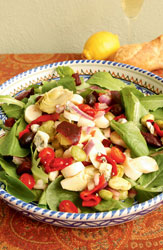
Even if the Cypriot were here today to find fault with the number of ingredients in the salad below, I doubt that he could argue with its flavor and texture balances. Or with its colors. It’s the perfect salad for bridging the gap between winter and spring. It’s got the root vegetables and lima beans to represent wintry hardiness contrasting with the verdant brightness of all those lettuces and hearts. It’s got the reds of the tomatoes and peppers. And it’s got onion to tangle with the tang of the lemon juice and blue cheese. By the way, the lima beans are even more inviting (to look at as well as to taste) if you roast them ahead of time in just a bit of olive oil and sea salt, then chill them until you’re ready to toss them into the mix.
I still miss some of those arguments with the Cypriot. I’m just glad he wasn’t around for the dawn of the Sundance Catalog.
Winter-into-Spring Salad
4 cups of mixed baby lettuces (including endive, radicchio and arugula)
1 14-ounce can of hearts of palm, drained, each cut into 1/2 inch-thick diagonals
1 14-ounce can of artichoke hearts, drained and quartered
1 roasted red pepper, halved lengthwise and thinly sliced crosswise
? cup cherry tomatoes, halved
8 pickled beets, sliced
? cup crumbled blue cheese
? cup (or more) lima beans
2 tablespoons of red onion, thinly sliced and diced
? cup olive oil
The juice of one large lemon
Combine all of the ingredients except the dressing in a large bowl and toss to blend. Add the dressing, tossing everything together until it is coated. Serves four to six.