
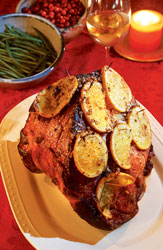
 If I’m not mistaken, my hometown of Huntingburg, Ind., was one of the first places in the United States to have a billboard proclaiming, "Pork: The Other White Meat." It may even have read "Pork: The Real White Meat!"
What I am absolutely certain of is that both of my grandmothers knew their way around a hunk of pork. My paternal grandmother even pickled her own pigs’ feet (and had a midnight snack of the hoofed delicacy, along with a glass of beer, every day of her adult life). But it was my other grandmother, the Irish one, who, every Christmas, filled her entire house with the scent of a slowly roasting ham, smeared with mustard and dotted with pineapples, cherries and cloves. The aroma, mixed with that of simmering potatoes and green beans, was enough to make even the least compatible of cousins and in-laws get along blissfully for hours on end. The sweet-savory taste and tender texture were heady enough to stop dead in its Catholic tracks the constantly in-progress arguments about what hell John XXIII had wrought with the Second Vatican Council.
Unfortunately, at about the same time I started cooking on a regular basis, that is to say in my early teenage years, I also struck up an infatuation with the novels of Chaim Potok, in which Orthodox Jews were featured as central characters, and I took it upon myself, as adolescents will, to give up pork. It didn’t last long, but it was long enough for me not to have watched and learned my grandmother’s process for roasting a ham. Any other hunk of meat — you name it, I can deal with it. But a ham to me has always seemed such a huge undertaking, and I’ve never quite understood exactly how "cooked" it already is by the smoking and curing processes it undergoes before it reaches the grocery store.
This is where my fri/files/storyimages/Chuck comes into the picture. For the first few years of our acquaintance I had no notion that Chuck was a ham expert. I knew he was a seafood aficionado; I knew we liked the same restaurants; but I did not know about the ham until the year my own holiday plans got snowed out, and my husband and I were invited to join Chuck’s family for Christmas dinner.
The moment we stepped into their house, I was overcome with nostalgia. I peeked around the corner just to make sure there were no uncles arguing about Vatican II. Nope. Nothing but a football game — some lesser bowl game, of course. Every 20 minutes or so, one of the sylvan daughters would ask, "Daddy, when is the ham going to be ready?" There’s this quality a well-baked ham possesses of making people feel they are going to go insane if they don’t get to taste it immediately. Yet the long, slow roasting is the very essence of the thing. And let’s not underestimate the secret ingredients of the glaze.
Years went by before I actually learned to make Chuck’s ham. Years and years of my husband asking, every time we were invited to their house (and sometimes even when they were coming to ours), "Is Chuck going to make his ham?" "Is Chuck going to make his ham?" "Is Chuck going to make his ham?"
This is what I now know about how Chuck makes his ham. The first rule, he says, is "don’t even think of using anything other than a full-fledged bone-in smoked half ham." Forget about those nothing-but-meat shortcut versions, which lack flavor. Picking out the ham is "a hugely important part of the process," says Chuck. Whether you choose a butt or shank portion, look for a rosy-pink, lightly marbled cutting face with a minimum amount of connective tissue. The ham — a 10- to 12-pounder will feed eight — should have a firm, well-muscled exterior and a not-too-thin fat layer on one side, which will be the top in the oven. Look for a reliable brand name such as Smithfield, as they are first dry salt cured, then smoked over oak, hickory and apple woods, after which they are aged for a year.
Once you’ve gotten down how to select the half ham, the next two concerns are how to roast it and how to glaze it. Twenty minutes per pound at 300 degrees (no more) is the ticket. No searing first at a higher temperature. The low baking temperature makes for a much juicier final product. Chuck made his first baked ham about 15 years ago, using the classic New York Times Cookbook recipe, which he deems "very straightforward, no tricks at all — cloves, brown sugar, dry mustard, ham drippings." But then Chuck, as is his wont (particularly when it comes to sauces and marinades), began to tinker and "jockey around" with the ingredients in the glaze. Before he knew it, he had not only added orange juice and slices and onions, but also a tincture of coarse-grain pancake mix and dark ale!
Chuck’s baked ham
1 10-12-pound bone-in smoked
half ham, shank or butt
1 cup of brown sugar
2 teaspoons dry mustard
2 tablespoons whole cloves,
finely ground in a coffee grinder
1 small onion, diced
?cup not-from-concentrate
orange juice
?cup dark ale
2 tablespoons buckwheat
pancake mix
Salt and fresh-ground pepper
1 juicy navel orange, thin-sliced
Unwrap the ham from its plastic sheath and place it for a few minutes under cold, running water, scrubbing it with a stiff vegetable brush to soften the casing. Using a kitchen towel (or two), dry it thoroughly. Place it fat side up on a rack in a large roasting pan, uncovered, in a pre-heated 300-degree oven, setting your timer for 20 minutes per pound. After about two and a half hours, use a turkey baster to collect as much of the drippings from the bottom of the pan as you can. Add to the brown sugar, dry mustard, cloves, onion, orange juice, ale, pancake mix, salt and pepper in a large Pyrex measuring cup and blend.
At the /files/storyimages/of the ham’s cooking time, remove it from the oven and turn the oven up to 400 degrees. Using a sharp, heavy knife, score the top and sides of the ham in diamond patterns. Attach the orange slices to the face and top of the ham with toothpicks and slowly pour the glaze over the entire surface of the ham, then place the ham back in the 400-degree oven for about 15 minutes.
Remove the ham from the oven, and let it sit for fifteen minutes before carving it, slicing across the grain. Place the slices on a large, warmed platter, and drizzle them with the glaze that has dripped back to the bottom of the pan.
(Chuck, by the way, recommends using Fuller’s ESB as the ale in the glaze — and then drinking Fuller’s with the ham and the complementary side dishes.)