
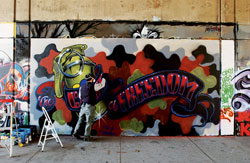
On a blustery weekday afternoon in November, lunchtime passersby on East Market Street watched as a piece of spray-can art came to life. Jeral Tidwell, decked out in a thermal cap, gloves and a respirator and surrounded by paint cans of every color, got to work. He began, as most artists do, by outlining his newest piece. But this one isn’t on paper; it’s on an overpass wall — the latest addition to the Experimental Urban Art Project sponsored by the Mayor’s Committee on Public Art.

Peripatetic spray-paint artist Jeral Tidwell (above) in his open-air studio below I-65.
Tidwell has excelled in several art genres, including lowbrow, graffiti and body art. His vivid color palette and pop-culture subject matter appeals to a variety of clients — from skateboarders and hot-rodders to rock stars and graphic novelists. Recent projects range from fantastic visions of urban fishing to a 21st-century re-interpretation of
American Gothic.
Tidwell splits his time creating new work at locales in the U.S. and abroad as well as in his Original Highlands studio. He’s been one of the champions of the "legal graffiti wall," introduced in Louisville in October as a way to encourage urban artists who may not otherwise have a creative venue. It’s a fluid medium: Anyone may arrive, paint cans in hand, to work on the concrete walls of Market Street’s I-65 overpass near Hancock and Jackson streets. And they’re allowed to paint over someone else’s existing images, although courtesy is suggested in allowing new works a few days or more of exposure.
"If something’s nice, you know, give it a minute," says Tidwell, who sprayed three different works there during the first month. "But it’s a free public space; guys’ll do what they’re gonna do."
The life cycle of the project’s graffiti art is approximately four days, according to Tidwell, although some of the work created by him and fellow artist Sean Griffin on the first night remained for more than a month — out of respect for the artists who got things rolling. The project runs through next October and may be renewed at that time. With more than 100 artists already represented, however fleetingly, Tidwell remains fascinated himself. "You start all over again every time you come down," he says. "That really makes people do it because they love it."
Jeral Tidwell’s work can be seen at www.humantree.com.